

3D Printed Auxetic Photonic Skin: Revolutionizing Battery-Free Underwater Communication and Safety
A groundbreaking innovation from a dedicated team of researchers at the National University of Singapore (NUS) is set to transform underwater exploration and operations. They have successfully developed and 3D printed an elastic “photonic skin” that possesses the remarkable ability to generate light autonomously, completely eliminating the need for traditional batteries or cumbersome cables. This pioneering technology leverages an innovative auxetic design, which means the material exhibits the counter-intuitive property of expanding laterally when stretched, rather than contracting. This unique characteristic, combined with its self-illuminating capabilities, promises significant advancements in communication and safety across various underwater environments, ranging from recreational diving adventures to advanced robotic exploration missions in the deepest, most challenging waters.
The vast and mysterious underwater world continues to present formidable challenges to human and robotic explorers alike. Low visibility, extreme salinity, immense pressure, and fluctuating temperatures are just some of the harsh conditions that can severely impair and even destroy conventional electronic devices. While existing solutions, such as LEDs and optical fibers, are utilized in some specialized underwater equipment, their inherent reliance on external power sources and their limited flexibility significantly restrict their effectiveness and practicality in dynamic, real-world marine conditions. The NUS team’s novel approach ingeniously combines two cutting-edge concepts: mechanoluminescence and 3D printing of auxetic structures. Mechanoluminescence refers to the fascinating property of certain materials to emit light when subjected to mechanical stress, such as stretching or pressing. By integrating this phenomenon with precisely engineered 3D printed auxetic materials, the researchers have created a smart material that literally glows when moved or deformed. This not only makes it self-powered but also incredibly adaptable, capable of conforming seamlessly to complex, curved surfaces like diving gloves, air tanks, or even the intricate forms of soft robots, opening up a new frontier for marine technology.
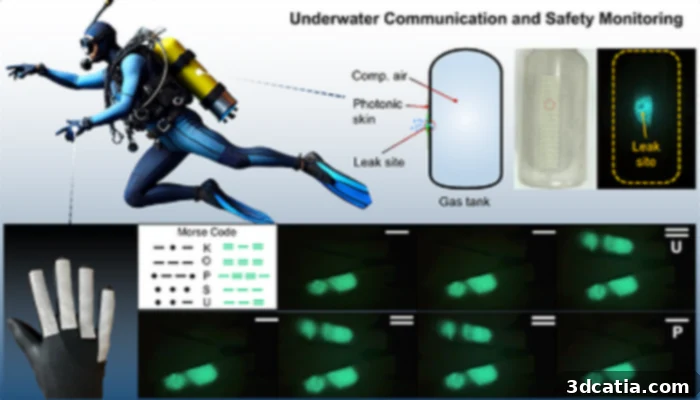
Auxetic structures adapt to curved surfaces, are elastic, shiny and have exceptional durability even in adverse conditions, enabling reliable exploration in deep waters.
The Science Behind the Glow: Mechanoluminescence and Auxetic Design
At the heart of this innovative photonic skin lies the principle of mechanoluminescence. This phenomenon, often observed in certain crystalline or ceramic materials, involves the conversion of mechanical energy into light energy. When these materials are stretched, compressed, or otherwise deformed, their internal atomic structures are momentarily disturbed, leading to the emission of photons. In this context, the NUS team has harnessed this effect to create a self-sustaining light source. This eliminates the need for bulky batteries or delicate electrical wiring, which are notoriously problematic in corrosive and high-pressure underwater environments. The inherent simplicity and robustness of this battery-free operation represent a monumental leap forward for long-duration underwater missions and equipment that requires continuous, reliable illumination without constant maintenance.
Complementing mechanoluminescence is the ingenious integration of auxetic materials. Unlike conventional materials that thin out when stretched (i.e., have a positive Poisson’s ratio), auxetic materials expand laterally, becoming thicker perpendicular to the applied tensile force (i.e., they have a negative Poisson’s ratio). This unique property is achieved through carefully designed internal geometric structures, which are precisely created using advanced 3D printing techniques. For the photonic skin, this auxetic characteristic is crucial. It allows the material to conform exceptionally well to irregular and curved surfaces without creating wrinkles or stress concentrations, ensuring a uniform distribution of mechanical forces. This not only enhances the material’s overall adaptability and aesthetic integration but also plays a vital role in maintaining consistent light emission across the entire surface of the skin, even under significant deformation. This combination of self-powering and exceptional adaptability makes the photonic skin a truly revolutionary component for future underwater technologies.
3D Printing and Advanced Material Composition
To fabricate this remarkable material, the research team employed advanced 3D printing techniques to create ZnS (zinc sulfide) cellular structures embedded within a flexible silicone matrix. Zinc sulfide was chosen for several compelling reasons: it is a stable compound, exhibits excellent biocompatibility, and is considered safe for prolonged exposure to marine environments, a critical factor for any underwater application. The strategic use of 3D printing allowed for the precise creation of intricate auxetic cellular designs. These designs are fundamental to the material’s unique mechanical properties, enabling it to expand in response to stretching and thus vastly improving the material’s adaptability to complex geometries. Without the precision afforded by 3D printing, achieving such finely tuned auxetic structures would be exceedingly difficult, if not impossible.
Furthermore, an outer layer of silicone encapsulates the ZnS-infused auxetic core. This external layer serves a dual purpose: it acts as a protective barrier against the harsh marine elements and, more importantly, it helps to distribute stress more evenly across the entire surface of the photonic skin. This even distribution of mechanical forces is crucial for ensuring uniform luminosity, preventing ‘hot spots’ or ‘dead zones’ of light emission, and guaranteeing consistent performance even under repeated and prolonged stretching cycles. The material’s resilience was rigorously tested in experiments where the photonic skin maintained its optimal performance after more than 10,000 cycles of use. This extraordinary durability is a testament to its robust design and material selection, demonstrating its remarkable potential for demanding, long-term applications in challenging marine conditions where reliability is paramount.
Real-World Applications and Enhanced Safety
To unequivocally demonstrate the practical potential and versatility of this innovative material, the researchers ingeniously integrated the photonic skin into a variety of different objects, showcasing its diverse applications. One compelling example is a luminous glove designed specifically for divers. By incorporating the photonic skin into the glove, divers can now transmit Morse code signals underwater purely through hand movements, without any electronic components or battery power. This enhances diver-to-diver communication and diver-to-surface signaling, particularly in low-visibility conditions where traditional visual cues are ineffective. This could prove invaluable for coordinating complex tasks, signaling distress, or simply indicating direction during group dives, significantly improving safety and coordination.
Another fascinating application involves its integration into a robotic fish prototype. This underwater robot now glows visibly when in motion, providing real-time visual feedback on its operational status and navigation. Such a feature is incredibly useful for testing and developing new concepts in underwater robotics, allowing researchers to easily track, identify, and monitor the robot’s movements in various test environments without additional onboard lighting systems. Beyond research, this could enable new forms of bio-inspired robotics that utilize light for identification, communication with other marine life, or even as a form of self-monitoring and fault detection, where changes in movement patterns could correspond to changes in light emission.
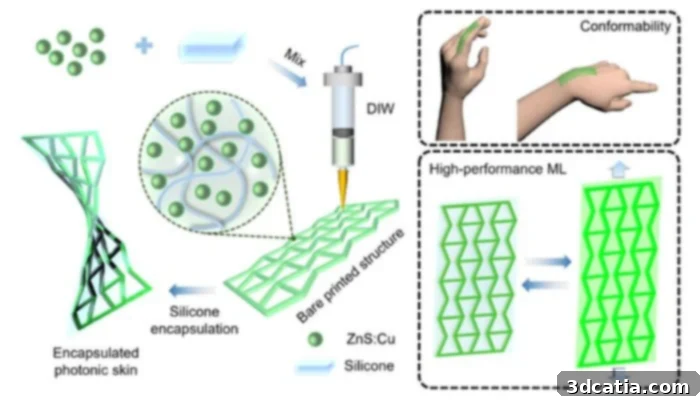
Representation of the photonic skin manufacturing process. The skin adapts and shines when deformed.
Furthermore, the photonic skin was successfully applied to a gas tank, where its ability to detect and communicate leaks was put to the test. In this scenario, any deformation caused by a gas leak, even a minuscule one, would cause the adjacent photonic skin to emit light, providing an immediate and clear visual alert. This real-time safety monitoring capability is critical for equipment where structural integrity is paramount, such as diving tanks, submersibles, or underwater pipeline components. The ability to visually identify a leak without the need for complex sensors or power inputs could prevent catastrophic failures and significantly enhance operational safety in critical underwater infrastructure. These practical demonstrations collectively underscore the material’s viability not only as an innovative visual communication system but also as a robust and reliable platform for real-time safety monitoring in dynamic and challenging aquatic environments.
The Future of Underwater Technology with Additive Manufacturing
The research team highlighted that the power of 3D printing was indispensable in bringing this technology to life. Additive manufacturing techniques empowered them to create devices with incredibly complex geometries and intricate internal structures that were previously impossible to achieve through conventional manufacturing methods. In this specific case, 3D printing proved to be the pivotal factor in enabling the precise generation, uniform distribution, and stable maintenance of light emission, even under the most extreme and fluctuating underwater conditions. This level of design freedom and precision control is what truly differentiates this innovation and paves the way for a new generation of self-powered, highly adaptable underwater devices.
Looking ahead, the next significant challenge for the researchers will be to further enhance the photonic skin’s long-term resistance and stability in persistently humid and corrosive marine environments. This includes addressing potential issues like biofouling, where marine organisms attach to surfaces, and long-term material degradation. Concurrently, efforts will be directed towards expanding the scale of production, moving from laboratory prototypes to commercially viable quantities. If these challenges are successfully met, this revolutionary technology holds the immense potential to become a standard component for a wide array of underwater equipment, including advanced diving gear, autonomous underwater robots, sophisticated submersibles, and next-generation wireless communication systems. All these advancements, powered by the flexibility and innovation of additive manufacturing, promise to usher in a new era of safer, more efficient, and more effective exploration and operation beneath the waves. Find more in-depth information about this groundbreaking study here.
What do you think of this incredible development and its potential impact on underwater exploration? We invite you to share your thoughts and insights in a comment below or connect with us on our LinkedIn or Facebook pages! Additionally, make sure you don’t miss out on the latest advancements in additive manufacturing by signing up for our free weekly Newsletter, delivered straight to your inbox. You can also explore all our engaging videos and content on our YouTube channel.
*Cover Photo Credits: Jason Edwards / Getty Images