
3D Printed Waterbushing: Vallourec & Total Revolutionize Offshore Oil & Gas Safety with WAAM Technology
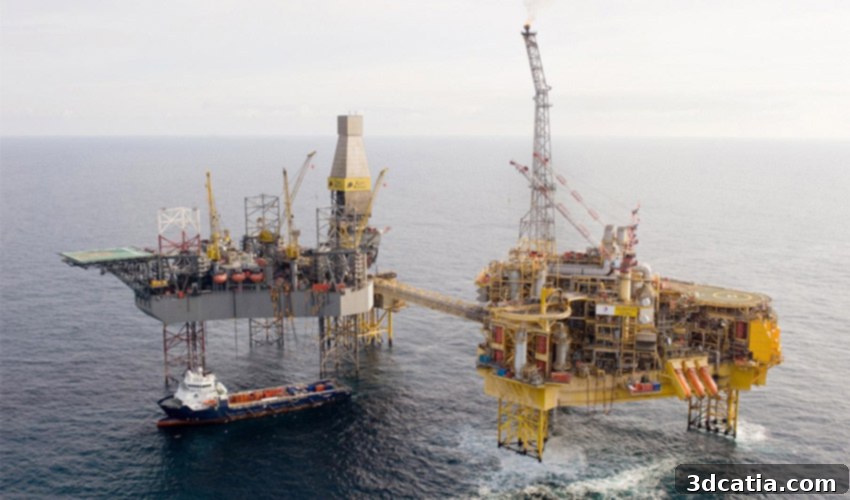
A groundbreaking collaboration between industrial leaders Vallourec and Total has culminated in a significant milestone for the energy sector: the successful installation of the very first 3D printed waterbushing in the challenging environment of the North Sea. This achievement, announced a few months ago after a year of dedicated development, represents a pivotal moment for additive manufacturing’s role in safety-critical applications. For those unfamiliar with the terminology, waterbushings are indispensable components within the oil and gas drilling industry. Their primary function is to actively counteract the dangerous buildup of hydrocarbons in wells during their construction phase, thereby mitigating the risk of uncontrolled hydrocarbon kicks and potential blowouts, which can have devastating environmental and safety consequences.
The innovative component was fabricated using state-of-the-art Wire Arc Additive Manufacturing (WAAM) technology, a method renowned for its ability to produce large-scale metal parts. Through this advanced process, Vallourec and Total successfully 3D printed a robust waterbushing, measuring an impressive 1.2 meters in height and weighing 220 kg. This represents a remarkable engineering feat, not only in terms of scale and complexity but also in its immediate benefits. The resulting component boasts a significant 50% reduction in total weight compared to conventionally manufactured parts, coupled with a substantial decrease in its carbon footprint. This dual advantage underscores the potential of additive manufacturing to deliver both operational efficiency and environmental responsibility.
The Expanding Horizon of Additive Manufacturing in Oil & Gas
While the applications of additive manufacturing often garner significant attention in sectors such as aerospace, automotive, and medical industries, its transformative potential in the oil & gas sector has historically been less publicized. However, this perception is rapidly changing. Recent studies, including one by GlobalData, project an exponential growth for additive manufacturing within this industry, forecasting a market value reaching an impressive $32 billion worldwide by 2025 and surging to over $60 billion by 2030. This projected growth highlights a growing recognition of AM’s capabilities to address specific, stringent requirements inherent to the energy sector.
Additive manufacturing is uniquely positioned to facilitate the development of critical parts that must endure extreme operational conditions. These include components capable of withstanding immense pressures, resisting corrosive fluids or high-temperature gases, and maintaining structural integrity in highly demanding environments. The continuous advancements in printing materials, coupled with the increasing capacity and sophistication of AM machines, are opening up unprecedented prospects for manufacturers operating in this crucial sector. It is precisely this emergent opportunity that Vallourec, a leading global provider of tubular solutions, has strategically capitalized upon, working closely with Total to pioneer the development of this undeniably important and safety-critical waterbushing.
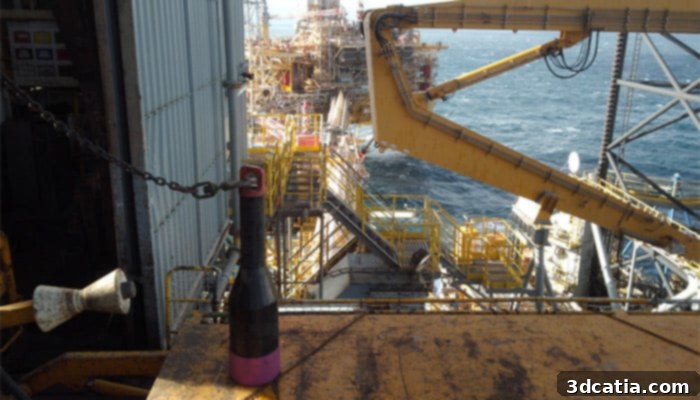
The waterbushing is a key component in securing a well (photo credits: Vallourec/Total)
Ensuring Safety: The Rigorous Journey of a 3D Printed Waterbushing
The waterbushing functions as a pressurized component, necessitating exceptional resistance and unwavering reliability to guarantee the safety and operational integrity of an offshore well. The decision to manufacture such a vital part using advanced 3D printing technologies therefore mandated a comprehensive re-qualification of the entire production process. This involved a series of numerous and exhaustive tests designed to rigorously verify that the additively manufactured component could flawlessly withstand the intense pressures exerted by hydrocarbons and effectively prevent the possibility of a hydrocarbon kick. A hydrocarbon kick, characterized by an abrupt and dangerous rise in wellbore pressure, carries the grave risk of escalating into a blowout – one of the most severe threats associated with oil rigs. Such incidents not only carry immense environmental consequences but also tragically pose a significant risk of loss of life.
Edwige Ravry, Additive Manufacturing Business Manager within Total’s R&D department, eloquently articulated the significance of this undertaking: “This is the first time that a safety-critical component has been created using additive manufacturing in the Energy industry. It was essential for us to have the right partner and a good business case. Vallourec, as a longstanding partner, provided us with that confidence.” This statement underscores the monumental nature of the project and the critical importance of a trusted partnership in venturing into uncharted technological territory for safety-critical applications in a high-stakes industry. The meticulous validation process ensures that despite the innovative manufacturing method, the component adheres to the highest safety and performance standards, paving the way for wider adoption.
Wire Arc Additive Manufacturing (WAAM): Powering Large-Scale Metal 3D Printing
To successfully execute this ambitious project, Vallourec strategically opted for WAAM metal 3D printing technology. WAAM is a specialized additive manufacturing method that operates by precisely welding successive layers of metal wires, gradually building up a three-dimensional object. Conceptually, it shares some similarities with Fused Deposition Modeling (FDM) in its layer-by-layer approach, but it is applied on a significantly larger scale and utilizes metal as the primary material, making it ideal for robust industrial components. This technology allows for the creation of sizable parts with complex geometries, offering distinct advantages over traditional manufacturing techniques that might involve extensive machining or forging.
For this pioneering endeavor, the French company collaborated closely with RAMLAB (Rotterdam Additive Manufacturing Lab), a leading 3D printing laboratory strategically located in the port of Rotterdam. RAMLAB specializes in large-scale metal additive manufacturing, particularly WAAM technology, and has a proven track record of innovative projects, exemplified by their impressive 3D printed boat propeller. This partnership brought together Vallourec’s deep industry knowledge and Total’s operational expertise with RAMLAB’s cutting-edge additive manufacturing capabilities. Bertrand Maillon, Additive Manufacturing Business Development manager at Vallourec, further elaborated on the collaborative spirit of the project: “The project came out of an open innovation collaboration with RAMLAB, a Rotterdam-based startup. The aim of this project was to go beyond Proof of Concept to successfully develop the Quality Assurance and Quality Control frame of supply for components using WAAM technology.” This statement underscores the commitment not just to demonstrate feasibility, but to establish a robust and repeatable industrial process for mission-critical parts.
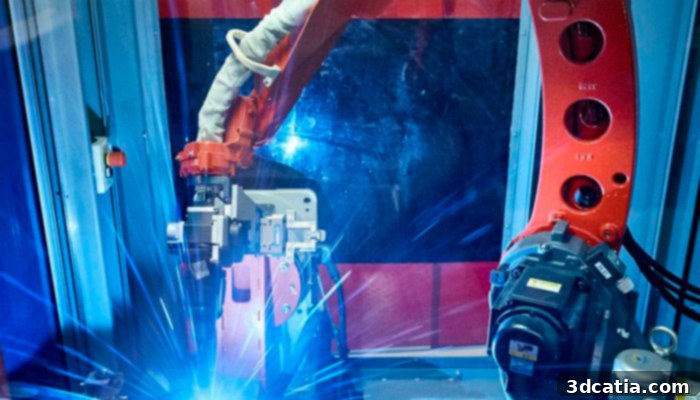
The WAAM process combines welding and 3D printing (photo credits: RAMLAB)
Transformative Benefits: Weight Reduction, Environmental Impact, and Supply Chain Efficiency
The implementation of WAAM technology for the waterbushing has yielded a multitude of significant benefits. As previously mentioned, the final component, standing at 1.2 meters high, weighs 220 kg – an impressive half the weight of its traditionally manufactured counterpart. This substantial weight reduction is not merely an engineering achievement; it translates into tangible operational advantages, potentially reducing transportation costs, simplifying handling, and easing installation processes on offshore platforms where every kilogram matters. Lighter components can also contribute to lower energy consumption during drilling operations.
Beyond the immediate operational gains, additive manufacturing offers profound positive environmental impacts. Vallourec proudly states that, thanks to the WAAM process, they have achieved an remarkable 45% reduction in emissions when compared to conventional machining and forging processes typically used for such components. This is a crucial point, particularly for an energy giant like Total, which has set ambitious goals to reduce its overall carbon footprint by at least 60% by 2050. Adopting such environmentally conscious manufacturing methods is a clear step towards achieving these sustainability targets, demonstrating a tangible commitment to greener industrial practices within the oil and gas sector.
Furthermore, the agility offered by 3D printing significantly shortens production lead times, allowing users to obtain complex and bespoke parts more quickly than with traditional methods. This efficiency translates into a more agile and resilient supply chain – a critical factor in the oil industry where unforeseen demands, geopolitical shifts, or sudden equipment failures can have considerable financial and operational implications. A rapid response capability for critical spare parts can minimize downtime, optimize maintenance schedules, and enhance overall operational continuity. Bertrand Maillon aptly summarizes this strategic advantage, stating, “Additive manufacturing enables us to move one step closer to the industry goal of a digital warehouse, increasing availability of crucial parts and reducing waste.” This vision of a digital warehouse, where parts can be printed on demand closer to the point of use, promises to fundamentally transform logistics and inventory management across the energy sector. You can find more information about this project HERE.
Paving the Way for a Sustainable and Secure Future in Energy
The successful deployment of the 3D printed waterbushing by Vallourec and Total is more than just a single technological triumph; it is a clear demonstration of additive manufacturing’s capacity to deliver practical, scalable, and highly beneficial solutions for the demanding oil and gas industry. This innovation not only enhances safety for offshore drilling operations by mitigating the risks associated with hydrocarbon kicks and blowouts, but it also aligns perfectly with global environmental imperatives by drastically reducing both component weight and carbon emissions. By embracing technologies like WAAM, the energy sector is taking decisive steps towards achieving greater operational efficiency, reducing its environmental footprint, and securing its supply chains for critical infrastructure. This project serves as a powerful case study, encouraging other industry players to explore and integrate additive manufacturing into their own operations, particularly for components that are safety-critical and require high performance under extreme conditions. The collaboration between Vallourec, Total, and RAMLAB illustrates a blueprint for future innovation, proving that through strategic partnerships and a commitment to pushing technological boundaries, even the most traditional industries can achieve remarkable progress towards a more sustainable and secure future.
*Photo Credits: AFP PHOTO / TOTAL E&P UK
What are your thoughts on this safety-critical 3D-printed component and its implications for the Oil & Gas Industry? We invite you to share your perspectives in a comment below or join the conversation on our Facebook and Twitter pages. Don’t forget to sign up for our free weekly newsletter, with all the latest news and advancements in 3D printing delivered straight to your inbox!