
Unveiling the Future: Top 5 Breakthroughs in 3D Printing and Additive Manufacturing This Week
Welcome to our weekly dive into the fascinating world of 3D printing and additive manufacturing! Each week, the landscape of this transformative technology evolves, bringing forth innovations that promise to redefine industries and improve lives. We scour the latest developments to bring you the most compelling and impactful stories. This compilation showcases the top five videos from the past week that highlight groundbreaking applications and advancements in 3D printing. From fashion-forward eyewear to life-changing prosthetics, revolutionary construction materials, community-focused library initiatives, and industrial-scale metal printing, these videos offer a glimpse into the future driven by additive manufacturing. We invite you to explore these incredible breakthroughs with us. Feel free to share your thoughts and videos by commenting on this article below, or join the conversation on 3Dnatives’ Facebook or Twitter account. We hope you enjoy this insightful roundup and have a fantastic Sunday!
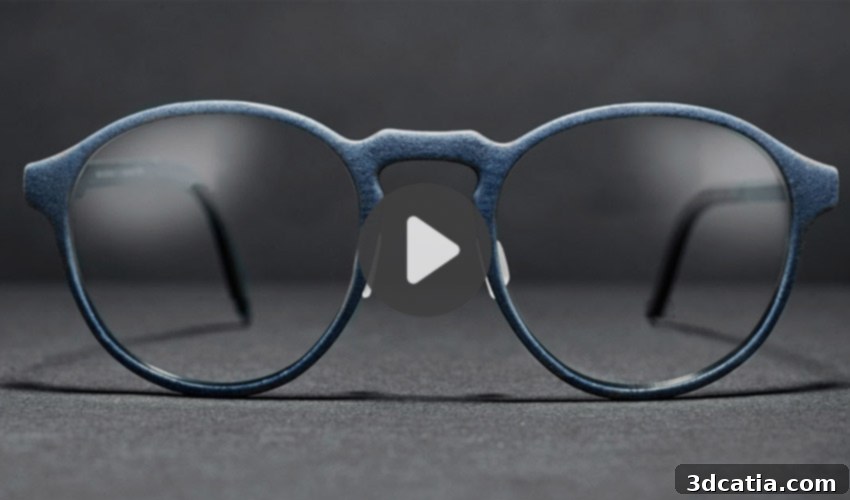
Top 1: 3D Printed Eyewear — Revolutionizing Vision and Style
The integration of 3D printing into the design and manufacturing process has opened up unprecedented possibilities across a multitude of sectors, and the eyewear industry is certainly no exception. Traditional methods often impose limitations on design complexity, customization, and material usage, but additive manufacturing elegantly circumvents many of these constraints. This week, we spotlight the Danish company Monoqool, which is making waves with their innovative “slider glasses.” These aren’t just any glasses; they represent a significant step forward in the commercialization of 3D printed eyewear. Monoqool’s approach leverages the unique capabilities of 3D printing to create glasses that are not only remarkably lightweight and durable but also feature a sleek, modern, and highly customizable design. The “slider” mechanism, enabled by the precision of 3D printing, offers enhanced functionality and a distinct aesthetic that sets them apart from conventional frames. This technology allows for intricate geometries that would be impossible or prohibitively expensive to produce with traditional manufacturing techniques, leading to frames that are tailored for comfort and an individualized fit. As consumers increasingly seek personalized products and sustainable manufacturing practices, 3D printed eyewear like Monoqool’s is poised to become a mainstream choice. Will your next pair of glasses be a beautifully designed, personalized, and comfortable 3D printed frame, moving beyond the limitations of traditional manufacturing?
Top 2: 3D Printing in Rwanda — Empowering Communities Through Prosthetics
The humanitarian potential of 3D printing is truly profound, especially when it comes to providing essential medical devices in challenging environments. We have previously highlighted how 3D printed prosthetics can offer critical assistance in crisis situations and underserved communities around the globe. This week, our focus shifts to an inspiring project underway in Rwanda, spearheaded by Jon Racek, a distinguished senior lecturer from the Indiana University of Art, Architecture, and Design. Racek has dedicated an entire year to an incredible endeavor: designing and producing 3D prosthetic arms for children in Rwanda. In regions affected by conflict, poverty, or limited access to healthcare, traditional prosthetics are often unattainable due to their high cost, complex manufacturing processes, and the need for specialized fitting. 3D printing offers a transformative alternative, providing affordable, customizable, and rapidly producible solutions tailored to individual needs. Racek’s work exemplifies his overarching goal to design objects that have a tangible and positive impact on communities, fostering independence and improving the quality of life for recipients. This initiative not only provides children with functional limbs but also instills hope, dignity, and new opportunities for education and social integration. The scalability and cost-effectiveness of 3D printing make it an ideal technology for such humanitarian efforts, promising a sustainable model for aid. You can delve deeper into this remarkable and life-changing project by visiting the official website.
Top 3: 3D Printed Structures — Bio-Inspired Cement for Resilient Infrastructure
Innovation in material science is a cornerstone of advancing additive manufacturing, particularly when it comes to large-scale applications like infrastructure. Researchers from Purdue University in the United States have achieved a significant breakthrough by developing a novel 3D printed cement paste. This material is a critical component of concrete and mortar, which are fundamental to constructing various elements of our modern infrastructure, from buildings and bridges to roads and dams. What makes Purdue’s new cement paste truly remarkable is its bio-inspired design, drawing lessons from nature’s most resilient structures. The researchers have engineered this cement to become tougher and more resistant under pressure, mimicking the incredible strength and adaptability found in the shells of arthropods, such as lobsters and beetles. These natural organisms have evolved shells that are surprisingly robust, capable of dissipating force and preventing catastrophic failure. By applying similar principles to their cement-based material, the Purdue team has created a composite that can withstand greater stresses and strains than conventional cement. This specific technique, which combines advanced cement materials with bio-inspired structural designs, holds immense potential. It could lead to the development of significantly more resilient structures, offering enhanced protection and durability during natural disasters such as earthquakes, hurricanes, or floods. This innovation could play a pivotal role in creating safer, more sustainable infrastructure worldwide, proving invaluable in the coming years as we face increasing environmental challenges.
Top 4: 3D Printing in Libraries — Fostering Innovation and Community Engagement
Libraries have long served as invaluable community hubs, indispensable centers of knowledge, learning, and cultural exchange. They are places where people gather to explore new ideas, delve into captivating stories, or conduct in-depth research. In an ever-evolving digital age, many libraries are proactively adapting to remain relevant and to continue empowering their communities. A growing trend sees these vital institutions embracing cutting-edge technologies like 3D printing to further prepare the public for the future. The Fairfax County Public Library system, for instance, has taken an admirable step forward by implementing 3D printers in several of its branches. This initiative is part of a broader movement to transform libraries into modern “makerspaces,” offering public access to advanced tools and technologies that might otherwise be out of reach for individuals. Their innovative program provides an exciting opportunity for patrons: the ability to print their own designs on the library’s 3D printers, often for free or at a minimal cost. This means that whether you’re an aspiring inventor, a student working on a project, or simply curious about additive manufacturing, you can now access this technology readily. This program not only democratizes access to 3D printing but also fosters digital literacy, encourages creative problem-solving, and cultivates a spirit of innovation within the community. So, if you’re keen to learn more about 3D printing technology, curious about its capabilities, or need to bring a digital design into the physical world, you can, once again, simply head to your local library and explore this exciting new offering.
Top 5: HP Metal Jet & Volkswagen — Accelerating Industrial Manufacturing
The industrial application of 3D printing, especially metal additive manufacturing, is rapidly transforming traditional production paradigms. Not long ago, we reported on the exciting initial announcements surrounding HP’s groundbreaking Metal Jet initiatives, signaling a new era for mass production of metal parts. This week, we witness the tangible impact of this technology as HP Metal Jet has already been successfully integrated into Volkswagen’s manufacturing process. This collaboration marks a significant milestone, showcasing how additive manufacturing can move beyond prototyping to high-volume industrial production. The HP Metal Jet technology enables the production of complex, high-quality metal parts with unprecedented speed and efficiency. For Volkswagen, this means being able to generate high mass production volumes in a significantly shortened timeframe. Crucially, this advanced manufacturing method allows for the direct use of 3D printed parts without the traditional constraints of requiring expensive and time-consuming molds or specialized manufacturing tools. This eliminates several costly and time-intensive steps in the conventional production chain, reducing lead times and allowing for greater design flexibility. The ability to rapidly produce intricate components on demand provides Volkswagen with a distinct competitive advantage, accelerating product development cycles, optimizing supply chains, and fostering continuous innovation. This partnership underscores the immense potential of metal 3D printing to revolutionize industrial manufacturing, making production more agile, cost-effective, and efficient across diverse industries.
Did you find this week’s TOP 5 videos as inspiring as we did, featuring everything from stylish 3D printed eyewear to life-changing prosthetics, resilient construction, community-enriching libraries, and cutting-edge industrial metal printing? The rapid pace of innovation in additive manufacturing continues to amaze and influence nearly every aspect of our lives. We value your insights and opinions. Please drop a comment below this article, or join the conversation on our Facebook and Twitter pages. And to ensure you never miss out on the latest breakthroughs, trends, and news in the dynamic 3D printing industry, don’t forget to sign up for our free weekly Newsletter, delivered straight to your inbox!