
Revolutionizing Metal Additive Manufacturing: MIT Unveils Liquid Metal Printing (LMP)
The landscape of manufacturing is constantly evolving, with innovations pushing the boundaries of what’s possible. Imagine a world where large-scale metal parts can be 3D printed not only quickly but also affordably. This ambitious vision is now closer to reality, thanks to groundbreaking research from a dedicated team at MIT, specifically the MIT Self-Assembly Lab. Their pioneering work addresses some of the most persistent limitations in traditional metal 3D printing by introducing a novel process called Liquid Metal Printing (LMP).
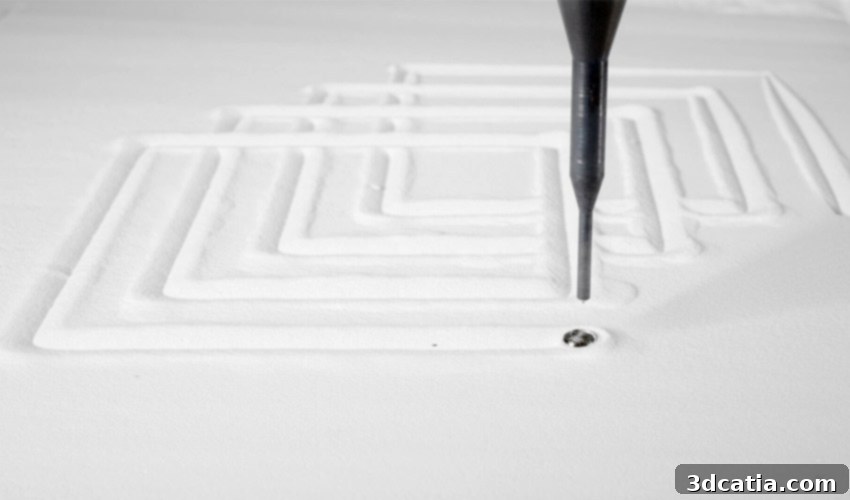
LMP is an innovative technique that draws inspiration from free-form casting. At its core, the process involves extruding molten metal into a meticulously prepared vat of 100-micron glass beads. These fine glass beads act as a dynamic, self-supporting mold, guiding the molten metal along a predefined path. As the metal cools and hardens within this granular medium, it forms the desired component. A significant advantage of this method is the complete elimination of traditional support structures, which are typically required in most additive manufacturing processes to prevent collapse during fabrication. The glass beads inherently provide the necessary support, simplifying the printing process and significantly reducing post-processing efforts.
Initial experiments conducted by the MIT team have primarily focused on aluminum, yielding remarkable results. The process has demonstrated exceptionally high printing speeds, proving to be an astounding 10 times faster than other existing metal 3D printing technologies available on the market, regardless of the part’s size. This dramatic increase in speed holds the potential to transform industries that rely on rapid prototyping and efficient production of large metal components.
Addressing the Core Challenges of Metal Additive Manufacturing
While 3D printing into a granular substance isn’t an entirely new concept – it has been successfully applied to polymers and silicones for some time – adapting this approach for metals presents a unique set of complexities. The primary challenges revolve around the extreme melting temperatures required for metals and the stringent constraints associated with their extrusion. Molten metals, particularly reactive ones like aluminum, cannot simply be extruded through any nozzle without causing rapid corrosion and destruction of the equipment. This fundamental hurdle has long restricted the widespread adoption and scalability of metal additive manufacturing.
Skylar Tibbits, an associate professor in MIT’s Department of Architecture and co-director of the Self-Assembly Lab, along with his dedicated colleagues, has been at the forefront of tackling these volume and time limitations that have historically plagued metal additive manufacturing. Current technologies, such as Wire Arc Additive Manufacturing (WAAM), can indeed handle large volumes. However, WAAM still struggles with speed when compared to conventional manufacturing methods, making it less competitive for high-throughput production. This is precisely where Liquid Metal Printing emerges as a game-changer, striving to achieve a crucial balance between exceptional speed and the capability to produce large-format parts efficiently and cost-effectively.

Molten metal is deposited in the powder pan
Delving Deeper: How Liquid Metal Printing Works
The sophisticated Liquid Metal Printing machine is engineered around three interconnected and critical components, each meticulously designed to handle the unique demands of molten metal extrusion. These include a specialized nozzle, a custom-built electric furnace, and a finely tuned print bed complemented by an advanced temperature regulation system. This system ensures precise control over the aluminum’s temperature throughout its journey, from the furnace to the extrusion point at the nozzle. The furnace, a custom-built 5 kW unit, serves as the primary heat source. It houses a robust graphite crucible, specifically chosen for its high-temperature resistance and non-reactivity, which keeps the metal in a molten state before it is extruded.
The design and material selection for the extrusion nozzle presented a significant engineering challenge. In virtually all additive manufacturing processes, ensuring the corrosion resistance and durability of mechanical components, especially those in direct contact with the printing material, is paramount. This challenge is vastly amplified when dealing with molten metals that are highly reactive and operate at extreme temperatures. Extruding molten metal through just any nozzle would lead to rapid material degradation and mechanical failure. To overcome this, the MIT team undertook extensive testing of various materials and designs, ultimately developing a specialized ceramic nozzle. Ceramic materials were chosen for their superior thermal resistance and chemical inertness, allowing for stable and prolonged operation even under the harsh conditions of molten aluminum extrusion.
Real-World Applications and Current Print Quality
To validate the capabilities of their LMP process, the research team conducted a series of practical experiments, successfully printing a variety of objects. These included functional items such as chairs and table legs, as well as more intricate decorative pieces. The results reinforced their claims regarding the extraordinary printing speeds, which consistently proved to be 10 times faster than commercially available metal 3D printing processes. The team explored various extrusion paths, including spiral patterns, straight lines, and overlapping trajectories, each demonstrating the system’s flexibility and potential for complex geometries. The impressive speed and versatility observed during these tests underscore the transformative potential of LMP.
However, an honest assessment of the print quality reveals that the aesthetics of the resulting parts are currently quite crude. While functionally robust, the surface finish and overall visual appeal are not yet refined enough for applications requiring high aesthetic standards. This aspect is acknowledged by the team as an area requiring further development and significant focus. The current resolution of the LMP process is comparable to that of WAAM, another large-scale metal additive manufacturing method. Both processes typically necessitate strategic post-machining to achieve the desired surface finish, dimensional accuracy, and aesthetic quality. This means that while LMP excels in speed and scale, the journey from raw print to finished product still involves subsequent steps for refinement.
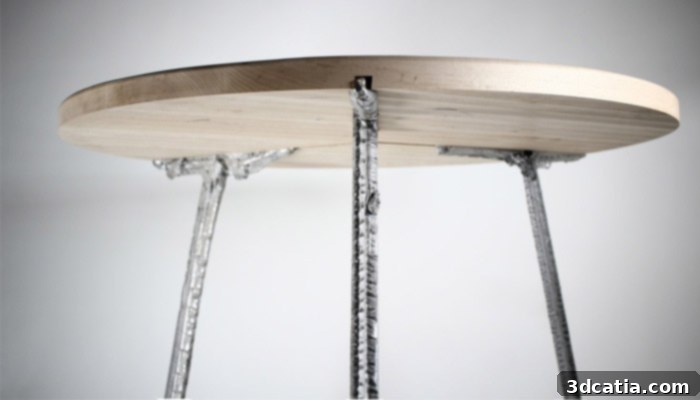
The table legs were 3D printed using liquid metal printing
LMP’s Unique Advantages and Transformative Future Potential
Despite the current need for post-machining, the LMP process offers compelling advantages over existing metal additive manufacturing technologies. Its inherent speed, being at least 10 times faster than WAAM, positions it as a highly efficient alternative for industrial applications. Furthermore, the team anticipates that with more efficient heating mechanisms, the process could achieve processing rates exceeding tens of kilograms per hour. This remarkable rate could potentially approach the processing efficiency of high-volume traditional manufacturing methods like injection molding or die casting, which typically operate at around 100 kg/hour. Such throughput would truly revolutionize the manufacturing of large metal components, making on-demand, large-scale metal additive manufacturing a viable and economically attractive option.
A distinctive advantage of LMP technology lies in its unique thermal cycle during the printing process. Unlike the WAAM process, which involves successive melting and cooling of the part layers to maintain structural integrity—a process that can introduce thermal stresses and warpage—LMP leverages its granular support system. In LMP, the bed of glass beads continuously supports the molten material throughout the entire printing process. This continuous support helps in dissipating heat more uniformly and prevents significant structural deformation, leading to more consistent part quality and reduced internal stresses. This fundamental difference in thermal management contributes significantly to LMP’s speed and ability to handle large geometries without complex internal support structures.
Looking ahead, a key long-term objective for the MIT team is to integrate recycled aluminum into the LMP process. This ambitious goal would involve melting down post-consumer or industrial aluminum scrap and using it to recreate new objects. The ability to utilize recycled materials would not only significantly reduce the environmental footprint of metal manufacturing but also drastically lower production costs, making the technology even more economically competitive and sustainable. This aligns with broader global efforts towards a circular economy and sustainable industrial practices, where waste materials are transformed into valuable products.
While the technology holds immense promise, the team openly acknowledges areas requiring further refinement. These primarily include improving the resolution of printed parts and achieving even finer control over the flow of molten metal. However, the progress made so far is unequivocally promising, indicating a bright future for this innovative approach to metal fabrication. Skylar Tibbits encapsulates this vision perfectly: “If we could make this machine something that people could actually use to melt down recycled aluminum and print parts, that would be a game-changer in metal manufacturing. Right now, it is not reliable enough to do that, but that’s the goal.” This statement highlights both the current challenges and the profound impact LMP could have once these refinements are achieved. The full potential of Liquid Metal Printing, combining speed, scale, and sustainability, is a fascinating prospect that could reshape how we think about metal production. You can find out more about Liquid Metal Printing HERE.
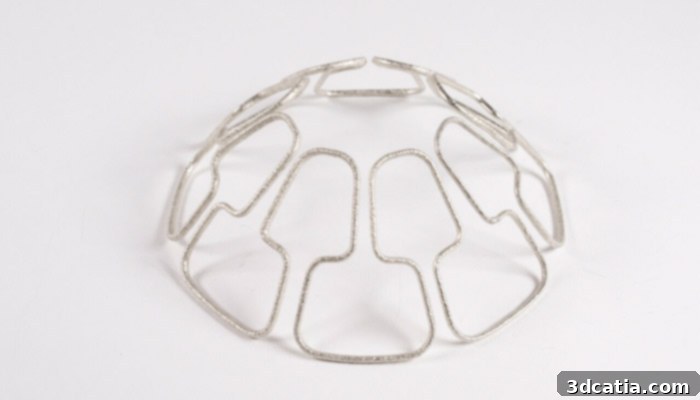
Another example of a shape 3D printed using the liquid metal printing process
The Road Ahead: Challenges and Opportunities
The journey of Liquid Metal Printing from a promising research concept to a widely adopted industrial technology involves navigating several challenges. The current coarse resolution means that while it’s excellent for rapid, large-scale production, finer details and smoother surface finishes still require significant post-processing. Improving the precision of the extrusion system and the solidification control within the granular bed will be critical for enhancing resolution. Furthermore, mastering the flow dynamics of molten metal at various temperatures and extrusion speeds is essential for consistent and reliable part production, especially for complex geometries.
Despite these challenges, the opportunities presented by LMP are immense. Its ability to combine speed, large format capabilities, and the potential for recycled materials positions it as a leading candidate for sustainable and efficient manufacturing in the future. From architectural components and automotive parts to industrial tooling and custom furniture, the applications are vast. As the MIT team continues to refine this groundbreaking technology, Liquid Metal Printing could very well become a cornerstone of the next generation of metal manufacturing, democratizing access to large-scale metal 3D printing and pushing the boundaries of what industries can create.
What do you think of this liquid metal printing process? Let us know in a comment below or on our LinkedIn, Facebook, and Twitter pages! Don’t forget to sign up for our free weekly newsletter here, the latest 3D printing news straight to your inbox! You can also find all our videos on our YouTube channel.
*All Photo Credits: MIT Self-Assembly Lab