
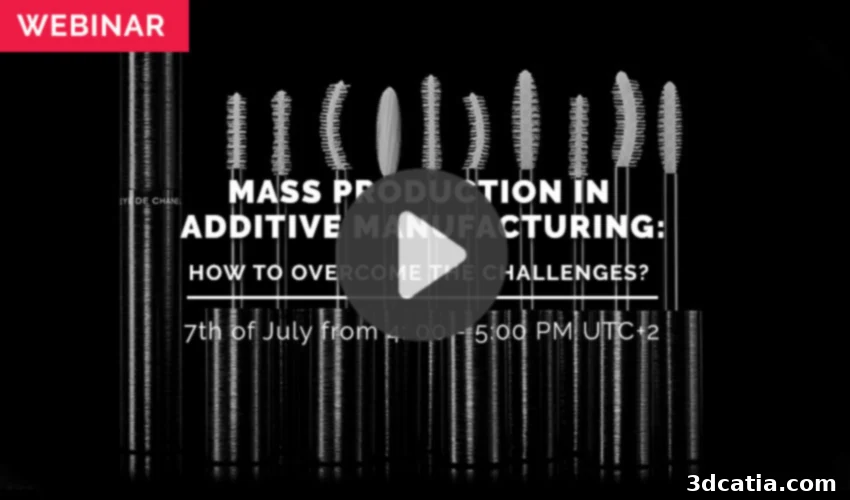
Unlocking Industrial Scale: Navigating the Path to Mass Production with Additive Manufacturing
The landscape of manufacturing is undergoing a profound transformation, driven by the rapid evolution of additive manufacturing (AM) applications. What once began as a revolutionary method primarily for rapid prototyping has swiftly progressed into a viable solution for small, medium, and even large series production. Manufacturers are increasingly recognizing the immense potential of additive manufacturing to redefine how products are designed, produced, and delivered. The core objective is to harness AM’s inherent advantages: the unparalleled ability to create custom-made, highly complex, and exceptionally durable parts, thanks to continuous advancements in high-performance materials and sophisticated industrial-grade machines.
However, this promising shift from prototype to full-scale production is not without its significant hurdles. Companies embracing this journey face a unique set of challenges when attempting to scale additive manufacturing for mass production. These include ensuring consistent material quality, managing production speed, optimizing post-processing, and integrating AM into existing global supply chains. A critical question arises: do current supply chain infrastructures possess the agility and robustness required to accommodate this new paradigm of production? Furthermore, how can manufacturers strategically overcome these multifaceted challenges to unlock the full potential of industrial 3D printing and realize its promise of efficient, customized, and on-demand manufacturing?
Pioneering the Future: Arkema’s Role in Advancing AM Materials
To shed light on these critical questions and explore practical solutions, 3Dnatives recently collaborated with leading advanced materials company, Arkema. Arkema stands at the forefront of material innovation for 3D printing, developing cutting-edge materials tailored for a diverse range of additive manufacturing processes. Their expertise spans across key technologies, including extrusion (FDM/FFF), photopolymerization (SLA/DLP), and powder bed fusion (SLS/MJF). This broad material portfolio allows Arkema to address the varied needs of industries seeking to integrate AM into their production lines.
Arkema’s approach is highly collaborative, working intimately with numerous professionals and manufacturers across the additive manufacturing sector. This close collaboration is crucial for developing and validating materials that consistently yield high-quality parts, meeting the stringent demands of industrial applications. The company is strategically focused on unlocking new opportunities within the AM space by forging valuable partnerships with market leaders. These alliances, exemplified by collaborations with giants like EOS, a pioneer in industrial 3D printing systems, and ERPRO, a prominent AM service provider, are instrumental in driving innovation from material development to end-part production.
Under the umbrella of “3D Printing Solutions by Arkema,” the business unit is dedicated to cultivating these strategic partnerships and developing materials precisely engineered to meet the evolving needs of manufacturers in additive manufacturing. As industry experts understand, the success of any AM application hinges significantly on the materials used. Additive manufacturing materials require specific, highly controlled specifications to perform optimally on AM systems, ensuring not only processability but also crucial factors like repeatability, accuracy, and precision in the final part. This fundamental understanding underscores why starting with the development of the right materials, meticulously tailored to manufacturers’ specific requirements and desired performance characteristics, is absolutely key to successful industrial-scale additive manufacturing.
A Benchmark in Production: The CHANEL Mascara Brush Success Story
One of Arkema’s most compelling and widely recognized projects exemplifies the real-world potential of additive manufacturing for mass production. This groundbreaking initiative was carried out in close collaboration with two other industry titans: EOS, the world’s leading technology supplier in industrial 3D printing for both metals and polymers, and Erpro Group, a renowned expert offering a full spectrum of services for the manufacture and finishing of AM projects since 1997. This powerful trifecta enabled the extraordinary feat of producing millions of 3D printed mascara brushes every week for CHANEL, a global luxury brand known for its uncompromising standards.
This project serves as a definitive benchmark for what is achievable when advanced materials, state-of-the-art industrial machines, and expert production services converge. It demonstrated that additive manufacturing could indeed transition from niche applications to high-volume consumer product manufacturing, delivering unparalleled customization and performance previously unattainable with traditional methods. EOS contributed its industrial-grade polymer 3D printing technology, ensuring high throughput and reliability. Arkema provided the specialized polymer materials, meticulously developed to meet CHANEL’s exacting aesthetic and functional requirements. Meanwhile, Erpro Group leveraged its extensive experience in additive manufacturing services, managing the complex production workflow from design optimization to final finishing, ensuring that millions of brushes met CHANEL’s stringent quality standards. This collaboration unequivocally proved that the challenges of mass production using AM are surmountable through strategic partnerships and continuous innovation.
Addressing Mass Production Challenges: Insights from Industry Leaders
The journey toward industrial-scale additive manufacturing involves overcoming several critical challenges. These include scaling up production without compromising quality, managing the economics of materials and machine time, ensuring robust supply chain integration, and developing effective post-processing workflows. The complexity of these factors necessitates insights from experienced professionals who are actively shaping the future of AM. The original webinar, from which this discussion is drawn, brought together these very experts to delve into the intricacies of mass production with additive manufacturing.
Meet the Esteemed Speakers: Driving Innovation in Additive Manufacturing
The panel assembled for this discussion represents a confluence of expertise across material science, industrial technology, and large-scale manufacturing services. Their collective experience provides invaluable perspectives on the current state and future trajectory of additive manufacturing for production:

Adrien Lapeyre is the Global Market Manager at 3D Printing Solutions by Arkema. With a solid background as a chemical engineer, Adrien brings over 17 years of diverse experience within Arkema, having excelled in various roles spanning R&D, sales, and business management. His deep understanding of material science and market dynamics makes him a key voice in defining Arkema’s strategy for developing high-performance AM materials that meet industrial demands for scalability and reliability.
 Fabian Krauss serves as the Global Business Development Manager of Polymers for EOS North America. Possessing an industrial engineering background and over seven years of dedicated experience in the additive manufacturing sector, Fabian joined EOS in 2012. Throughout his tenure, he has played an instrumental role in the development of sophisticated in-process monitoring solutions, the design and creation of advanced 3D printing machines, and crucially, in facilitating the seamless transition of innovative technologies from R&D stages to successful serial production applications. His insights are vital for understanding the technicalities of scaling AM operations.

Cyrille Vue is the esteemed CEO of Erpro Group, a company he has led since its inception in 1997. Under his visionary leadership, Erpro Group has evolved into a premier service provider, offering a comprehensive suite of services for the manufacture and finishing of projects, adeptly managing everything from initial prototypes to small and large volume production runs. The group’s mastery of diverse 3D printing technologies positions them as a critical partner for companies seeking to outsource or integrate complex AM production workflows. Cyrille’s long-standing experience offers a macro perspective on the practicalities of industrial AM.
 Quentin Bertucchi is the R&D Process Engineer at Erpro 3D Factory. He was a pivotal figure behind the monumental CHANEL project, leading the creation of Erpro 3D Factory in 2017 specifically to address high-volume additive manufacturing needs. His direct involvement in one of the most significant AM mass production cases provides unique, hands-on insights into overcoming the engineering and production challenges associated with such scale. Quentin’s technical expertise is crucial for understanding the operational realities of AM at an industrial level.
 Carlota Valdivieso serves as the Editor in Chief of 3Dnatives, recognized as the largest international online magazine dedicated to 3D printing and its diverse applications. In her role, Carlota is responsible for curating and defining the content 3Dnatives provides to its extensive English-speaking audience. Her work involves meticulously tracking and disseminating the latest news, trends, and implications within the additive manufacturing sector to a global readership. As a moderator, her ability to guide discussions and synthesize complex information is invaluable.
The Future Landscape: Additive Manufacturing’s Role in Next-Gen Production
The insights shared by these leaders underscore a critical truth: additive manufacturing is no longer a futuristic concept but a present-day reality for industrial production. The transition from rapid prototyping to mass production demands a holistic approach, encompassing continuous innovation in materials, the development of robust and high-speed industrial machines, and the strategic integration of specialized manufacturing services. The successful collaboration between Arkema, EOS, and Erpro Group on the CHANEL mascara brush project stands as a powerful testament to what can be achieved when these elements align.
Looking ahead, the future of additive manufacturing in mass production is bright, characterized by increasing automation, advanced process monitoring, and the ongoing development of novel materials tailored for specific industrial applications. As manufacturers continue to navigate the complexities of global supply chains and demand for customized products, AM offers a flexible, efficient, and innovative solution. By addressing challenges related to material consistency, machine scalability, post-processing efficiency, and quality assurance through collaborative efforts and expert knowledge, the additive manufacturing industry is steadily paving the way for a new era of agile, high-volume production. The journey from prototype to millions is indeed challenging, but with the right partnerships and continuous innovation, the potential for transformative impact on manufacturing is limitless.