
AnatomikModeling: Revolutionizing Personalized Medicine with Advanced 3D Technologies for Superior Patient Outcomes
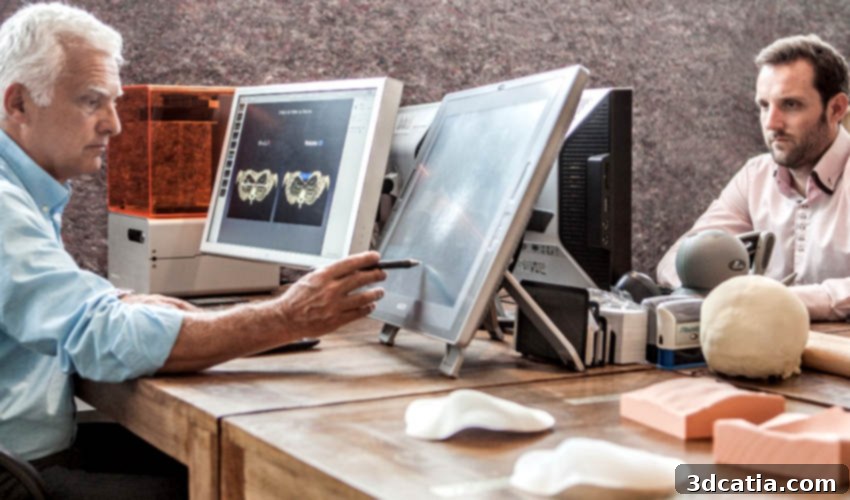
In the dynamic world of medical innovation, AnatomikModeling stands out as a pioneering force, harnessing the power of 3D technology to develop customized solutions for a range of challenging medical conditions, including congenital thoracic pathologies. Founded just two years prior to this conversation, AnatomikModeling has rapidly established itself as a leader in its field, demonstrating impressive growth and a commitment to improving human health. We had the privilege of engaging with their team to delve into their groundbreaking applications of 3D technology, their vision for the future of the medical device industry, and their ambitious plans to enhance patient quality of life globally.
AnatomikModeling’s Innovative Approach to Medical Devices with 3D Technologies
AnatomikModeling is an innovative young company that emerged in 2015, built upon a foundation of extensive research and development. This R&D was a collaborative effort, spearheaded by Professor Jean-Pierre Chavoin, the esteemed former Head of the Department of Restorative Surgery and Aesthetics and the serious burns unit at the University Hospital of Toulouse, alongside Benjamin Moreno, who co-founded the company. Their collective expertise and vision laid the groundwork for a company dedicated to pushing the boundaries of medical device customization.
Operating within the rapidly evolving MedTech sector, specifically the Medical Devices industry, AnatomikModeling specializes in the Computer Assisted Design and Manufacturing (CAD/CAM) of highly customized 3D implants. Their expertise spans a critical range of surgical disciplines, including Restorative Surgery, Thoracic Surgery, Maxillofacial/Orthopedic Surgery, and Pneumology. The company’s unique know-how is deeply rooted in its mastery and optimization of advanced 3D technologies. This includes sophisticated 3D processing of data derived from high-resolution medical imaging techniques like X-ray tomography and magnetic resonance imaging (MRI). Furthermore, their capabilities encompass precise 3D design using cutting-edge CAD software, complex computer simulation for predictive analysis, advanced 3D machining (subtractive manufacturing) for molds and specialized components, and state-of-the-art 3D printing (additive manufacturing) for anatomical models and certain implant prototypes. This integrated approach ensures that each medical device is perfectly tailored to the individual patient’s unique anatomy and specific clinical needs, marking a significant leap forward in personalized medicine.
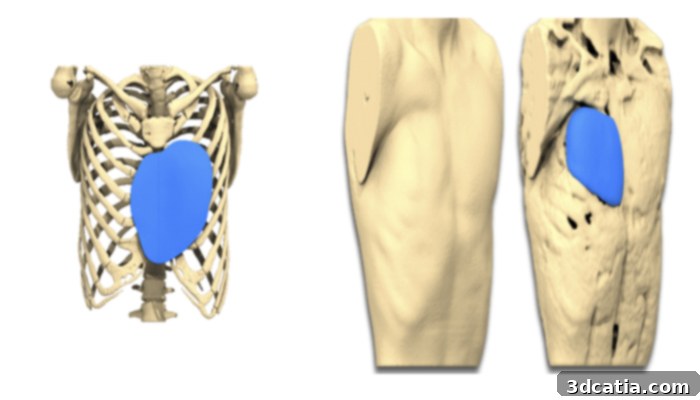
Customized 3D implant design for congenital thoracic pathologies
The Meticulous Process of Manufacturing a Custom 3D Implant
The manufacturing of a customized implant at AnatomikModeling involves a meticulously structured two-phase process, ensuring precision, safety, and optimal patient outcomes:
-
1. 3D DESIGN PHASE: Crafting the Digital Blueprint for Personalized Implants
The initial and critical step begins with the secure and dematerialized reception of patient data. This vital information, primarily medical scans and MRI images, is securely transmitted by surgeons and healthcare professionals from hospitals and clinics globally, underscoring AnatomikModeling’s expansive international reach and collaborative network. The speed and security of this data transfer are paramount, allowing for rapid initiation of the design process regardless of geographical location.
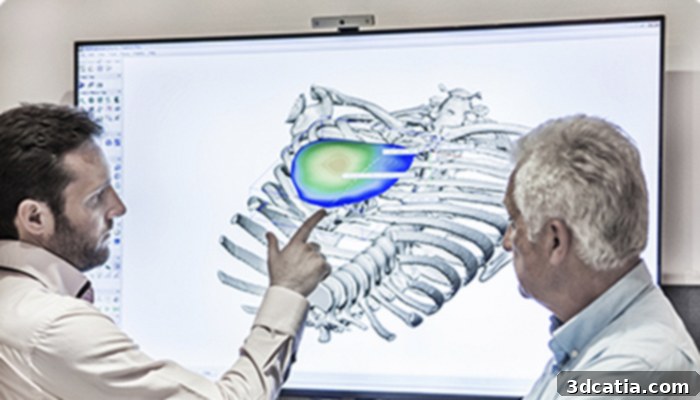
Following data reception, the second step involves sophisticated processing to construct a virtual 3D model of the patient. This digital representation meticulously includes all relevant tissues, such as skin, muscles, bones, cartilage, and fat. The result is a highly accurate digital double of the patient’s specific anatomical region, achieving a precision of less than a millimeter. This intricate process leverages a suite of advanced mathematical algorithms combined with the power of high-performance graphics computing stations, ensuring an incredibly detailed and true-to-life virtual replica that serves as the foundation for the implant design.
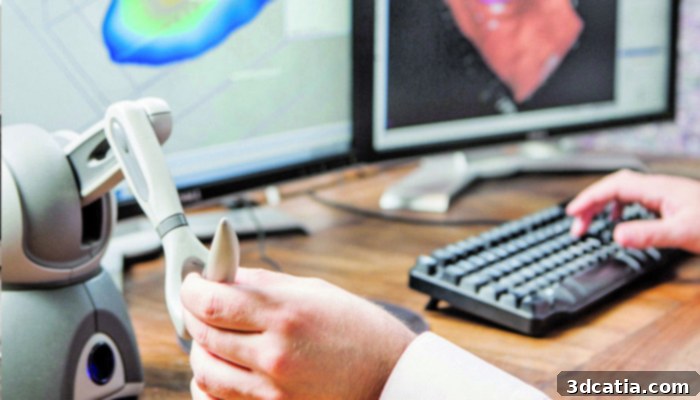
Finally, using this precise digital double, our team employs Computer-Aided Design (CAD) software to meticulously design the future customized implant. This stage involves complex 3D modeling and numerical simulation software, allowing for iterative adjustments and optimizations. Surgeons often collaborate closely during this phase, providing critical input to ensure the implant perfectly addresses the patient’s unique pathology and integrates seamlessly with their anatomy, leading to predictable and superior surgical outcomes.
2. 3D MANUFACTURING PHASE: Bringing the Digital Design to Life
Once the 3D design is finalized and approved, the digital model is then transmitted to our advanced CNC (Computer Numerical Control) or 3D printing machines. These machines are responsible for producing either the mold for the implant or the positive model directly. The selection between 3D additive manufacturing (3D printing) and subtractive manufacturing (CNC machining) technology is determined by the geometric complexity of the implant and the specific material requirements, ensuring the most efficient and precise production method is utilized.
For our custom 3D implants crafted from medical-grade silicone, the meticulously designed molds and positive models are sent to our trusted partner in Paris, Groupe SEBBIN. As a leader in the manufacture of high-quality medical silicone implants, Groupe SEBBIN plays a crucial role in the final production stage. Upon completion, these implants undergo rigorous sterilization procedures before being dispatched to surgeons around the world, ready for implantation.
Additionally, AnatomikModeling produces 3D anatomical models specifically intended for surgeons and other healthcare professionals. These models are invaluable tools for the preparation and anticipation of complex surgical procedures, as well as for comprehensive surgical training. Crucially, these anatomical models are performed directly in-house using advanced 3D printing technologies, allowing for rapid prototyping and detailed, patient-specific representations that significantly enhance pre-operative planning and educational experiences. These models are essential in minimizing risks and optimizing procedural success.
Benefits and Current Limits of 3D Printing in Anatomical Modeling
The integration of 3D printing in anatomical modeling offers a multitude of compelling advantages that are rapidly transforming medical practices. Firstly, it allows for a direct and seamless transition from a complex 3D digital model to a physical anatomical replica, maintaining an exceptionally high level of precision. This capability translates into significant time and cost savings compared to traditional methods, while also ushering in an unprecedented era of personalization for medical devices. The ability to create patient-specific models ensures that surgical interventions are planned with unparalleled accuracy, reducing intraoperative complications and improving patient safety.
Furthermore, 3D printing empowers the creation of anatomical models with highly intricate and complex geometric shapes. These designs would be exceedingly difficult, if not impossible, to achieve using conventional manufacturing techniques. Such complexity is often critical for accurately representing individual patient pathologies, thereby enabling surgeons to visualize and rehearse procedures on an exact replica of the patient’s anatomy. This leads to more efficient surgical times, better functional outcomes, and a clearer understanding of challenging cases.
However, despite these profound benefits, certain limitations persist, primarily concerning the availability and characteristics of suitable materials. Industry standards mandate the use of biocompatible materials or those with rigorously validated properties for mold creation. This strict requirement is essential to prevent any transfer of particles or molecules from the mold to the final implant, which could compromise patient safety. Currently, the range of materials meeting these stringent criteria for medical 3D printing remains relatively limited. Nevertheless, significant research and development efforts are underway by material manufacturers to expand the palette of biocompatible materials and ensure they meet the rigorous regulatory standards required for clinical applications. As these material science advancements continue, the scope and impact of medical 3D printing are poised for even greater expansion.
Strategic Partnerships and Future Horizons for AnatomikModeling
AnatomikModeling recognizes the crucial role of collaboration in driving innovation within the MedTech space. We have cultivated robust academic partnerships with leading institutions, including the University Hospital of Toulouse, which hosts the Medical Device Evaluation Platform (EDIT) and the Institute of Advanced and Surgical Technologies (ITAC). Our collaborations extend to their Restorative Surgery and Interventional Pulmonology Services, the Cancéropole de Toulouse, and the Cancer-Bio-Health competitiveness cluster. Further enhancing our research capabilities are partnerships with the CNRS CIRIMAT laboratory and the Anatomy laboratory of Montpellier University of Medicine. These alliances are vital for conducting cutting-edge research, validating new technologies, and ensuring our devices meet the highest clinical standards.
We are continually investing significantly with our R&D partners to bring to market a new generation of innovative medical devices. These advancements are designed to address the complex challenges of tomorrow’s medicine, aiming to significantly improve patient quality of life and reduce complication rates by offering personalized devices perfectly adapted to individual anatomies. This patient-centric approach also contributes to reducing the medico-economic burden on healthcare systems by fostering more effective and less invasive treatments.
Currently, AnatomikModeling offers a successful range of bespoke 3D implants that are marketed in over 35 University Hospitals (CHUs) and clinics across Europe. These implants are specifically designed for the surgical repair of congenital chest abnormalities, a condition affecting approximately one in 300 people, highlighting the significant need for personalized solutions. Our global reach is steadily expanding, with these implants now also being introduced into markets in South America and Asia. To ensure widespread adoption and proper utilization, we train approximately twenty new surgeons from around the world each year. These highly skilled professionals subsequently join our growing network of referring surgeons, advocating for and expertly placing our implants. We remain committed to continuously deploying and strengthening this network, ensuring that patients can readily find a local surgeon who is not only trained but also proficient in the best practices for implant placement – a crucial guarantee of quality for patients seeking optimal care.
Looking ahead, we are excited to introduce a new generation of implants specifically for Pneumology and Thoracic Surgery: our tailor-made 3D tracheobronchial stents. We are presently in Phase 1 clinical trial, with initial implantations in 10 patients at the Interventional Pulmonology Department of Toulouse University Hospital showing promising results. Building on this success, we anticipate implementing Phase 2 in 2018 with a significantly larger cohort of patients, further validating the efficacy and safety of these advanced devices.
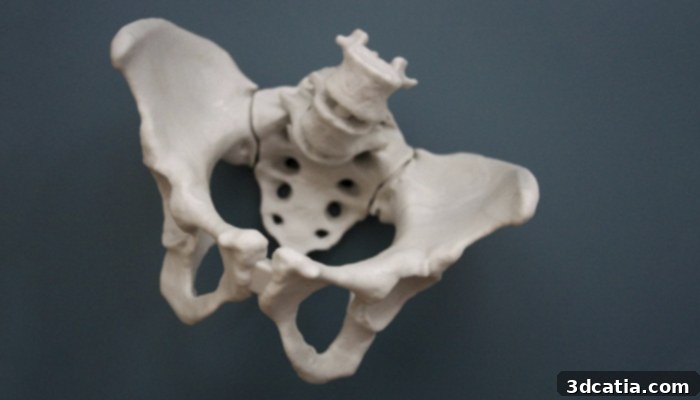
Pathological anatomical model printed in 3D by sintering polyamide 12 powder from the pelvis and the first vertebrae of a patient from the scanner data, used for surgical planning and training.
In addition to implant development, we have recently expanded our offerings to healthcare professionals with the 3D printing of pathological anatomical models. These highly detailed, patient-specific models are invaluable for preparing and better anticipating the intricacies of surgical procedures. They serve as exceptional tools for surgical training, providing a realistic and hands-on experience based on actual medical data, thereby enhancing surgeon proficiency and confidence before entering the operating room.
The Transformative Future of 3D Technologies in Surgical Fields
3D technologies have been an integral part of the medical sector for many years, significantly advancing with the explosive growth of medical imaging techniques. These technologies now enable highly precise diagnostics without the need for invasive procedures, offering unprecedented insights into patient anatomy and pathology. The field of robotics, guided by real-time medical imaging, is also experiencing a tremendous boom, revolutionizing specialties such as neurology, vascular surgery, and urology by enhancing precision and minimizing invasiveness.
Within the surgical field, 3D printing is poised to bring about even more profound transformations in the very near future. The advent of “Plug & Play” implants, precisely tailored to individual patient anatomies, will dramatically reduce operating times and streamline surgical procedures. This personalization will lead to superior morphological and functional results, significantly fewer complications, and a more effective management of complex pathologies. The ability to precisely design and manufacture implants that perfectly fit a patient’s unique biological structure minimizes the need for intraoperative adjustments, contributing to smoother, safer, and more successful operations.
Looking further ahead, the arrival of new active and intelligent biomaterials, coupled with the potential for 3D printing of complex tissues and even complete organs, promises to revolutionize the future of medicine. While we are only at the nascent stages of these developments, the pace of progress is incredibly rapid. These groundbreaking technologies hold the potential to allow us to live not just longer, but also with a significantly better quality of life, fundamentally reshaping healthcare as we know it.
AnatomikModeling’s Commitment to Patient-Centric Innovation
At AnatomikModeling, our unwavering ambition drives us every single day: to continually bring forth new therapeutic solutions that lead to a better quality of life and enhanced care for patients worldwide. The customization of our medical devices, powered by the incredible capabilities of new 3D technologies, is the cornerstone that enables us to achieve this vital goal. We are dedicated to pushing the boundaries of what is possible, ensuring that each patient receives the most precise, effective, and personalized care available.
For those interested in other pioneering ventures, last month’s Startup of the Month featured Livrea Yachts. You can explore their innovative work in detail by checking out the article here.
We’d love to hear your thoughts on AnatomikModeling and their transformative work! Share your comments below or connect with us on our Facebook and Twitter pages. Don’t forget to sign up for our free weekly Newsletter to receive all the latest news and updates in 3D printing directly in your inbox!