
Exploring the Cutting Edge: Top 5 Additive Manufacturing Videos Unveiling 3D Printing’s Impact
Welcome to our weekly showcase of groundbreaking innovations in the world of 3D printing. This week, we dive deep into the fascinating realm of additive manufacturing, exploring how this transformative technology is fundamentally reshaping diverse industries and production paradigms. From advanced medical applications to revolutionary developments in automotive design, construction, and materials science, 3D printing continues to push the boundaries of what’s possible. Our carefully curated selection of the top five videos will provide insightful glimpses into the latest advancements, keeping you informed and inspired by the rapid evolution of this sector. If you find these insights valuable, remember to visit our YouTube channel for an extensive library of 3D printing content. We hope you enjoy this journey into the future of manufacturing!
Featured Innovations in Additive Manufacturing
TOP 1: ADDITIV digital World – The Premier Virtual AM Event
In an era where global health challenges have necessitated a re-evaluation of traditional gatherings, the additive manufacturing community, like many others, has had to adapt. The cancellation of physical events prompted a significant shift towards virtual platforms, providing new avenues for networking, sharing breakthroughs, and collectively propelling the industry forward. In response to this evolving landscape, 3Dnatives proudly launched its own series of virtual events, known as ADDITIV digital. Following the resounding success of its French and Spanish editions, the highly anticipated ADDITIV digital World is set to take place on October 22nd. This global event promises an unparalleled experience, featuring a distinguished lineup of experts from world-renowned institutions and companies, including MIT, NASA, and Facebook. Attendees will gain access to cutting-edge research, industry insights, and collaborative opportunities, all from the comfort of their own location. We strongly encourage you to take advantage of this incredible opportunity to connect with pioneers and thought leaders in additive manufacturing, as registration is entirely free. Mark your calendars for an immersive day of innovation, scheduled from 8 AM to 6 PM EDT.
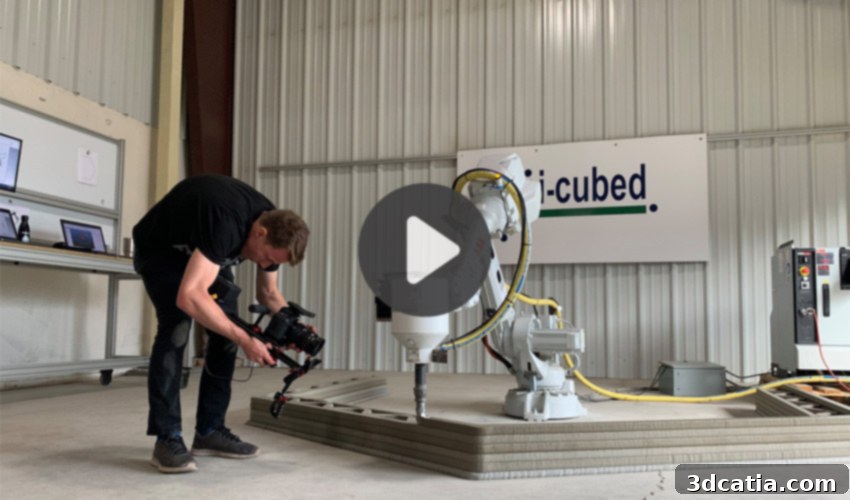
TOP 2: i-cubed Paving the Way in Construction 3D Printing
The construction industry stands as one of the most promising sectors poised for transformation by additive manufacturing. The technology’s ability to erect structures with unprecedented speed, significantly reduce labor requirements, and lower overall project costs makes it an incredibly attractive solution for the future of building. While the vision of 3D printing an entire house on demand might still be on the horizon for widespread adoption, numerous projects are demonstrating remarkable progress and potential. Among these pioneers is i-cubed, a company that exemplifies the innovative spirit in construction 3D printing. i-cubed leverages the power of advanced robotics, specifically an ABB robot, combined with sophisticated Mastercam software, to precisely extrude concrete. This method allows them to design and construct complex architectural structures layer by layer, achieving levels of geometric freedom and customization previously unattainable. Their current system is capable of efficiently 3D printing the structural walls for a house spanning 110 square meters. Driven by their commitment to innovation and scaling solutions, i-cubed is already developing their second-generation printing system, which aims to expand its capacity to an impressive 185 square meters. This advancement signifies a major leap towards making large-scale, cost-effective 3D printed homes a reality, promising faster development and more sustainable building practices for communities worldwide.
TOP 3: The Incredible Potential of 3D Bioprinting Human Skin
The field of bioprinting continues to amaze with its rapid advancements, pushing the boundaries of regenerative medicine and tissue engineering. This incredible technology has already demonstrated its capability to produce a range of complex biological structures, from a functional bioprinted ovary and a sophisticated bionic eye prototype to viable ears, elastic bones, lung tissue, and even a miniature functioning human heart pump. Among these remarkable achievements, the bioprinting of human skin, the body’s largest organ, stands out as a particularly impactful development. Today, medical professionals are already able to lay down strips of 3D printed skin onto affected areas, offering new hope for burn victims and those suffering from extensive skin damage. Beyond this, doctors and scientists are actively testing advanced bioprinters designed to create full-thickness skin transplants. A significant breakthrough comes from a dedicated group of researchers at the Rensselaer Polytechnic Institute in New York. They have successfully conceived and demonstrated a method to 3D print living skin that not only replicates the tissue structure but also ingeniously incorporates functional blood vessels. This vascularization is a critical step, as it allows the bioprinted skin to integrate seamlessly with the host’s circulatory system, ensuring nutrient delivery and waste removal – vital for the survival and long-term viability of transplanted tissue. Such advancements promise to revolutionize wound healing, reconstructive surgery, and the development of more accurate models for drug testing, moving us closer to a future where damaged organs and tissues can be repaired or replaced with precision-engineered biological constructs.
TOP 4: Advancements in Laser Materials Processing for Additive Manufacturing
The continuous evolution of the additive manufacturing industry heavily relies on the pioneering work conducted at technology centers worldwide. These research hubs are dedicated to developing novel solutions that enhance the efficiency, precision, and applicability of 3D printing across various industrial sectors. One such globally recognized research group, LUT Laser, is at the forefront of this innovation. Their core focus lies in the meticulous investigation and development of highly efficient methods and processes specifically tailored for industrial additive manufacturing, primarily utilizing laser beam technology. Laser materials processing is a versatile and critical component in many advanced manufacturing workflows. It encompasses a broad range of applications where a high-energy laser beam is used to modify or transform materials with exceptional accuracy. The laboratory research at LUT Laser delves into several key areas. This includes traditional laser welding, where precise control over material fusion is paramount; advanced surface treatment techniques that enhance material properties like hardness, corrosion resistance, and aesthetics; and cutting-edge laser cutting processes for metallic materials, offering intricate geometries and clean finishes. Beyond metallic applications, the group also extends its expertise to the processing of non-metallic materials, broadening the scope of what can be achieved with laser-based additive manufacturing. Their work is instrumental in refining the reliability and performance of 3D printed components, driving the industrial adoption of these advanced fabrication techniques by ensuring high quality and repeatable results.
TOP 5: Pollen AM’s Strategic Investment in Ceramics 3D Printing
The landscape of additive manufacturing technologies is incredibly diverse, supporting a vast array of materials, each with unique properties and applications. Among these, ceramics represent a particularly compelling, albeit niche, market. While the 3D printing industry is still largely dominated by plastics and metals, a growing number of forward-thinking companies are recognizing the immense potential and intriguing properties offered by ceramic materials. Ceramics boast exceptional characteristics such as high hardness, excellent thermal conductivity, superior chemical resistance, and biocompatibility, making them ideal for demanding applications. Pollen AM stands out as an innovator in this space. This manufacturer has developed a sophisticated additive manufacturing technology that offers remarkable material versatility. Their system is compatible not only with conventional plastic granules but also extends its capabilities to processing metals and, notably, a range of advanced ceramics. A prime example of this is their successful work with aluminum oxide, commonly known as alumina. Components produced using Pollen AM’s ceramic technology exhibit outstanding mechanical and thermal properties, including very high thermal conductivity and extreme hardness. These attributes make ceramic 3D printing particularly valuable in sectors where performance under harsh conditions is crucial. For instance, in the medical sector, biocompatible ceramic implants and instruments are highly sought after. In the electronics industry, ceramics are essential for high-performance insulators, substrates, and components that can withstand high temperatures and electrical stress. Pollen AM’s investment and advancements in ceramic 3D printing are instrumental in expanding the material options available to designers and engineers, opening up new possibilities for high-performance applications previously unachievable with other additive manufacturing materials.
We hope this week’s dive into the latest 3D printing innovations has been both informative and inspiring. Which of these groundbreaking videos resonated most with you? We’d love to hear your thoughts and insights! Share your favorite video or any comments you have below, or join the conversation on our Facebook and Twitter pages. To ensure you never miss out on the most recent developments and exciting news from the fast-paced world of the 3D industry, remember to sign up for our free weekly Newsletter. Get all the latest updates delivered straight to your inbox and stay ahead of the curve in additive manufacturing!