
Hyperganic: Redefining Design Freedom and Automation in Additive Manufacturing
Imagine a world where you could engineer and design objects with the intricate complexity and efficiency found in nature. What revolutionary products would emerge from such a capability? Traditional software tools for additive manufacturing often fall short when confronted with this level of organic complexity, imposing limits on true design freedom. This is precisely the challenge the Munich-based company Hyperganic aims to overcome. By pioneering a technology that transcends current design constraints, Hyperganic empowers engineers and designers to create objects with unparalleled freedom, moving beyond the simplistic forms dictated by conventional manufacturing methods. We recently had the privilege of speaking with Markus Finke, Director of Business Development at Hyperganic, to delve deeper into the innovative technology they are bringing to the forefront of the 3D printing industry.
3DN: Can you introduce yourself and elaborate on your connection to additive manufacturing?
 My name is Markus Finke, and as Director of Business Development at Hyperganic, my role involves showcasing how our cutting-edge technology transforms the landscape of additive manufacturing. My connection to this field is deeply rooted in the belief that the true potential of 3D printing has yet to be fully realized due to inherent software limitations. Today’s software tools, by and large, were conceived for traditional manufacturing processes, where design simplicity was not just a preference but a necessity for economical production. However, additive manufacturing thrives on complexity; it’s where its unique advantages truly shine. The ability to produce generatively designed objects featuring intricate internal structures, lightweight geometries, and optimized performance characteristics unlocks unprecedented opportunities. Hyperganic is at the forefront of this evolution, developing the foundational technology that enables customers to reliably automate complex design processes. This automation ensures that highly intricate objects can be accurately and efficiently fabricated on the most advanced next-generation 3D printers, paving the way for applications like large-scale mass customization and sophisticated print automation across various industries. We are moving beyond simple prototypes to functional, optimized, and customized end-use parts, changing how products are conceived and brought to life.
3DN: How was Hyperganic founded, and what is its core mission?
Hyperganic was founded in 2015 with a clear and ambitious vision: to revolutionize design and production by mirroring the efficiency and complexity of nature itself. Our core mission is multifaceted yet singular in its goal – to empower our customers to build objects that possess the complexity and functional sophistication of natural organisms. This involves several key pillars: first, enabling the creation of designs that push the boundaries of current manufacturing capabilities; second, automating these intricate design and engineering processes, making them accessible and repeatable; and third, ensuring that the resulting, highly complex objects are not just conceptual, but can be easily and reliably printed. By doing so, we aim to help our clients fully utilize the immense potential of today’s advanced 3D printing machinery. We actively collaborate with companies seeking to automate their entire production workflows, transforming their design-to-manufacture pipeline. Furthermore, we partner with leading printer manufacturers, providing them with the necessary intelligence to unlock the full capabilities of their hardware. Our technology allows these manufacturers, and in turn their users, to precisely control print parameters at the most granular level – the voxel-level. This unprecedented control facilitates optimization strategies for speed, quality, and material usage. It also opens the door for groundbreaking next-generation applications such as multi-material gradient printing, where material properties can transition seamlessly within a single object, leading to previously unimaginable functionalities and performance characteristics.
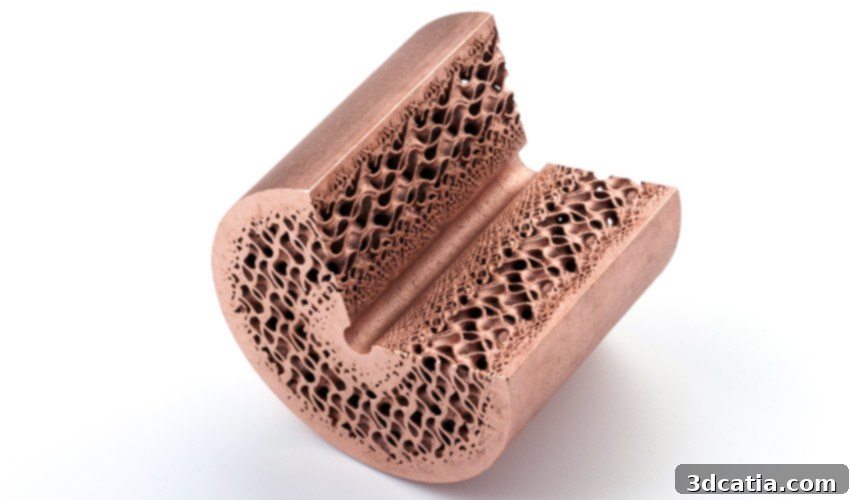
One of the most profound aspects of our technology lies in its ability to empower engineers to create powerful workflows for breakthrough designs, shifting from manual design to automated generation. Consider, for instance, a business specializing in the design of heat exchangers. Traditionally, this involves meticulous manual iterations to optimize for specific performance criteria. With Hyperganic, engineers can define the key input variables that govern their design, such as the desired build volume and the required heat dissipation rate. Utilizing our algorithmic engine, they can then ‘write a recipe’ – a set of rules and parameters – to algorithmically generate the perfect heat exchanger based on these inputs. This process establishes an automated design workflow. We often refer to this as the “object’s DNA”; it’s not merely a static blueprint, but a dynamic workflow that generates a blueprint. The next time the input variables change – perhaps a different size or a higher heat dissipation requirement – the engine will automatically generate an entirely new, optimized object. This is what we define as a mass customization workflow. It’s incredibly versatile and can be configured for virtually any application requiring custom parts, from highly specialized industrial components to custom-fitted, close-to-body medical devices or consumer products. This paradigm shift fundamentally changes how products are designed, developed, and manufactured, offering unprecedented flexibility and efficiency.
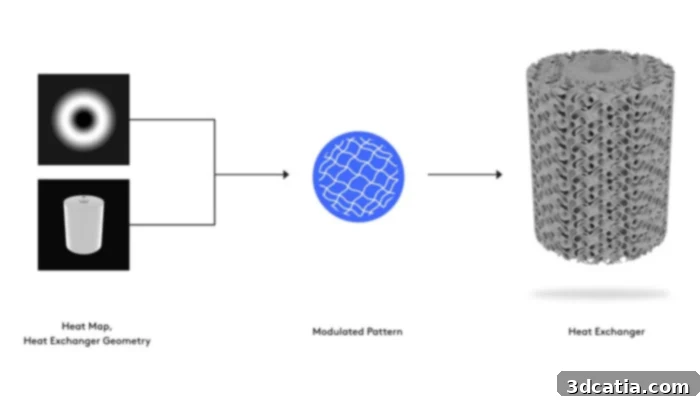
Visualization of an automated object generation workflow for mass customization. I Credits: Hyperganic
3DN: What are the current design limitations of additively manufacturing objects?
When evaluating the frontiers of design, we consistently look to Nature as the ultimate benchmark for complexity and efficiency. Natural objects are, in essence, multi-material, high-tech organisms that have evolved over millennia to achieve optimal functionality within their environments. Their intricate internal structures, material gradients, and adaptive forms far surpass what most conventional manufacturing – and even current additive manufacturing – can easily replicate. Our technology is designed to bridge this gap, allowing us to generate designs that approach this level of natural complexity on screen. However, while our software enables us to dream big and visualize highly complex geometries, the critical question remains: can we actually manufacture these objects yet? The answer is nuanced. For some designs, yes, we can. But we generally identify existing printer hardware as the primary limiting factor preventing the full realization of truly nature-inspired complexity. Nevertheless, the capabilities of 3D printer hardware are advancing at an incredible pace. We are witnessing a vibrant landscape of innovation, with many manufacturers developing revolutionary new printers, particularly in the realm of multi-material capabilities. These advancements are crucial because they directly impact the degree of design freedom available to our users. As printers become more sophisticated, they empower designers to create even more interesting, efficient, and functional objects. Imagine, for example, composite objects manufactured with continuous multi-material gradients, allowing a part to be rigid in one area and flexible in another, or to transition from one thermal property to another. This ongoing improvement in hardware, combined with our advanced generative design software, is rapidly closing the gap between digital design dreams and physical manufacturing reality, driving the next wave of innovation in additive manufacturing.
3DN: How does your software differ from other solutions on the market?
Our software distinguishes itself fundamentally through its core approach, setting it apart from conventional solutions in several critical ways. The first and most significant difference is our philosophy: we are not providing just another CAD tool. Instead, Hyperganic offers a revolutionary way to describe and create objects using sophisticated algorithms and artificial intelligence. This means moving beyond drawing shapes to defining the underlying rules and intelligence that govern an object’s form and function. At the technical heart of our system lies our proprietary geometry kernel, which is built upon a high-performance voxel engine. Unlike traditional mesh-based or NURBS-based CAD systems, our voxel engine operates at the printer’s native resolution or even higher, enabling unprecedented levels of detail and control. Voxels, or volumetric pixels, provide a secure, reliable, and fundamentally different way to automate complex design processes. They allow for precise control over print-parameters at the most granular level, meaning every tiny unit of an object can be individually specified for material, density, and structure. Because the specific print requirements – such as material properties, machine capabilities, and desired print resolution – are integrated directly into the input data for our generative algorithms, we can confidently ensure that the objects generated by our system are always inherently printable. Our workflows are not static designs but dynamic ‘recipes’ – adaptable sets of instructions that can be easily adjusted, modified, and extended. This flexibility allows designers to explore vast design spaces, quickly iterate on concepts, and produce highly optimized, production-ready parts without the limitations typically associated with traditional design software.
3DN: What are Hyperganic’s future plans and vision?
Hyperganic’s future is intrinsically linked to pushing the boundaries of additive manufacturing, and our strategy involves continuous innovation and strategic partnerships. We are committed to collaborating with the most technologically advanced market players across the additive manufacturing ecosystem. This diverse partner base includes both leading printer manufacturers and forward-thinking companies that are eager to leverage the full potential of AM for their products and processes. In recent years, we have observed a significant transformation within the additive manufacturing industry. It has evolved from primarily being a tool for rapid prototyping into a robust method for the efficient production of industry-standard, high-performance end-use parts. This shift underscores the growing maturity and reliability of 3D printing technologies. Today, we are witnessing the next phase of this evolution: companies are increasingly focused on producing highly customized parts on machines that offer ever-greater levels of design complexity. Our vision is to be the foundational technology that enables this transition. We aim to empower businesses to move beyond simple, mass-produced items to bespoke, performance-optimized products, tailored to individual needs or specific application requirements. By fostering these partnerships and continuously enhancing our generative design platform, Hyperganic will remain at the forefront, driving the adoption of complex, nature-inspired designs and automated manufacturing workflows that will define the future of production.
3DN: Any final words or insights you’d like to share with our readers?
To anyone involved in design, engineering, or manufacturing, I encourage you to ask yourself a powerful question: “If design complexity was absolutely free, what would I design?” This simple inquiry is incredibly liberating because it forces you to think beyond the conventional constraints of cost, manufacturability, and traditional design paradigms. It’s a question I constantly pose to myself and my team, as it’s a potent catalyst for out-of-the-box thinking. The answer might not come immediately, but when it does, you will likely be surprised by the sheer ingenuity and innovative potential that emerges. Freeing yourself from the mental shackles of current manufacturing limitations opens up a vast realm of possibilities, allowing you to envision products and solutions that are truly optimized, sustainable, and revolutionary.
What are your thoughts on Hyperganic’s innovative approach to generative design and additive manufacturing? We invite you to share your comments below or connect with us on our Facebook and Twitter pages! Don’t miss out on the latest advancements and news in the world of 3D printing; sign up for our free weekly Newsletter, delivered straight to your inbox.