
Revolutionizing Diagnostics: 3D Printing Microfluidic Channels Directly on Curved Surfaces
In a groundbreaking advancement poised to transform medical diagnostics and wearable technology, researchers at the University of Minnesota (UMN) have successfully developed a novel method for 3D printing intricate fluid channels at the micron scale. This pioneering effort, undertaken in collaboration with the U.S. Army Combat Capabilities Development Command Soldier Center, represents a significant leap forward in additive manufacturing. The ability to create such sophisticated microfluidic channels through 3D printing holds immense potential, promising to automate and streamline the production of crucial diagnostic tools, advanced sensors, and complex assays used across a diverse range of medical tests and scientific applications.
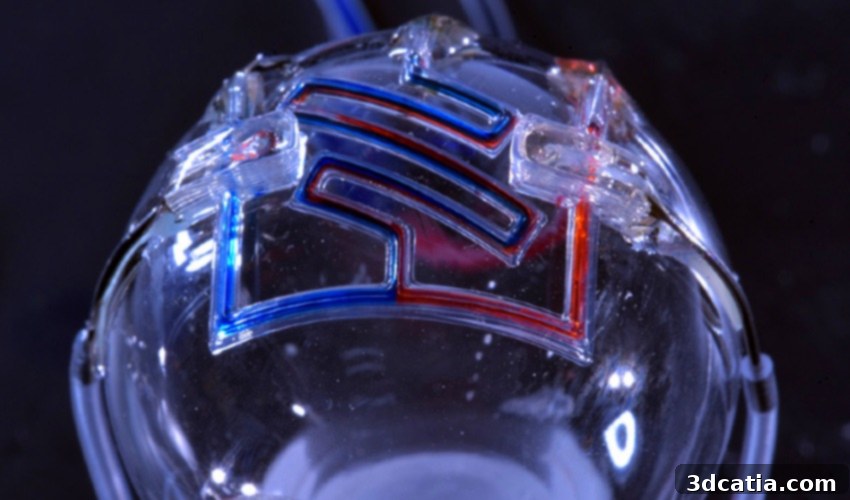
What makes this research particularly revolutionary is the UMN team’s unprecedented achievement: they are the first to demonstrate the successful 3D printing of these microstructures directly onto a curved surface. This critical development is not merely an engineering feat; it marks the pivotal first step toward an exciting future where diagnostic devices can be printed directly onto the skin. Such capabilities would enable real-time, continuous sensing of bodily fluids and functions, ushering in a new era of personalized medicine and on-demand healthcare monitoring.
Understanding Microfluidics: The Science of Tiny Flows
To fully appreciate the significance of this breakthrough, it’s essential to understand the field of microfluidics. Microfluidics is a rapidly expanding interdisciplinary science and technology focused on the precise control and manipulation of fluids at extremely small scales, typically within channels with dimensions ranging from tens to hundreds of micrometers. At this minuscule level, fluid behavior changes dramatically compared to macro-scale flows. Phenomena such as surface tension, laminar flow (where fluid layers move parallel to each other without mixing), and diffusion become dominant, enabling precise control over chemical reactions and biological interactions.
Microfluidic devices, often referred to as “labs-on-a-chip,” leverage these unique fluid dynamics to perform complex laboratory functions on a miniature platform. They offer numerous advantages over traditional macroscopic laboratory techniques, including reduced sample and reagent consumption, faster reaction times, increased automation, higher throughput, and enhanced portability. These benefits have made microfluidics invaluable in a wide array of application areas:
- Medical Diagnostics: Microfluidic systems are at the forefront of point-of-care testing (POCT), enabling rapid and accurate diagnosis of various conditions, from infectious diseases like COVID-19 to critical illnesses such as cancer. They are used in pregnancy testing, blood analysis, genetic screening, and the detection of biomarkers for numerous health issues, offering quick results outside of centralized laboratories.
- Drug Discovery and Screening: Pharmaceutical companies utilize microfluidics for high-throughput drug screening, toxicology testing, and the development of “organ-on-a-chip” models that mimic human physiology, leading to more efficient and ethically sound drug development.
- Environmental Sensing: These devices play a crucial role in monitoring water quality, detecting pollutants, and analyzing air samples, providing rapid alerts for environmental hazards.
- Chemical Synthesis and Energy: Beyond healthcare, microfluidics contributes to controlled chemical reactions, efficient energy harvesting, and advanced material synthesis.
The global microfluidics market is a multi-billion dollar industry, experiencing consistent growth driven by the increasing demand for advanced diagnostics, personalized medicine, and miniaturized analytical tools. This market expansion underscores the profound impact microfluidic technology has on modern science and industry.
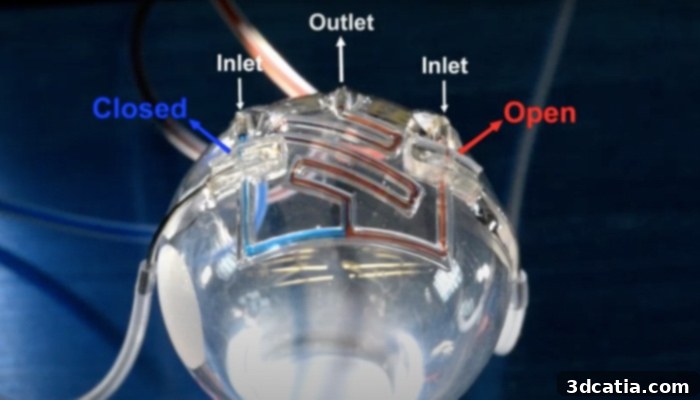
The 3D printed microfluidic channels demonstrate precision and intricate design. (All image credits: University of Minnesota)
The Additive Manufacturing Revolution: Breaking Cleanroom Barriers
Traditionally, the fabrication of microfluidic devices has been an incredibly complex, expensive, and time-consuming process. The dominant technique, photolithography, requires highly controlled cleanroom environments, specialized equipment, and multiple sequential steps involving masks, etching, and bonding. This multi-step approach limits design flexibility, increases production costs, and creates significant barriers to rapid prototyping and widespread adoption, especially for customized or on-demand applications.
The UMN research introduces a paradigm shift by enabling the creation of functional microfluidic channels in a single step using advanced 3D printing technology. The team utilized a custom-built 3D printer, likely employing a high-resolution direct ink writing or stereolithography-based method, to directly print these intricate channels onto various surfaces. Crucially, this was achieved in an open lab environment, completely bypassing the need for a costly and restrictive cleanroom. This capability dramatically reduces manufacturing complexity, time, and expense, making microfluidic device production far more accessible and versatile.
The 3D printed channels in this study are approximately 300 microns in diameter, which is roughly three times the thickness of a human hair or one one-hundredth of an inch. This level of precision is critical for effective microfluidic operation. Beyond mere fabrication, the research team successfully demonstrated full control over fluid flow within these 3D-printed channels. They showcased the ability to pump fluids through the system, precisely redirect their paths, and regulate their movement using a series of integrated valves. This functional validation confirms that the 3D-printed structures are not just physically accurate but also fully operational, ready for practical applications.
Groundbreaking Implications: Portability, Automation, and Accessibility
The ability to 3D print microfluidic channels outside of a cleanroom setting is truly groundbreaking, unlocking numerous future possibilities across healthcare, defense, and beyond. This innovation directly addresses several critical limitations of traditional fabrication methods, offering transformative benefits:
- Enhanced Portability and Decentralization: Without the need for specialized cleanrooms, diagnostic tools can be produced on-demand and on-site. This means a doctor could print a customized diagnostic device directly in their office for a specific patient, or soldiers in the field could fabricate essential medical sensors for immediate use in remote or austere environments. This decentralization dramatically improves response times, reduces logistical burdens, and makes advanced diagnostics accessible in underserved areas.
- Robotic-Based Automation: The single-step additive manufacturing process lends itself perfectly to robotic automation. This could lead to fully automated production lines for microfluidic devices, enabling mass customization and efficient scaling, while minimizing human error and labor costs. Automated systems could also rapidly prototype and iterate designs, accelerating research and development cycles.
- Cost Reduction and Accessibility: By eliminating the need for expensive cleanroom infrastructure and complex multi-step processes, the cost of manufacturing microfluidic devices can be significantly reduced. This increased affordability will democratize access to advanced diagnostic capabilities, making sophisticated medical testing available to a broader population.
The Future of Wearable Sensing: Direct Printing on Skin
Perhaps one of the most exciting aspects of this research is the successful printing on curved surfaces. Michael McAlpine, a distinguished University of Minnesota mechanical engineering professor and senior researcher on the study, eloquently captured the profound impact of this achievement: “This new effort opens up numerous future possibilities for microfluidic devices. Being able to print on a curved surface also opens up many new possibilities and uses for the devices, including printing microfluidics directly on the skin for real-time sensing of bodily fluids and functions.“
The potential applications of direct-to-skin microfluidic printing are vast and transformative. Imagine flexible, conformable sensors seamlessly integrated onto the body, capable of continuously monitoring a wide range of physiological parameters. These wearable microfluidic patches could analyze sweat, tears, or even interstitial fluid for biomarkers indicating hydration levels, electrolyte balance, glucose concentrations, stress hormones, inflammatory markers, and indicators of fatigue or disease onset. Such devices could revolutionize:
- Personalized Health Monitoring: Individuals with chronic conditions like diabetes could receive continuous glucose monitoring without invasive procedures. Athletes could track performance and recovery metrics in real-time.
- Military and First Responder Applications: Soldiers and emergency personnel could wear sensors that monitor vital signs, stress levels, and exposure to environmental toxins, providing critical data for mission readiness and safety.
- Early Disease Detection: Continuous monitoring could detect subtle changes in biomarkers indicative of disease much earlier than traditional episodic testing, leading to timelier interventions and improved patient outcomes.
- Drug Delivery: Beyond sensing, these flexible microfluidic systems could potentially be adapted for controlled, localized drug delivery, further enhancing personalized therapeutic approaches.
This research represents a pivotal moment in the convergence of additive manufacturing, microfluidics, and biomedical engineering. The findings from this groundbreaking study were published in Science Advances, a prestigious scientific journal renowned for disseminating high-impact research, published by the American Association for the Advancement of Science (AAAS). For those interested in the full scientific details, the research paper can be accessed HERE.

Illustrating the advanced capability, the channels are shown in the process of being 3D printed directly onto a sphere, highlighting the curved surface printing achievement.
Looking Ahead: A Future Shaped by On-Demand Microfluidics
The achievements of the University of Minnesota team, in collaboration with the U.S. Army, are not just about printing tiny channels; they represent a fundamental shift in how we conceive, design, and produce sophisticated diagnostic and sensing platforms. By democratizing access to microfluidic fabrication, this research paves the way for a future where advanced medical tools are more affordable, more accessible, and seamlessly integrated into our daily lives. From empowering remote medical care to revolutionizing personal health monitoring, the implications of 3D printing microfluidics on curved surfaces are truly profound and far-reaching.
What are your thoughts on these unique 3D printed microfluidic channels and their potential to transform healthcare and wearable technology? We encourage you to share your insights in a comment down below or join the conversation on our Facebook and Twitter pages! Don’t forget to sign up for our free weekly Newsletter to stay updated with all the latest news and innovations in the rapidly evolving world of 3D printing, delivered straight to your inbox!