
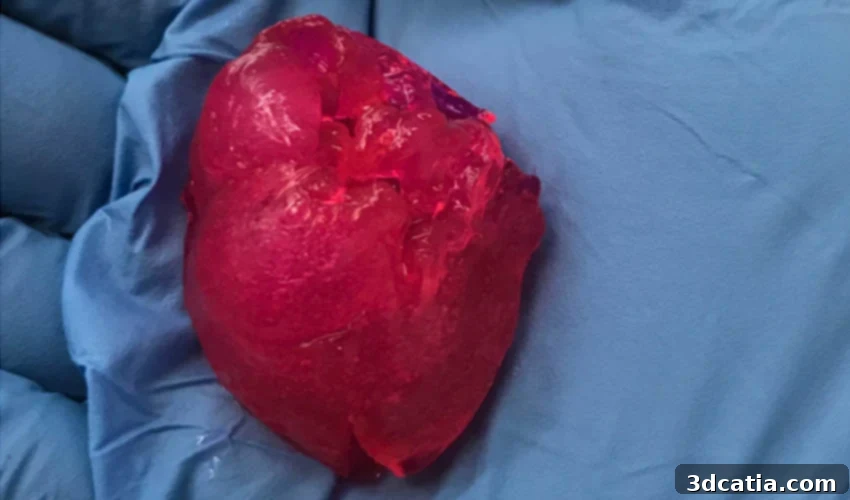
BIOLIFE4D Achieves Historic Milestone: 3D Bioprinting a Miniature Human Heart
In a monumental leap forward for regenerative medicine and the nascent field of 3D bioprinting, BIOLIFE4D, a recognized pioneer in developing groundbreaking bioprinting technologies, has successfully bioprinted a miniature human heart. This incredible achievement marks a significant first for any U.S. company, moving the scientific community closer to a future where fully functional, transplantable human organs can be created on demand. The ambitious mission of BIOLIFE4D is to harness the power of advanced bioprinting to produce full-sized human hearts using a patient’s own cells. This innovative approach aims to fundamentally address two of the most critical challenges in organ transplantation today: the severe shortage of donor organs and the life-threatening issue of organ rejection, which often necessitates lifelong immunosuppressive therapies. This recent success with the miniature heart represents not just a milestone for BIOLIFE4D but a beacon of hope for millions suffering from cardiovascular diseases worldwide, bringing the vision of personalized, bioprinted organs much closer to reality.
Addressing the Global Organ Transplant Crisis with Bioprinting
The global crisis surrounding organ transplantation is profound and escalating. Thousands of patients worldwide endure agonizing waits on donor lists, with many succumbing to their conditions before a suitable organ becomes available. The challenges are multi-faceted: a severe scarcity of compatible donors, the complexities of surgical procedures, and the persistent threat of immune rejection post-transplant. When a patient receives an organ from a donor, their immune system often perceives it as a foreign invader, leading to a rejection response that can range from mild to life-threatening. To mitigate this, transplant recipients must take powerful immunosuppressant drugs for the rest of their lives, which carry significant side effects and increase susceptibility to infections and other health complications. This urgent need for a viable alternative has spurred intense research into innovative solutions, with 3D bioprinting emerging as one of the most promising avenues. The ability to create organs using a patient’s own cells bypasses the fundamental issues of donor matching and immune rejection, offering a personalized and potentially limitless supply of transplantable tissues and organs. BIOLIFE4D’s advancement is therefore not merely a scientific curiosity but a direct response to one of humanity’s most pressing medical dilemmas, holding the potential to transform the landscape of organ transplantation entirely.

Credits: BIOLIFE4D
The Science Behind BIOLIFE4D’s Pioneering Achievement
Dr. Ravi Birla, Chief Science Officer at BIOLIFE4D, articulated the company’s pride and vision: “We are extremely proud of what we have accomplished, from the ability to 3D bioprint human cardiac tissue last summer to a mini heart with full structure now. We believe we are at the forefront of whole heart bioengineering, a field that has matured quickly over the last year, and well positioned to continue our rapid scientific advancement. Today is an exciting day, but we continue forward earnestly toward the end goal of 3D bioprinting whole human hearts.” This statement underscores the rapid progress BIOLIFE4D has made and its commitment to tackling the ultimate challenge of bioprinting a full-sized, transplantable heart. The core of BIOLIFE4D’s innovation lies in its unique bioprinting process, which enables the creation of complex biological structures. The journey begins by reprogramming a patient’s own peripheral blood cells—specifically, white blood cells—into induced pluripotent stem cells (iPS cells). These iPS cells possess the remarkable ability to differentiate into almost any cell type in the body. For heart bioprinting, they are meticulously guided to develop into various types of cardiac cells, including cardiomyocytes (heart muscle cells), endothelial cells (lining blood vessels), and fibroblasts (connective tissue cells), all essential for forming a functional heart.
Central to this process is the development of a proprietary bioink. Unlike traditional printing inks, bioinks are biocompatible materials infused with living cells, growth factors, and other biomolecules. BIOLIFE4D has meticulously engineered its bioink using a unique composition of different extracellular matrix compounds. This matrix is crucial because it closely replicates the natural environment and structural properties of the mammalian heart, providing the necessary scaffold and signaling cues for cells to organize, grow, and function correctly. The company’s bioprinter then precisely deposits layers of this bioink, laden with the differentiated cardiac cells, in a pre-designed 3D structure. This layer-by-layer assembly mimics the intricate architecture of a real heart, allowing for the formation of ventricles, chambers, blood vessels, and other vital components. While the miniature heart bioprinted by BIOLIFE4D is smaller than a human heart, its performance characteristics and structural integrity are remarkably similar, signifying a critical step towards scaling up this technology for full-sized organ creation.
Comparing Breakthroughs: BIOLIFE4D and Global Research
The field of organ bioprinting is an intensely competitive and collaborative global endeavor. While BIOLIFE4D has achieved a significant milestone as the first U.S. company to bioprint a miniature human heart, other notable advancements have been made internationally. For instance, back in April of the previous year, a team of pioneering scientists at Tel Aviv University, located in Israel, also successfully produced a tiny heart. This remarkable achievement involved bioprinting a heart approximately the size of a cherry, utilizing a patient’s own cells, much like BIOLIFE4D’s approach. The Israeli team’s bioprinted heart was complex, containing various essential cardiac components, including cells, intricate blood vessels, ventricles, and distinct chambers. A crucial aspect of their achievement was that the bioprinted heart cells demonstrated the ability to contract spontaneously, a fundamental characteristic of heart muscle. However, at that particular juncture, the cells had not yet developed the coordinated pumping ability required for a fully functional organ.
BIOLIFE4D’s recent accomplishment builds upon and differentiates itself within this global context. While both achievements are groundbreaking, BIOLIFE4D’s success as the first U.S. company to reach this stage underscores the accelerated progress being made within the American biotech landscape. The detailed characterization of their bioprinted miniature heart indicates it performs in a similar way to a biological heart, suggesting a level of functional integration that is highly encouraging. These parallel advancements highlight the rapid pace of innovation in bioprinting, with different research groups pushing the boundaries of what’s medically possible. Such developments are not in isolation; they collectively contribute to a growing body of knowledge and techniques that will ultimately pave the way for the routine bioprinting of organs, transforming treatment options for cardiovascular disease and numerous other conditions requiring organ replacement.
BIOLIFE4D’s Incremental Progress Towards Full-Sized Organs
BIOLIFE4D’s journey to bioprinting a miniature human heart has been marked by a series of deliberate and successful incremental steps, showcasing a methodical approach to tackling complex bioengineering challenges. The company’s significant progress can be traced back to June 2018, when their team successfully achieved the groundbreaking feat of bioprinting human cardiac tissue. This initial step was crucial, demonstrating the ability to create viable cellular structures that could form the building blocks of a heart. Building on this foundation, by the beginning of 2019, BIOLIFE4D had advanced further, successfully bioprinting various individual heart components. These included vital structures such as functional valves, complex ventricular sections, and intricate blood vessels – each representing a key piece of the anatomical puzzle required to construct a complete heart.
The culmination of these efforts is the recently announced bioprinting of a miniature human heart, integrating these components into a unified, structured entity. This systematic progression from basic tissue to complex components and finally to a miniature organ highlights the company’s scientific rigor and strategic development. Steven Morris, CEO at BIOLIFE4D, eloquently captured the significance of this trajectory: “This is an incredibly exciting time for BIOLIFE4D, and we are so proud of Dr. Birla and the team for this tremendous accomplishment. We began this journey with an end goal of developing a technology that has the potential to save lives, and we are a step closer to that today. We will continue our work until we are able to 3D bioprint full-sized hearts viable for transplant, and change the way heart disease is treated forever.” Morris’s statement encapsulates the profound impact this technology promises for the future of medicine, particularly in revolutionizing the treatment of heart disease, which remains a leading cause of mortality worldwide. The company’s unwavering commitment to achieving the ultimate goal of full-sized, transplantable hearts underscores the immense dedication driving this pioneering research.
The Future of Cardiovascular Health: Implications of Bioprinting
The successful bioprinting of a miniature human heart by BIOLIFE4D opens up unprecedented possibilities for the future of cardiovascular health and regenerative medicine. This advancement is not merely a scientific curiosity but a foundational step towards addressing critical unmet medical needs. Imagine a future where patients requiring a heart transplant no longer face agonizing waiting lists or the risk of organ rejection. Instead, a fully compatible, functional heart, precisely tailored to their unique physiological needs, could be bioprinted using their own cells. This personalized approach to organ replacement promises to drastically improve patient outcomes, reduce complications associated with immunosuppression, and significantly extend lives. Beyond full organ transplantation, this technology could also lead to advancements in repairing damaged heart tissue. Patches of bioprinted cardiac tissue, custom-designed to integrate seamlessly with existing heart muscle, could be used to treat areas affected by heart attacks or other forms of cardiac injury, restoring function and preventing heart failure.
Furthermore, the ability to bioprint miniature hearts and complex cardiac tissues provides invaluable tools for drug discovery and disease modeling. Pharmaceutical companies can use these bioprinted structures as highly accurate, human-specific models to test new drugs for efficacy and toxicity, thereby accelerating the development of novel therapies and reducing reliance on animal testing. Researchers can also create disease-specific heart models to better understand the mechanisms of various cardiovascular conditions, leading to more targeted and effective treatments. While challenges remain, such as ensuring proper vascularization (blood supply) and innervation (nerve connections) for larger, more complex bioprinted organs, BIOLIFE4D’s consistent progress demonstrates that these hurdles are not insurmountable. The potential to revolutionize how we diagnose, treat, and ultimately prevent heart disease is immense, painting a hopeful picture for the future of medicine.
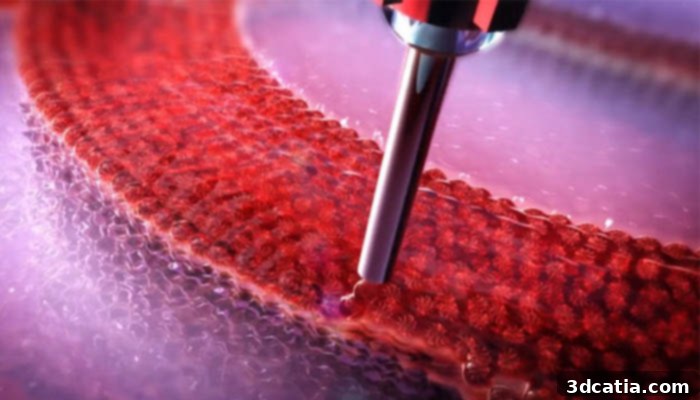
Credits: BIOLIFE4D
What do you think of BIOLIFE4D’s remarkable achievement in bioprinting a miniature human heart? This breakthrough marks a critical step towards a future free from organ donor shortages and rejection. Share your thoughts and join the conversation by leaving a comment below or connecting with us on our Facebook and Twitter pages! Don’t forget to sign up for our free weekly Newsletter to receive all the latest news and advancements in 3D printing sent directly to your inbox.