
Revolutionizing Nuclear Manufacturing: Rosatom Unveils Russia’s Largest Industrial 3D Printer
In a move set to profoundly transform Russia’s nuclear industry, Rosatom – Additive Technologies (RusAT), a leading subsidiary of the state nuclear corporation Rosatom and its nuclear fuel manufacturer TVEL, has proudly unveiled a monumental 3D printer. This groundbreaking installation, positioned as the largest of its kind within Russia, promises to usher in a new era of efficiency and innovation through additive manufacturing. Specifically designed for the intricate demands of the nuclear sector, this advanced system boasts the unparalleled capability to produce large-sized, critical components for nuclear reactors, offering significant reductions in both manufacturing costs and production timelines. This development not only underscores Russia’s commitment to technological advancement but also positions it at the forefront of industrial-scale additive manufacturing for high-stakes applications.
The introduction of such a powerful industrial 3D printer marks a strategic leap for Rosatom, aiming to enhance the self-sufficiency and innovative capacity of the Russian nuclear energy complex. By leveraging additive technologies, the nation can streamline supply chains, reduce dependence on external suppliers for specialized parts, and accelerate the development of next-generation nuclear power solutions. The ability to print complex geometries and large components in-house offers unprecedented flexibility in design and repair, ultimately contributing to safer and more efficient nuclear operations.
Advanced Engineering and Direct Metal Deposition Technology
This formidable 3D printer is the culmination of extensive research and development, forged through a collaborative effort with the prestigious Institute of Laser and Welding at St Petersburg Marine Technical University. Its technical specifications are truly impressive, underscoring its readiness for heavy industrial applications. The machine boasts a remarkable load capacity of eight tonnes, making it capable of handling substantial component weights during the additive manufacturing process. Powering its precise movements are two robust industrial six-axis robots, ensuring intricate control and accuracy over large build volumes.
The cutting-edge system is engineered to manufacture products with an imposing diameter of up to 2.2 meters and a height of 1 meter. At its core, the printer utilizes a sophisticated direct metal deposition (DMD) system, a specialized form of laser metal deposition. This process involves the precise delivery of metal powder into a molten pool created by a high-power laser beam, allowing for the layer-by-layer formation of complex metallic structures. A key advantage of the DMD system is its exceptional flexibility in producing composite products. By strategically feeding various metal powders with different material properties, the printer can create components with tailored characteristics, optimizing them for specific operational requirements within a nuclear reactor. This capability for multi-material printing opens up vast possibilities for developing components with enhanced durability, thermal resistance, and structural integrity.
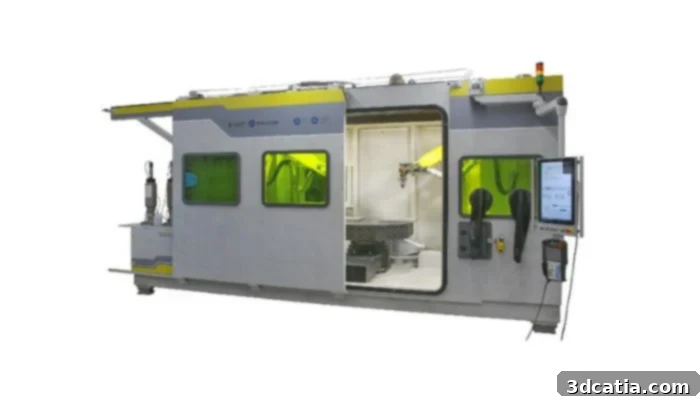
RusAT’s DMD 3D printer (Photo credits: RusAT)
Strategic Applications and Industry Impact
While the versatility of this industrial 3D printer allows for its application across diverse heavy industries, its initial and most significant triumph lies in its ability to successfully manufacture a 1-meter-high fragment of the baffle for the internal device of a nuclear power reactor. The baffle, a critical structural component within a reactor core, plays a vital role in directing coolant flow and ensuring the structural integrity of fuel assemblies. Producing such a large and complex part using additive manufacturing not only demonstrates the printer’s technical prowess but also proves the viability of large-scale 3D printing for critical nuclear components.
Olga Ospennikova, Director of the Association for the Development of Additive Technologies, eloquently articulated the profound implications of these advancements, stating, “Additive technologies are one of the drivers that determine the shape of a new generation of production … this is a breakthrough technology that opens up the possibility for a wide application of additive technologies in the nuclear industry, in particular, it will allow printing large-sized parts of nuclear reactors.” Her statement highlights additive manufacturing not just as a tool, but as a fundamental paradigm shift in industrial production, promising a future where customized, complex parts can be produced with unprecedented efficiency and precision. This paradigm is particularly relevant for the nuclear sector, where the demand for specialized, high-integrity components is constant and critical.
The Vision: Heavy Engineering in Tonnes, Not Kilograms
Ilya Kavelashvili, the Director General of RusAT, passionately underscores the paramount importance of robust, high-capacity installations like this new 3D printer for the full integration of additive technologies into heavy engineering. He articulates a transformative vision for the future, where the weight of products manufactured on industrial 3D printers will be measured not in mere kilograms, but in substantial tonnes. This ambitious transition signifies a profound shift from prototyping and small-batch production to truly industrial-scale manufacturing of heavy-duty components.
Such a monumental shift is anticipated to yield a multitude of benefits across the manufacturing landscape. Foremost among these is a substantial saving of raw materials. Additive manufacturing, by its nature, is a ‘near-net-shape’ process, meaning it builds parts layer by layer, generating significantly less waste compared to traditional subtractive manufacturing methods like machining. This material efficiency translates directly into reduced production costs and a smaller environmental footprint. Furthermore, Kavelashvili emphasizes the expected increase in production productivity, as the ability to rapidly produce complex parts can drastically shorten lead times and accelerate development cycles. Concurrently, the precision and control inherent in additive processes are set to enhance product quality, allowing for the creation of components with superior mechanical properties and intricate internal structures that were previously impossible to achieve through conventional means.
Rosatom’s commitment to this advanced technological frontier is evident through its comprehensive, large-scale additive technology program. This initiative is not merely about acquiring new machines; it represents the strategic genesis of extensive 3D printing usage across the entirety of Russian mechanical engineering. The vision extends beyond nuclear applications, aiming to permeate various sectors that rely on heavy machinery and complex components, thereby fostering a broader industrial renaissance.
Collaborative Success and Future Prospects
A significant achievement highlighted by Rosatom is the printer’s innovative design, which enables multiple growing tools to operate simultaneously without any interference in their respective temperature fields. This synchronized, multi-tool capability is a crucial advancement for improving throughput and efficiency in large-scale additive manufacturing, allowing for the simultaneous creation of multiple components or complex multi-part assemblies. The positive outcomes derived from their ongoing collaboration with academic institutions demonstrate a robust and successful application of additive technologies within the demanding domain of heavy engineering, showcasing how theoretical knowledge can be effectively translated into practical, industrial solutions.
Rosatom’s strategic commitment to fostering additive manufacturing is further reinforced by its existing network of three dedicated additive technology centers, strategically located in Moscow, Novouralsk, and Nizhny Novgorod. These centers serve as hubs for research, development, and application of 3D printing across various industrial needs. The recent unveiling of this state-of-the-art 3D printer at the prestigious Metalworking 2023 conference in Moscow garnered considerable attention and excitement. The event provided an ideal platform to showcase this technological marvel to industry experts, potential partners, and enthusiasts, solidifying Russia’s position as a serious contender in the global additive manufacturing landscape, particularly for critical infrastructure industries.
Transforming Russia’s Industrial Landscape
The advent of this monumental 3D printer holds immense potential to reshape not only the nuclear industry but also the broader industrial landscape in Russia. By enabling the precise and efficient production of large-scale components for nuclear reactors, the technology directly contributes to enhancing national energy security and fostering innovation within a critical sector. The promise of reduced costs, significantly shorter manufacturing times, and a tangible enhancement in product quality paves the way for a paradigm shift in how heavy engineering components are designed, produced, and maintained. The strategic implementation of advanced additive technologies opens up a vast world of possibilities for Russian mechanical engineering, extending its influence far beyond the immediate nuclear sector to encompass shipbuilding, aerospace, defense, and other heavy industries.
This innovative technology marks a pivotal milestone in the global advancement of industrial 3D printing, especially concerning large-scale applications. It signifies a clear trajectory towards the widespread adoption of additive manufacturing for complex, high-value components, moving beyond niche applications to become a core method in heavy industries. Rosatom’s commitment and the successful deployment of this printer underscore a forward-thinking approach that is poised to drive significant economic and technological benefits, not just for Russia, but potentially setting new benchmarks for industrial additive manufacturing worldwide. The implications for developing more resilient, efficient, and cost-effective industrial infrastructure are profound and far-reaching.
What are your thoughts on Rosatom’s groundbreaking industrial 3D printer and its potential impact on the nuclear and heavy engineering sectors? Share your insights and comments below, or connect with us on ourLinkedIn,Facebook, andTwitter pages! Don’t forget to sign up for our free weeklyNewsletter here to get the latest 3D printing news straight to your inbox! You can also find all our videos on ourYouTube channel.
*Cover photo credits: Erik Romanenko