
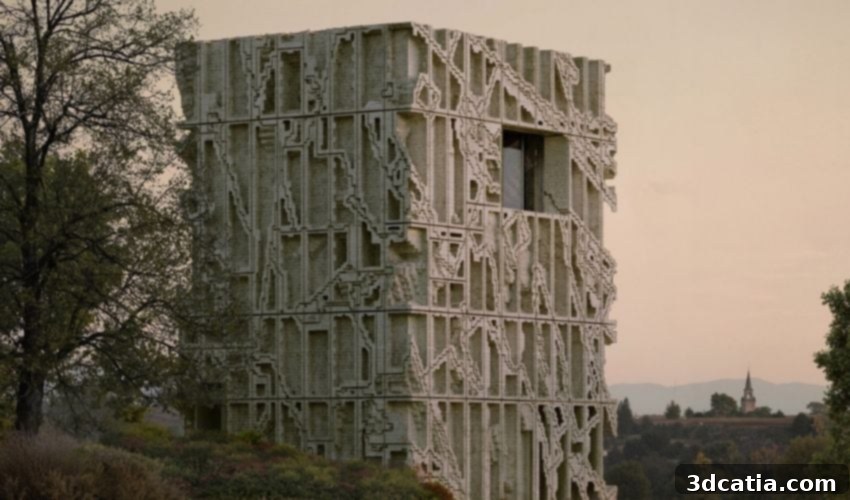
Building the Future: Exploring 3D Printed Sand Homes with the Tùr House
Imagine a home constructed primarily from sand. While the concept might seem far-fetched, the Tùr House project, spearheaded by Barry Wark Studio, is pushing the boundaries of architectural innovation to make this a tangible possibility. This ambitious speculative architectural research project delves into the potential of sand 3D printing to fabricate modular building blocks. These blocks can then be assembled to create functional and adaptable structures. The core idea behind Tùr House isn’t about erecting a permanent, fixed building. Instead, it’s about investigating how locally sourced, reusable materials can be used to create architectural systems that are inherently designed for disassembly, reconfiguration, and long-term adaptation. This innovative approach challenges traditional construction methods and opens up exciting new avenues for sustainable and flexible housing solutions. The project prompts us to consider a future where buildings are not static entities but dynamic systems that evolve with the needs of their inhabitants and the surrounding environment.
The Tùr House concept envisions a residential building composed of numerous blocks, each meticulously 3D printed using sand. While the specific 3D printing process and the sand sourcing methods remain undisclosed, the overarching goal is to present a paradigm shift in construction practices. This vision allows for the reuse, replacement, or even complete removal of building materials as needed. The ultimate aim is to create a living structure that adapts and evolves over time, responding to changing circumstances and user requirements. While the practical implementation of this project presents significant challenges, its innovative approach and potential benefits make it a compelling exploration of the future of construction. The concept encourages a rethinking of traditional building methods and a focus on sustainability, adaptability, and resource efficiency. It opens up the possibility of creating homes that are not only functional but also environmentally responsible and responsive to the needs of their occupants.
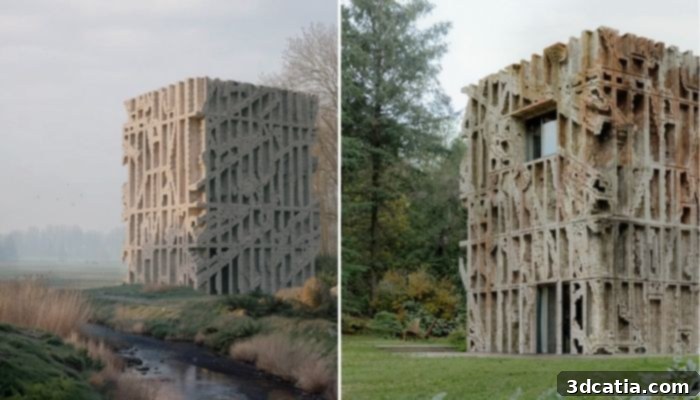
Blocks of 3D printed sand form the Tùr House.
Each 3D-printed sand block is designed with sufficient thickness to provide effective thermal insulation. When assembled, these blocks create an independent outer layer, similar to the protective function of cardboard packaging. This external layer safeguards the core living space within. The interior of the Tùr House is thoughtfully designed, with open, communal living areas on the ground floor, fostering social interaction and a sense of community. Upstairs, more private spaces cater to individual needs and provide a sense of retreat. The entire structure is supported by strategically placed 3D-printed columns, demonstrating the structural integrity and load-bearing capabilities of the sand-based construction. This design approach combines the practical benefits of thermal insulation and structural stability with a focus on creating a comfortable and functional living environment. The integration of open communal spaces and private retreats reflects a thoughtful consideration of the diverse needs of modern living.
The Tùr House project vividly illustrates the growing role of additive manufacturing in architecture, enabling the creation of novel, sustainable, and innovative building solutions. It serves as a prime example of the modularity and design flexibility that 3D printing technologies offer. The ability to create custom-designed blocks with specific properties opens up a world of possibilities for architectural design. While the Tùr House is currently a conceptual project, it represents a significant step towards a future where buildings are more adaptable, sustainable, and responsive to the needs of their inhabitants. The project’s focus on locally sourced materials and reusable components aligns with the growing emphasis on environmentally responsible construction practices. Whether the Tùr House ever becomes a physical reality remains to be seen, but its impact on the architectural landscape is undeniable. To explore more projects from this innovative architecture firm, you can visit their website HERE. The firm’s portfolio showcases a commitment to pushing the boundaries of architectural design and exploring the potential of emerging technologies.
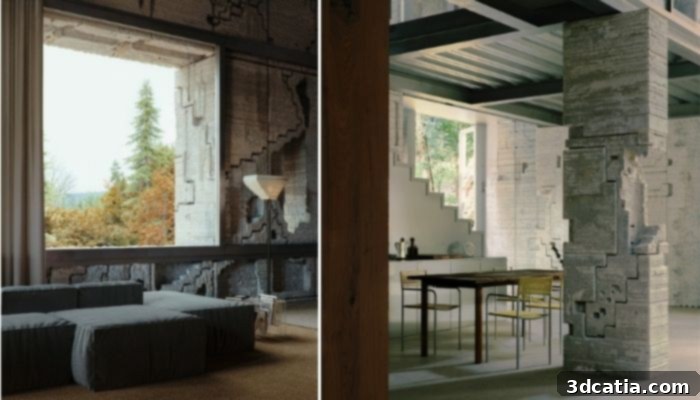
The Tùr House interior
What are your thoughts on the Tùr House and the broader application of additive manufacturing in architecture? Share your opinions and insights in the comments section below. We encourage you to join the conversation on our LinkedIn and Facebook pages. Stay informed about the latest developments in 3D printing by subscribing to our free weekly Newsletter, delivered directly to your inbox. You can also explore a wealth of informative content on our YouTube channel. We value your participation and encourage you to share your perspectives on the future of construction and the role of innovative technologies. Your contributions help to shape the ongoing dialogue and drive the evolution of the field.
The Tùr House project serves as a catalyst for discussion about the future of sustainable housing and the potential of 3D printing to revolutionize the construction industry. By exploring the use of locally sourced materials and modular design principles, the project offers a compelling vision for more adaptable, resource-efficient, and environmentally responsible buildings. The challenges of implementing such a project are significant, but the potential rewards are substantial. As technology continues to advance and new materials are developed, the possibility of building homes from sand and other unconventional resources becomes increasingly realistic. The Tùr House is not just a conceptual design; it’s a call to action, urging architects, engineers, and policymakers to embrace innovation and explore new approaches to addressing the global housing crisis.
Beyond the immediate benefits of using locally sourced materials and reducing construction waste, the Tùr House also offers the potential for greater design flexibility and customization. The modular nature of the 3D-printed blocks allows for a wide range of architectural configurations, enabling homes to be tailored to the specific needs and preferences of their occupants. This level of customization is difficult and costly to achieve with traditional construction methods. Furthermore, the ability to disassemble and reconfigure the structure over time provides a level of adaptability that is essential in a rapidly changing world. As families grow, needs evolve, and environmental conditions shift, the Tùr House can be adapted to meet these new challenges, ensuring its long-term relevance and sustainability. The project also highlights the potential for greater community involvement in the construction process, as 3D printing technologies can be used to empower local communities to build their own homes using locally sourced materials.
The development of sand-based 3D printing technologies also has significant implications for disaster relief and humanitarian aid. In the aftermath of natural disasters, the ability to quickly and efficiently construct temporary shelters and permanent housing is crucial. Sand, as a readily available resource in many affected areas, could be used to 3D print durable and affordable shelters, providing immediate relief to those in need. This approach would be far more sustainable and cost-effective than relying on imported building materials. Furthermore, the modular nature of the 3D-printed structures would allow for easy expansion and adaptation as communities rebuild. The Tùr House project, therefore, not only represents a potential solution for sustainable housing but also offers a valuable tool for disaster preparedness and humanitarian response. The ability to leverage local resources and innovative technologies to address urgent housing needs could save lives and help communities recover more quickly from devastating events.
In conclusion, the Tùr House project is a compelling exploration of the future of sustainable housing and the transformative potential of 3D printing technologies. By challenging traditional construction methods and embracing innovation, the project offers a glimpse into a future where buildings are more adaptable, resource-efficient, and environmentally responsible. While significant challenges remain, the potential benefits of sand-based 3D printing are undeniable, ranging from greater design flexibility and customization to more effective disaster relief and humanitarian aid. The Tùr House serves as a powerful reminder that the future of construction lies in embracing innovation and exploring new approaches to building a more sustainable and equitable world.
*All Photo Credits: Barry Wark Studio