
Revolutionizing Medical Training: How 3D Printing Creates Realistic Swab Models for Enhanced COVID-19 Preparedness
Additive manufacturing, commonly known as 3D printing, has profoundly transformed numerous industries, but its impact on the medical sector is particularly groundbreaking and continues to grow exponentially. For years, this innovative technology has been instrumental in advancing medical care, from facilitating intricate surgical procedures to customizing dental prosthetics and enhancing diagnostic capabilities. Physicians, surgeons, dentists, and a wide array of medical support staff across nearly every specialized field have consistently recognized and leveraged the unparalleled benefits that 3D printing brings to their daily practice. The ability to create highly accurate, patient-specific models, instruments, and even implants has ushered in an era of personalized medicine and improved patient outcomes, significantly elevating the standards of patient care and medical education.
A prime example of this transformative power emerged during the early stages of the global pandemic. As COVID-19 spread rapidly, the demand for testing surged dramatically, placing immense pressure on healthcare systems worldwide. Q & M Dental Group, a leading dental healthcare provider known for its extensive network and community involvement, stepped up to play a crucial role in managing the overwhelming rush for COVID-19 testing. Their dedicated efforts and significant contributions to public health were widely acknowledged, culminating in their distinguished recognition with the President’s Volunteerism & Philanthropy Award by the City of Good. This commitment underscored their adaptability, social responsibility, and willingness to serve the community beyond traditional dental care, demonstrating exemplary civic engagement during a critical time.
As the pandemic evolved, COVID-19 testing transitioned from an emergency measure to a routine requirement for a multitude of daily activities, including international travel, dining out, and participation in large gatherings. This shift created a new and unforeseen challenge: the need for widespread swabbing procedures to be performed not only by medical professionals but also by trained non-medical personnel. Ensuring consistent accuracy and safety in these high-volume procedures became paramount, necessitating an efficient, scalable, and effective training solution that could be rapidly deployed. Recognizing this critical demand and the importance of equipping a broader workforce with essential skills, Q & M Dental Group embarked on an innovative partnership with Singapore-based Creatz3D, a renowned additive manufacturing solutions provider, and its specialized subsidiary, AuMed. The collaboration aimed to develop a state-of-the-art, life-sized 3D-printed medical model specifically designed for comprehensive swabbing procedural training, tailored to meet the urgent needs of both medical and non-medical learners.
The development of such realistic training models is a profound testament to the power of 3D printing in education and skill development within healthcare. As we have observed in numerous other cutting-edge applications of 3D printing in medicine, the capability to visualize and physically interact with a patient’s anatomy offers profound advantages over theoretical learning alone. This hands-on, immersive approach allows not only seasoned physicians to refine their techniques but now also empowers non-medical staffers to gain a deeper, more intuitive understanding of human physiology and anatomical landmarks. By fostering enhanced comprehension and practical proficiency, these models ultimately enable trainees to provide superior patient care, ensuring procedures are performed accurately, safely, and with greater empathy. For critical diagnostic procedures like nasal and oral swabbing, accurate anatomical knowledge and precise technique are indispensable, and traditional training methods often fall short in delivering the necessary tactile and visual realism that 3D printing provides.
Joseph Lua, an insightful associate at Q & M Dental Group, articulated the precise vision and critical requirements behind this innovative training tool. He emphasized, “Our focus was to find models with a cross-sectional view of the nose area so that we could teach learners about specific anatomical landmarks and what to watch out for while swabbing. We wanted a model that could let us explain procedures effortlessly to a non-medical trained person.” This statement brilliantly highlights the dual challenge that the project sought to address: providing highly detailed anatomical instruction that medical professionals require, while simultaneously simplifying complex medical procedures into an easily digestible and intuitive format for individuals without a formal medical background. The meticulously crafted 3D-printed model directly addresses this by offering an intuitive, interactive learning experience that effectively bridges the gap between abstract theoretical knowledge and concrete practical application, drastically improving the confidence, competence, and consistency of all trainees, regardless of their prior medical exposure.
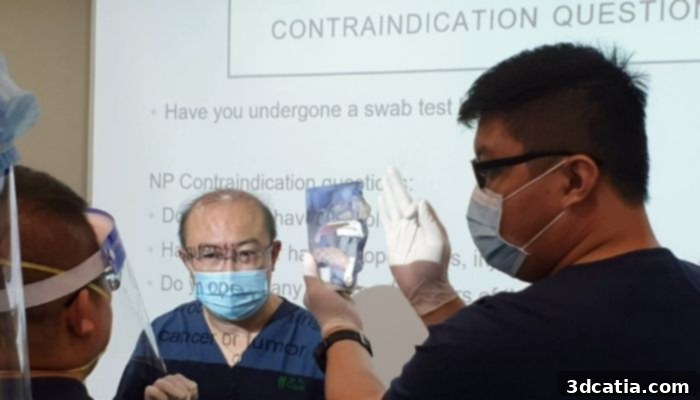
Non-medical personnel training with a 3D-printed medical model of nose/nasal cavity. (Photo Credit: Creatz3D)
Advanced 3D Printed Medical Model for Enhanced Training Accuracy
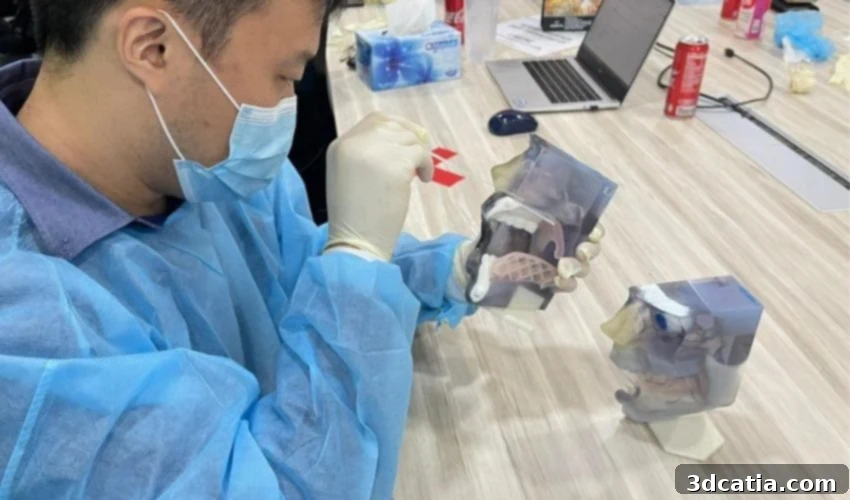
The innovative 3D-printed medical model developed through this strategic collaboration stands as a cornerstone of the comprehensive training program. This meticulously designed, life-sized anatomical replica provides an unparalleled level of realism, enabling trainees to engage with a physiologically accurate representation of the human nasal and oral cavities. Through hands-on, experiential interaction with this advanced training aid, participants gain a thorough and nuanced understanding of the intricate anatomical features of the nose and nasal cavity, including the nasal septum, the superior, middle, and inferior turbinates, and the delicate structures leading to the nasopharynx. This detailed visual and tactile learning is absolutely crucial for accurately identifying key landmarks necessary for correct swab insertion and manipulation, preventing errors and ensuring effective sample collection. Furthermore, the model is ingeniously engineered to simulate possible resistance points that might be encountered during an actual swabbing procedure, allowing trainees to learn how to navigate these challenges gently and effectively, thereby minimizing discomfort, potential injury, and anxiety for the patient.
Beyond achieving anatomical familiarity and procedural precision, the training curriculum utilizing this sophisticated 3D-printed model rigorously focuses on instilling the best practices for gathering an optimal swab sample. This comprehensive instruction includes mastering the correct angle of entry, determining the appropriate depth of insertion for different swab types, and executing the precise technique for rotating the swab to ensure a comprehensive sample collection while consistently maintaining paramount patient safety and comfort. Such detailed, hands-on procedural training is essential for obtaining consistently accurate test results, reducing the likelihood of false negatives, and minimizing the need for inconvenient and costly re-swabbing. This practical model training is seamlessly integrated into Q & M College’s highly regarded COVID-19 Swabbing Proficiency Course. The course is expertly taught by seasoned medical professionals who leverage the realistic model to re-create a high-fidelity, in-person learning experience that mirrors real-world patient interactions. A core tenet of this robust curriculum is the emphatic emphasis on patient-focused interactions, cultivating strong, clear communication skills, and building profound empathy among trainees. Understanding patient anxiety, potential discomfort, and individual sensitivities, and responding with utmost care, reassurance, and professionalism, is deemed as critically important as the technical skill itself in ensuring a positive patient experience.
One of the primary motivations for developing this custom 3D-printed solution stemmed from the identified significant limitations of existing nasal simulators and models commercially available on the market. According to detailed information and extensive research provided by Creatz3D, conventional models proved critically inadequate in several essential areas necessary for comprehensive and effective swabbing training. These inadequacies were particularly evident when simulating the specific anatomical nuances and procedural complexities required for different types of swabs: namely, the nasal mid-turbinate swab, the nasopharyngeal swab (which necessitates deeper insertion into the upper part of the pharynx behind the nose, often requiring a specific angle and depth), and the oropharyngeal swab (also widely known as a throat swab, which targets the back of the throat and often involves managing tongue reflexes). Traditional models frequently lacked the requisite anatomical accuracy, the crucial tactile feedback, and the realistic resilience and tissue compliance needed to adequately prepare trainees for the varied challenges of real-life scenarios, potentially leading to procedural errors, patient discomfort, or even an increased risk of complications.
To comprehensively overcome these identified shortcomings and engineer a truly superior training tool, the collaborative team meticulously referenced a vast and comprehensive library of diverse anatomical models. This extensive data was combined with high-resolution CT and MRI scans expertly provided by AuMed, ensuring an unprecedented level of detail and fidelity. This data-driven, evidence-based approach guaranteed that the resulting 3D-printed model was not merely a generic representation but an anatomically precise replica, faithfully reflecting the true complexities, intricate structures, and natural variations of human anatomy. This unwavering commitment to accuracy allowed for the creation of a model that authentically represents soft tissue compliance, underlying bone structure, and the intricate pathways of the nasal and oral cavities, providing a highly realistic training environment. One of the most innovative and notable features ingeniously integrated into the nasal model is its unique ability to provide bouncing feedback from the tongue when simulating the crucial use of a tongue depressor. This seemingly small yet incredibly significant detail is vital, as it trains individuals to manage patient reflexes, correctly position the tongue depressor for effective visualization, and perform comfortable and accurate throat swabbing, precisely mimicking a critical physiological response encountered in actual patient interactions.
Beyond its remarkable anatomical precision and functional realism, the speed of development for this 3D-printed medical model presented a monumental advantage, especially crucial during a rapidly evolving global health crisis. Using traditional manufacturing methods for such a complex, highly detailed, and anatomically accurate replica would typically have required many months of intensive work, involving laborious mold creation, precise casting processes, and intricate assembly. However, thanks to the inherent efficiency, agility, and rapid prototyping capabilities of advanced 3D printing technology, the entire project, encompassing everything from initial CAD designing and iterative prototyping to final printing and meticulous post-processing, was completed in an astonishingly short timeframe of only 5 working days. This unparalleled rapid turnaround capability meant that essential, high-quality training tools could be designed, produced, and deployed swiftly, allowing Q & M Dental Group to significantly accelerate their training initiatives and contribute rapidly and effectively to the broader public health response. This project serves as a compelling and exemplary case study for how additive manufacturing can revolutionize the development cycle of critical medical training aids, making cutting-edge education more accessible, responsive, and adaptable to immediate global needs and emerging health challenges.
The profound implications of this successful and innovative project extend far beyond specific COVID-19 swabbing training. The demonstrated ability to rapidly design and produce highly realistic, functionally accurate anatomical models using advanced 3D printing technology opens entirely new avenues for medical education across a vast array of specialties. This groundbreaking approach can significantly improve the quality and effectiveness of training for medical students, nursing professionals, and allied health professionals alike, providing them with invaluable hands-on, risk-free experience in a safe, controlled environment before they ever interact with live patients. Whether it involves practicing intricate surgical techniques, gaining a deeper understanding of complex organ systems, or refining diagnostic procedures, 3D-printed medical models offer a highly cost-effective, customizable, and infinitely repeatable solution that dramatically enhances learning outcomes and ultimately contributes to safer, more efficient, and more effective patient care across the entire healthcare spectrum. This exemplary collaboration between Q & M Dental Group, Creatz3D, and AuMed truly embodies a forward-thinking and innovative approach to healthcare education, brilliantly demonstrating how cutting-edge technology can be ingeniously harnessed to meet evolving demands and revolutionize medical training in the 21st century.
For those interested in delving deeper into the specifics of this groundbreaking swab testing training program and exploring the detailed design and technical specifications of the 3D printed nasal model, we encourage you to visit Creatz3D’s dedicated project page. This invaluable online resource provides further insights into the intricate technical aspects and the collaborative process that brought this innovative and highly impactful solution to fruition. You can learn more about this transformative project HERE.
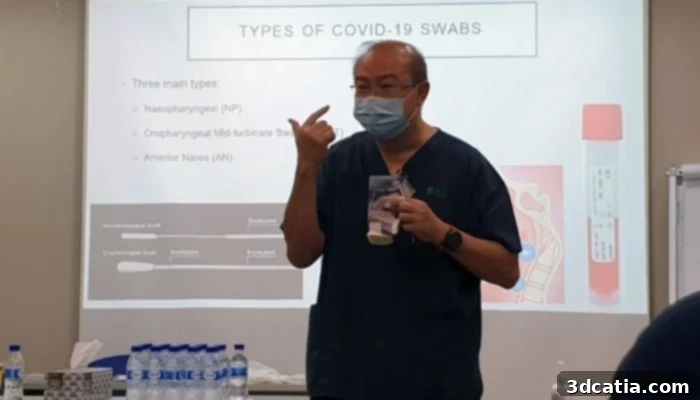
Q & M College’s COVID-19 Swabbing Proficiency Course. (Photo Credit: Creatz3D)
What are your thoughts on the groundbreaking advancements exemplified by this innovative 3D-printed nasal model for critical medical training? We warmly invite you to share your valuable insights and informed opinions in a comment below, or engage with us on our vibrant social media platforms like Facebook and Twitter. Your perspective is highly valued as we continue to explore and report on the cutting edge of additive manufacturing and its ever-expanding applications in various industries. Furthermore, to stay consistently abreast of all the very latest developments, pioneering innovations, and crucial news in the dynamic and rapidly evolving world of 3D printing, don’t forget to sign up for our comprehensive and completely free weekly newsletter, which delivers all the essential updates directly to your inbox!
Cover Photo Credit: Creatz3D