
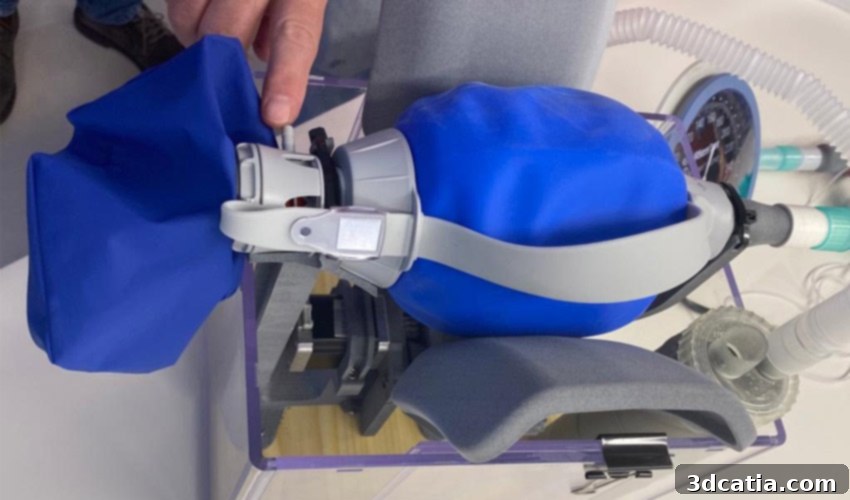
Spain Leads with First Medically Approved 3D Printed Emergency Respirator Amidst Global Health Crisis
In a pivotal moment for healthcare innovation and additive manufacturing, Spain has achieved a significant milestone: the development and medical approval of its first 3D printed emergency respirator. This groundbreaking device emerges as a beacon of hope, designed specifically to bolster hospitals and intensive care units grappling with the immense pressures of the ongoing health crisis. A formidable consortium, bringing together diverse expertise from industry and healthcare, spearheaded this initiative. Key players include the Consorci de la Zona Franca (CZFB), global technology giant HP, the innovative Leitat Technology Centre, automotive leader SEAT, the Consorci Sanitari de Terrassa (CST), and the Parc Taulí Hospital in Sabadell. Together, they have engineered a sophisticated yet rapidly deployable 3D printable respirator. This critical emergency device is engineered to provide vital respiratory support to patients for short durations, offering a crucial lifeline when conventional ventilators are scarce. The ambitious goal of this alliance is to swiftly industrialize its production, aiming to manufacture hundreds of these life-saving units daily to meet urgent demand, demonstrating the profound potential of additive manufacturing in crisis response.
The Global 3D Printing Community’s Response and the Quest for Validation
The global 3D printing community has demonstrated an unprecedented mobilization in response to widespread shortages of essential medical equipment. Across continents, countless initiatives have sprung up, dedicated to developing 3D printed masks, protective goggles, and face shields. While these grassroots efforts highlight the ingenuity and rapid prototyping capabilities of additive manufacturing, many have unfortunately struggled with a fundamental hurdle: medical validation. Enthusiasts with personal 3D printers have enthusiastically contributed to the production of 3D printed protective masks, for instance. However, concerns regarding their efficiency, long-term durability, and, most critically, patient safety often remain unconfirmed. The medical profession operates under stringent regulations, necessitating rigorous validation for any equipment used, regardless of supply chain pressures. This imperative ensures that patient care is never compromised and that devices meet specific performance and safety standards. In this critical context, the Spanish initiative stands out, having successfully navigated the complex path to producing a medically approved device, thus setting a benchmark and paving the way for its significant impact on a large scale. This achievement underscores the importance of combining rapid manufacturing with stringent medical oversight.
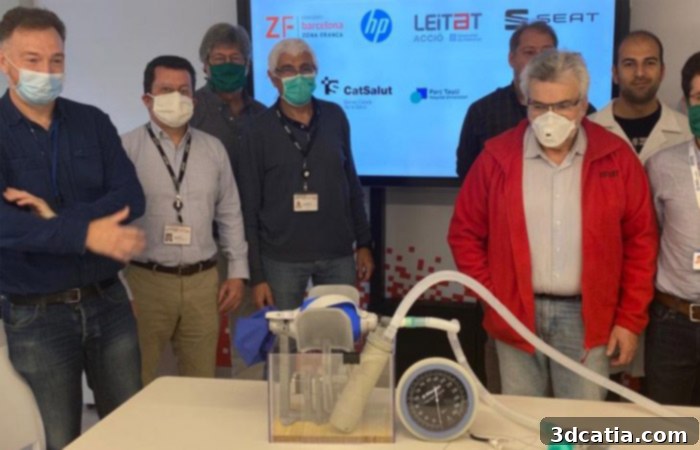
The collaborative project brought together several key partners from technology, industry, and healthcare, showcasing the power of multidisciplinary teamwork.
Engineering the Leitat 1: Design, Simplicity, and Rigorous Medical Scrutiny
At the heart of this innovation lies the Leitat Technology Centre, which meticulously developed the 3D model for this emergency breathing device. Christened “Leitat 1,” this pioneering field device exemplifies a philosophy of radical simplification and robust functionality. Its design purposefully reduces the number of necessary components, streamlining the assembly process for rapid deployment in high-pressure environments where time is of the essence. The intricate design was ingeniously conceived by Mr. Magí Galindo, a talented engineer at the Spanish centre, whose vision prioritized both efficacy and ease of production. Following its initial development, the device underwent rigorous medical validation by Dr. Lluís Blanch, the distinguished Director of Innovation at the Parc Taulí Hospital in Sabadell, a renowned expert in mechanical ventilation. His extensive experience and critical assessment were instrumental in ensuring the device met crucial medical standards for safety and performance. The very first prototype was brought to life using cutting-edge 3D printing technology, leveraging the advanced machines available across the various project partners. This collaborative manufacturing approach allowed the team to meet all the demanding requirements and functionalities expected of a life-supporting medical device in an emergency context. Leitat anticipates a production capacity of between 50 and 100 units daily, with operations commencing immediately. Indeed, production has already begun, and the consortium is not resting on its laurels; the different partners are already actively engaged in developing a second iteration, the “Leitat 2,” which aims to align even more closely with the stringent regulations set forth by the Spanish Agency for Medicines and Medical Devices, promising an even more robust and widely applicable solution for long-term use.
Scaling Up Production: A Collaborative Effort for Rapid Deployment
The ability to scale production rapidly is paramount in a public health crisis, and the Spanish consortium has risen to this challenge with remarkable speed and efficiency. Manel Balcells, Health Commissioner at the Leitat Technology Centre, eloquently summarized the device’s immediate role and potential: “This is an emergency respirator, designed for an emergency situation, leveraging 3D technologies and integrating other readily available market components. Its assembly is exceptionally fast, allowing us to produce approximately 100 units per day, and I am optimistic that this number will significantly increase in the days to come.” This statement underscores both the urgency of the situation and the innovative, adaptive approach taken to address it. The consortium has actively sought and successfully engaged additional companies across Spain to bolster the 3D printing capacity required for this device. Major industrial groups like Navantia and Airbus have generously responded to this call, lending their sophisticated 3D printing machines and invaluable technical expertise to the project. This demonstration of corporate solidarity and shared purpose highlights the profound collaborative spirit driving this initiative, showcasing how industry can pivot quickly to support critical national needs. The project remains open to further support; interested organizations wishing to contribute their resources or expertise are encouraged to contact the consortium directly HERE. This concerted effort exemplifies how rapid manufacturing techniques, combined with cross-sector collaboration, can dramatically accelerate the deployment of critical medical solutions during times of unprecedented crisis, effectively bridging gaps in traditional supply chains.

The innovative 3D model for the emergency respirator was meticulously designed by a Leitat engineer and underwent crucial validation by a medical expert specializing in mechanical ventilation.
Beyond Spain: Global Initiatives and the Future of Additive Manufacturing in Healthcare
The Spanish success story with the Leitat 1 respirator is not an isolated incident but rather a prominent example of a worldwide movement to leverage additive manufacturing for public health. This global mobilization underlines the transformative potential of 3D printing to address supply chain vulnerabilities and accelerate medical device development during crises. From localized efforts producing essential Personal Protective Equipment (PPE) to international challenges spurring ventilator innovation, the additive manufacturing community is demonstrably at the forefront of this global response. For instance, in Canada, the Montreal General Hospital Foundation, Code Vie, in partnership with the Research Institute of the McGill University Health Centre (RI-MUHC), has launched an ambitious global innovation challenge. This initiative, aptly named the Code Vie Ventilator Challenge, aims to consolidate and structure the myriad of smaller, often fragmented, initiatives emerging within the AM community. It extends an open invitation to designers, scientists, engineers, and manufacturers worldwide to conceive and develop ventilation systems that are not only simple and accessible but also exceptionally easy to manufacture, regardless of whether they employ additive or subtractive manufacturing methods. The challenge provides a vital platform for collecting and evaluating diverse solutions, fostering a collaborative ecosystem dedicated to solving critical medical needs with innovative and scalable designs. Applications for this significant challenge are being accepted until the 31st of March, offering a prime opportunity for innovators to submit their groundbreaking respirator models and contribute to a global pool of life-saving technologies. You can apply to the challenge HERE. This global exchange of ideas and technologies, exemplified by both the Spanish consortium and the Code Vie Challenge, is fundamentally reshaping how medical devices are designed, produced, and deployed in urgent situations, highlighting a paradigm shift towards agile, resilient, and collaborative healthcare solutions for a more secure future.
The Enduring Impact of Rapid Innovation and Collaboration in Healthcare
The development and rapid deployment of the Leitat 1 emergency 3D printed respirator in Spain represents far more than just a temporary solution to a critical shortage; it signifies a landmark achievement in the convergence of advanced manufacturing, inter-organizational collaboration, and medical exigency. This initiative sets a powerful precedent, demonstrating that with strategic partnerships, rigorous medical validation, and the inherent agility of additive manufacturing, life-saving innovations can move from concept to mass production with unprecedented speed. The commitment to further develop the Leitat 2 model, adhering to even stricter regulatory standards, illustrates a forward-thinking approach that aims for sustained impact beyond the immediate crisis. This forward momentum ensures that the lessons learned translate into long-term improvements in medical device design and production capabilities. As the world continues to grapple with various health challenges, the invaluable lessons learned from projects like Spain’s 3D printed respirator and Canada’s Code Vie Challenge will serve as blueprints for future responses. They underscore the critical need for robust ecosystems that can foster rapid innovation, ensure medical safety through stringent validation, and facilitate scalable production, ultimately leading to more resilient and responsive healthcare systems globally.
What are your thoughts on this emergency 3D printed respirator and its potential impact on future healthcare challenges? How do you envision the 3D printing community further contributing to global health initiatives, particularly in times of crisis? We invite you to share your insights and ideas in a comment below or engage with us on our Facebook and Twitter pages! For all the latest news and developments in 3D printing, including more stories of innovation and community response, don’t forget to sign up for our free weekly Newsletter, delivered straight to your inbox!