
Weekly 3D Printing Insights: Top 5 Additive Manufacturing Videos You Can’t Miss
Another dynamic week in the world of additive manufacturing has concluded, and as is our Sunday tradition, we’ve curated a compelling list of the top 5 videos to keep you informed and inspired! This week’s selection dives deep into some of the most fascinating aspects of 3D printing, catering to both seasoned enthusiasts and newcomers alike. Our journey begins with an in-depth exploration of Fused Deposition Modeling (FDM) technology, widely recognized as the most accessible and popular process among 3D printing hobbyists and professionals. Following this, we’ll take you inside the AMcubator, an innovative hub entirely dedicated to fostering advancements in additive manufacturing. You’ll also witness the incredible progress in construction 3D printing, specifically observing the foundation of a 3D printed house taking shape. We then shift our focus to industrial applications, showcasing FreeForm’s optimal utilization of Desktop Metal’s advanced Production System for metal binder jetting. Finally, prepare to be mesmerized by a timelapse video demonstrating the intricate production of a functional mechanical 3D model. We genuinely hope you enjoy this week’s top 5 videos and wish you a wonderfully relaxing Sunday!
Top 1: FDM Technology: The Foundation of Desktop 3D Printing
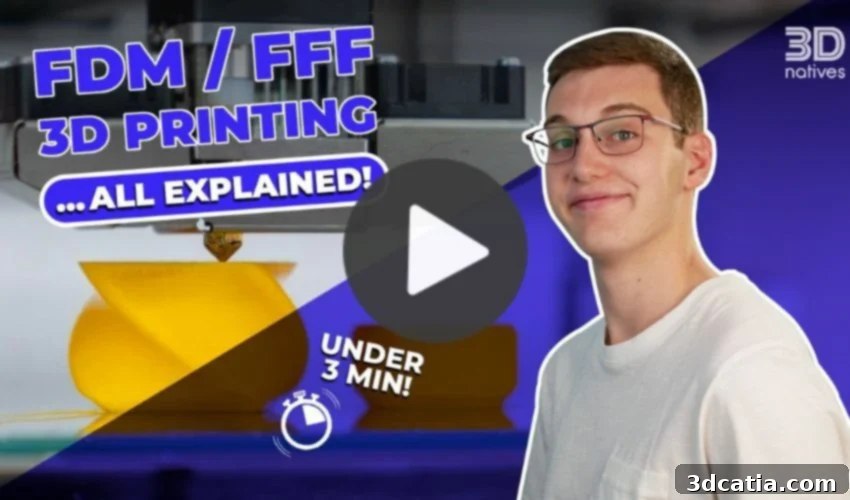
Fused Deposition Modeling (FDM), often interchangeably referred to as Fused Filament Fabrication (FFF), stands as the most prevalent and user-friendly 3D printing technology available today. Its widespread adoption stems from its relative affordability, ease of operation, and versatility, making it the gateway for millions into the additive manufacturing world. Developed by S. Scott Crump in the late 1980s and subsequently commercialized by Stratasys in 1990, FDM operates on a fundamental principle: heating a thermoplastic filament to its melting point and extruding it layer by layer onto a build plate to construct a three-dimensional object. The process relies on three primary components: a heated print bed (or platform) that ensures proper adhesion and minimizes warping, a spool of thermoplastic filament which serves as the raw material, and an extrusion head, commonly known as an extruder, equipped with a nozzle that precisely deposits the molten material. This technology supports a vast array of materials, including common plastics like PLA (Polylactic Acid) and ABS (Acrylonitrile Butadiene Styrene), as well as more advanced engineering filaments such as PETG, Nylon, and even composites infused with carbon fiber or wood particles. FDM printers are extensively used for rapid prototyping, creating functional parts, manufacturing jigs and fixtures, educational purposes, and even producing end-use consumer products. While celebrated for its accessibility, FDM does present certain limitations, such as visible layer lines, potential for anisotropic properties (varying strength depending on print orientation), and slower production speeds for highly complex geometries compared to some other AM processes. However, ongoing innovations continue to push the boundaries of FDM, improving print quality, speed, and material capabilities. In the video below, 3Dnatives provides an excellent visual and detailed explanation of how FDM technology functions, breaking down each step of the printing process:
Top 2: AMcubator: A Dedicated Hub for Additive Manufacturing Innovation
Innovation thrives in collaborative environments, and the AMcubator exemplifies this principle by serving as a cutting-edge center entirely focused on advancing additive manufacturing technologies. Spanning an impressive 1100 square meters, this state-of-the-art facility is strategically located on the renowned Brainport Industries campus in Eindhoven, the Netherlands – a region celebrated for its high-tech industry and collaborative ecosystem. The AMcubator provides a unique platform for 3D printing companies, enabling them to bring together their top experts within a specialized application center. This center is seamlessly integrated with a pilot plant where their advanced equipment is housed, creating a powerful synergy between research, development, and practical application. By fostering this close integration of the entire additive manufacturing value chain, from material science to design, printing, and post-processing, the AMcubator plays a pivotal role in accelerating market entry for innovative applications. Its mission extends beyond mere research; it actively works to optimize existing additive manufacturing processes, refine material properties, and significantly enhance the competitiveness of 3D printing technologies across various industries. This collaborative model not only drives technological breakthroughs but also nurtures a vibrant community of specialists, ensuring that additive manufacturing continues to evolve and address complex industrial challenges. The facility serves as a beacon for industrial partners looking to leverage the full potential of AM, offering resources for prototyping, small-batch production, and advanced process validation. The following video offers a compelling glimpse into the AMcubator’s operations, illustrating its commitment to pushing the boundaries of what’s possible with additive manufacturing:
TOP 3: The Foundation of a 3D Printed House: Revolutionizing Construction
The construction industry is experiencing a paradigm shift with the advent of construction 3D printing (C3DP), a technology that promises to revolutionize how we build structures. This week, we highlight a remarkable project in Denmark, where the Danish additive manufacturing construction company 3DCP Group, in close collaboration with the globally recognized 3D printing and construction solutions provider COBOD, has successfully 3D printed a compact yet fully functional house. This innovative dwelling, spanning 37 square meters, ingeniously incorporates all essential living spaces: a comfortable bathroom, an open-plan kitchen, a welcoming living room, and a serene bedroom. What makes this project particularly significant is not just the creation of a complete home, but the focus on the foundational elements, which are crucial for structural integrity and longevity. COBOD, renowned for its advanced BOD2 construction 3D printer, brings its expertise to the forefront, enabling the rapid and precise fabrication of the building’s base. Construction 3D printing offers numerous advantages over traditional methods, including significantly reduced construction times, lower labor costs, enhanced design freedom for complex architectural geometries, and often a more sustainable approach due to optimized material usage and reduced waste. Projects like this demonstrate the immense potential of C3DP to address pressing global challenges such as housing shortages, particularly in areas requiring rapid deployment or customized solutions. Furthermore, the ability to automate the construction of foundational elements paves the way for faster overall project completion and consistent quality. Witness the groundbreaking work on the foundation, expertly designed and executed by COBOD, in the compelling video below:
Top 4: FreeForm Technologies and The Power of Desktop Metal’s Production System
The realm of metal additive manufacturing is constantly evolving, with Binder Jetting technology emerging as a frontrunner for high-volume, cost-effective production of complex metal parts. FreeForm Technologies, an agile American startup, is at the forefront of this evolution, leveraging Metal Binder Jetting (MBJ) as a contract manufacturer to deliver innovative solutions for its diverse clientele. In the featured video, FreeForm Technologies eloquently articulates how they harness the unparalleled capabilities of the Production System™ developed by Desktop Metal. This advanced system is not merely a piece of machinery; it represents a significant leap forward in metal 3D printing, enabling FreeForm to push the boundaries of customer innovation and demonstrate the myriad ways this device can be optimally utilized across various applications. Metal Binder Jetting works by selectively depositing a liquid binder onto a thin layer of metal powder, bonding the particles together layer by layer to form a “green part.” This part is then sintered in a furnace, where the binder burns away and the metal particles fuse into a dense, solid component. Key advantages of MBJ include its impressive speed, ability to produce complex geometries without the need for traditional support structures (as the surrounding powder acts as support), and a wide selection of metal alloys. FreeForm’s primary objective is to make binder jetting technology accessible and understandable to a broader audience, demonstrating its potential for industrial-scale manufacturing beyond niche applications. By partnering with Desktop Metal and utilizing their robust Production System, FreeForm is not only meeting the demanding requirements of industries like automotive, aerospace, and consumer electronics but also actively educating the market on the transformative power of this high-throughput, low-cost metal 3D printing solution. The video provides valuable insights into their operational workflow, highlighting the precision, efficiency, and versatility that the Desktop Metal Production System brings to their contract manufacturing services, ultimately driving down costs and accelerating time-to-market for complex metal components.
Top 5: Mechanical 3D Model in Timelapse: The Magic of Print-in-Place
Our final video offers a captivating and often mesmerizing glimpse into the production of a mechanical 3D model, presented in an accelerated timelapse format. What makes this particular demonstration truly compelling is the inherent mechanical functionality of the printed object. This segment highlights a marvel of additive manufacturing known as “print-in-place” or “ready-to-use” mechanisms. The core principle behind such designs is the ability to fabricate complex, multi-part assemblies as a single, contiguous object, directly within the 3D printer, eliminating the need for any subsequent assembly. In the case shown, a classic wind-up teeth toy is brought to life. Upon completion of the printing process, and without requiring any additional support material removal or post-processing, the object emerges fully functional. All its gears, springs, and interlocking components are perfectly aligned and ready for immediate use, directly out of the build chamber. This capability represents a significant advantage in rapid prototyping, as it drastically reduces the time and effort typically associated with assembling multi-component parts. For designers and engineers, print-in-place designs offer unparalleled freedom to create intricate mechanical systems that would be challenging, if not impossible, to produce using traditional manufacturing methods. Furthermore, it simplifies the supply chain by reducing part count and offers opportunities for innovative product designs where integration and immediate functionality are paramount. The timelapse format itself is not just aesthetically pleasing; it vividly demonstrates the layer-by-layer additive process, allowing viewers to appreciate the precision and ingenuity involved in fabricating such a sophisticated, fully functional mechanical item. This video underscores the profound impact 3D printing has on product design and manufacturing, showcasing how it can deliver complex, functional parts directly from digital design to physical reality with unprecedented efficiency.
We hope this week’s collection of top 3D printing videos has provided valuable insights and sparked your interest in the ever-evolving world of additive manufacturing. What were your thoughts on FDM technology’s applications, or the impressive strides in construction 3D printing? Perhaps the industrial efficiency of metal binder jetting or the clever design of print-in-place mechanical models captured your imagination? We encourage you to share your perspectives and engage with our community! Let us know your thoughts in a comment below or connect with us on our LinkedIn, Facebook, and Twitter pages. To stay truly current with all the latest developments, breaking news, and exclusive insights from the 3D printing industry, don’t forget to sign up for our free weekly Newsletter here, delivered straight to your inbox. You can also explore our extensive library of videos and subscribe to our YouTube channel for more engaging content. Until next week, keep innovating!