
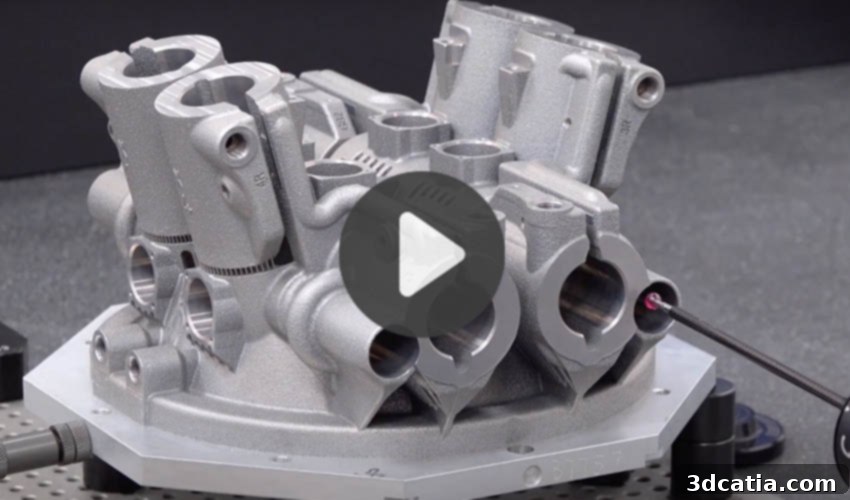
Top 5 Revolutionary 3D Printing Videos: Unveiling Manufacturing’s Future
The world of additive manufacturing is constantly evolving, pushing the boundaries of what’s possible across countless sectors. From intricate medical devices to robust automotive components, 3D printing technology is not just a tool, but a catalyst for innovation, redefining production processes globally. This week, we’ve curated a collection of five compelling videos that showcase some of the most exciting developments and insights in the 3D printing landscape. These selections highlight breakthroughs in printer technology, the power of digital collaboration, advancements in industrial applications, the inspiring journey of an entrepreneur, and the essential principles behind designing for optimal 3D printability. Prepare to delve into the forefront of manufacturing, uncover groundbreaking solutions, and gain a deeper understanding of how additive manufacturing is shaping our future. If you find these features intriguing, remember that an even broader selection of 3D printing videos awaits on our Youtube channel. We hope you enjoy this insightful journey into the heart of innovation!
Top 1: Stratasys J55 – A New Era for Desktop 3D Printing
Leading additive manufacturing solutions provider, Stratasys, recently unveiled its revolutionary J55 3D printer, a compact desktop solution designed to bring the power of PolyJet technology directly to designers’ workstations. This innovative machine represents a significant leap forward in accessibility and efficiency for product development. Based on Stratasys’s renowned PolyJet technology, the J55 offers unparalleled capabilities for creating highly realistic, full-color prototypes and concept models with exceptional surface finish and intricate detail. This technology allows for the simultaneous printing of multiple materials, enabling designers to achieve complex geometries, varied textures, and vibrant color gradients in a single print job. The J55 is specifically engineered to empower designers, engineers, and educators to rapidly iterate on their ideas, transforming digital designs into tangible objects with unprecedented speed and fidelity.
What truly sets the J55 apart is its innovative rotating print platform combined with a fixed print head. This unique design not only makes the printer more compact and office-friendly but also significantly enhances print speed and operational reliability. Designers can now produce multiple iterations of parts or even different components for an assembly in a fraction of the time, dramatically accelerating the design validation process. This streamlined workflow allows for crucial design decisions to be made earlier, reducing costly errors and shortening product development cycles. The introduction of the J55 underscores Stratasys’s commitment to making advanced additive manufacturing more pervasive and user-friendly, catering to a broad spectrum of creative professionals who demand precision, versatility, and efficiency. Deliveries for this exciting new printer were scheduled to commence in July 2020, marking a pivotal moment for desktop prototyping.
Top 2: The Digital Additive Manufacturing Marathon (DAMM 2020)
In a testament to the adaptability and resilience of the additive manufacturing community, the Digital Additive Manufacturing Marathon (DAMM 2020) emerged as a groundbreaking event, bringing together thousands of industry professionals in a unique virtual setting. DAMM 2020 was heralded as the first digital marathon specifically dedicated to additive manufacturing, brilliantly designed to overcome the limitations posed by global restrictions on physical gatherings and traditional trade exhibitions. The premise was elegantly simple yet remarkably effective: for an uninterrupted period of 26.2 hours – mirroring the length of a traditional marathon – participants from across the globe engaged in a rich program of conferences, workshops, and interactive networking sessions. This innovative format ensured that knowledge exchange, critical discussions, and peer-to-peer interaction remained vibrant and accessible, even when in-person events were not possible.
The success of DAMM 2020 was undeniable, attracting over 2,000 participants representing 85 different countries. This impressive global reach serves as powerful evidence of the critical importance of communication and collaboration within the additive manufacturing sector. In an industry characterized by rapid innovation and complex technological advancements, opportunities for professionals to connect, share insights, and learn from experts are invaluable. By providing a robust digital platform, DAMM 2020 not only facilitated these crucial interactions but also democratized access to cutting-edge information and networking opportunities for a far wider audience than a traditional event could ever hope to reach. Organizations like 3Dnatives played a pivotal role in organizing and championing this initiative, ensuring that the spirit of innovation and community continued to thrive. The overwhelming positive response and significant turnout undoubtedly paved the way for future digital events, demonstrating that the industry is ready to embrace new models of engagement. We encourage you to watch the welcome message from the show’s organizers to grasp the full scope of this pioneering event and stay tuned for announcements regarding its much-anticipated second edition!
Top 3: Renishaw’s Industrial Metal 3D Printers – Precision in Production
The realm of metal 3D printing is where some of the most transformative applications of additive manufacturing are realized, enabling the creation of high-performance, complex parts that are impossible to produce with traditional methods. UK-based manufacturer Renishaw, a global leader in engineering and scientific technologies, stands at the forefront of this segment, having developed an impressive range of industrial metal 3D printers designed to meet the rigorous demands of advanced manufacturing. Renishaw’s approach goes beyond merely supplying hardware; they offer a comprehensive solution that encompasses the entire additive manufacturing value chain, from initial design and simulation to printing and critical post-processing tools. This holistic strategy ensures that manufacturers can consistently produce high-quality, fully functional metal parts for a diverse array of industries, including aerospace, medical, automotive, and tooling.
At the heart of Renishaw’s metal additive manufacturing portfolio is machines like the RenAM 500Q, a testament to their engineering prowess. The ‘Q’ in its name signifies its quad-laser system, a feature that dramatically increases productivity and build rates compared to single-laser machines. With a generous printing volume of 250 x 250 x 350 mm, the RenAM 500Q is capable of producing a wide range of components, from intricate, lightweight aerospace structures to robust, custom medical implants. The ability to precisely control the laser melting process allows for the creation of parts with superior mechanical properties, excellent surface finish, and minimal internal stresses. Renishaw’s integrated software solutions further empower users to optimize print parameters, monitor the build process in real-time, and ensure repeatable results. By offering such advanced systems, Renishaw is not just selling 3D printers; they are providing the foundational tools necessary for industries to embrace industrial-scale additive manufacturing, driving innovation and efficiency in high-value component production.
Top 4: The Entrepreneurial Spirit: Adopting 3D Printing for Business
One of the most inspiring aspects of additive manufacturing is its potential to empower individuals and small businesses, fostering an entrepreneurial spirit that can transform passion into profit. The story of Pam from Youngstown, Ohio, beautifully exemplifies this. With over 30 years of experience in various aspects of additive manufacturing, Pam possessed a deep understanding of the technology’s capabilities and its immense potential. In a bold move approximately ten years ago, she decided to harness her extensive expertise and venture into the world of entrepreneurship by opening her own contract 3D printing business. This decision marked a significant transition from being an employee in the additive manufacturing space to becoming a proprietor, offering specialized 3D printing services to a range of clients.
The video, shared by re:3D, delves into Pam’s remarkable journey, highlighting how she initially established her business by installing 3D printers in the basement of her home. This humble beginning underscores the increasing accessibility of 3D printing technology, allowing individuals to start specialized manufacturing operations with a relatively low barrier to entry. Pam’s success story is a powerful narrative for aspiring entrepreneurs, demonstrating that with expertise, dedication, and the right tools, it’s possible to build a thriving business even from a home-based setup. Her contract 3D printing business likely serves a diverse clientele, from local inventors and small businesses needing prototypes to larger companies requiring short-run production or specialized custom parts. Such ventures play a crucial role in the broader additive manufacturing ecosystem, providing essential services and democratizing access to advanced fabrication capabilities. Her journey not only highlights personal achievement but also mirrors a larger trend of decentralized manufacturing and the rise of service bureaus that cater to a growing demand for on-demand 3D printing. Learn more about Pam’s inspiring transition and her unique business model in the video below!
Top 5: Mastering Design for Additive Manufacturing (DfAM)
While 3D printing offers unprecedented design freedom, simply using a 3D printer isn’t enough to unlock its full potential. The way a part is designed fundamentally differs depending on the manufacturing process. A component destined for traditional machining, for instance, is conceived with subtractive processes in mind, adhering to specific constraints like tool access and material removal. In stark contrast, designing for additive manufacturing (DfAM) requires a completely different mindset and set of techniques, tailored to leverage the unique capabilities of layer-by-layer fabrication. DfAM is a critical discipline focused on creating optimized designs that not only maximize the functional performance of the part but also reduce cost, enhance reliability, and improve overall product lifecycle considerations.
The core objective of DfAM is to move beyond simply replicating traditionally manufactured parts with 3D printing. Instead, it encourages engineers and designers to rethink component structures from the ground up, embracing geometries previously impossible to achieve. Several advanced techniques fall under the DfAM umbrella, each offering distinct advantages:
- Generative Design: This innovative approach uses artificial intelligence and machine learning algorithms to autonomously generate numerous design variations based on defined parameters such as load conditions, material properties, and manufacturing constraints. The software explores thousands of potential solutions, often resulting in highly optimized, organic-looking geometries that surpass human intuition.
- Topology Optimization: A mathematical method that optimizes material distribution within a given design space for a set of loads, boundary conditions, and constraints. The goal is to maximize the performance of a structure (e.g., stiffness or strength) by systematically removing material from areas that contribute least to its structural integrity, leading to significant weight reduction without compromising strength.
- Lattice Structures: These intricate, repeating cellular structures can be integrated into a part’s interior, offering exceptional strength-to-weight ratios, improved energy absorption characteristics, and enhanced thermal management properties. Lattice structures are particularly valuable for lightweighting applications in aerospace and medical implants, where both performance and weight are critical.
By employing these DfAM strategies, designers can achieve remarkable improvements in part performance, consolidate multiple components into a single print, reduce material consumption, and create bespoke parts perfectly tailored to specific applications. Understanding and implementing DfAM principles is paramount for anyone looking to truly innovate with 3D printing. Educational institutions like MIT, with their “Additive Manufacturing for Innovative Design and Production” course, are crucial in disseminating this knowledge, equipping the next generation of engineers and designers with the skills necessary to harness the transformative power of additive manufacturing.
We hope this curated selection of videos has offered you valuable insights into the dynamic world of 3D printing and additive manufacturing. From desktop innovations making advanced prototyping more accessible to the sophisticated realm of industrial metal production, and from inspiring entrepreneurial journeys to the essential principles of design optimization, these examples underscore the immense breadth and impact of this transformative technology. The continuous evolution of 3D printing promises even more exciting breakthroughs in the near future, further cementing its role as a cornerstone of modern manufacturing. What are your thoughts on these applications and the future direction of 3D printing? We encourage you to share your comments below or engage with us on our Facebook and Twitter pages! To ensure you stay at the forefront of all the latest news, trends, and innovations in the 3D industry, don’t forget to sign up for our free weekly Newsletter, delivered straight to your inbox.