
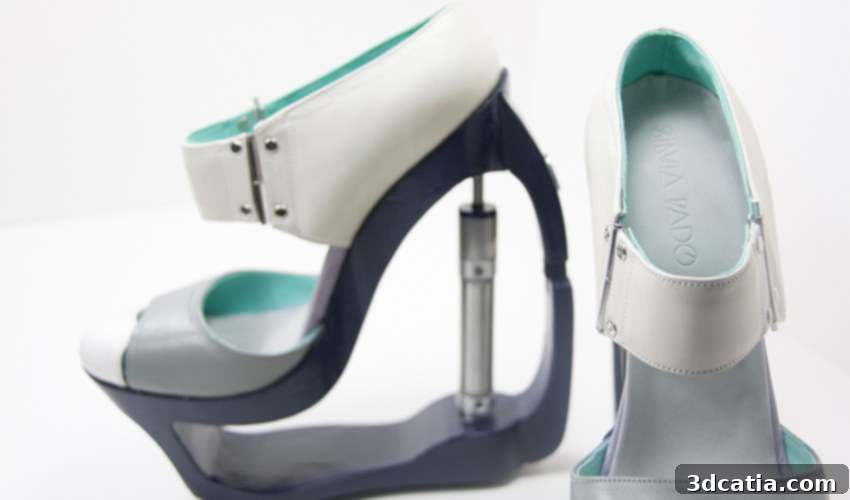
Silvia Fado: Pioneering the Future of Footwear Design with 3D Printing
The rapid evolution of 3D printing technology continues to reshape numerous industries, and its integration into the realm of fashion is particularly transformative. From bespoke garments to intricate accessories, additive manufacturing is opening new avenues for creativity and production. This revolutionary trend has significantly extended its reach into the shoe industry, where designers are harnessing its capabilities to redefine traditional footwear concepts. At the forefront of this innovation is Silvia Fado, a visionary designer whose eponymous brand, established in 2012, exemplifies the harmonious blend of technology and artistry. Enriched by a diverse professional background, which includes foundational knowledge in architecture and practical experience in knitwear design, Silvia Fado approaches footwear design with a uniquely creative and multidisciplinary perspective. Her work is not just about making shoes; it’s about engineering wearable art that challenges conventions. Eager to delve deeper into the impact and potential of 3D printing in footwear, we reached out to Silvia Fado to gather her invaluable insights on this fascinating subject. Her expertise offers a compelling glimpse into the methodologies, challenges, and boundless opportunities presented by this cutting-edge technology.
Meet Silvia Fado: My Journey into Footwear Innovation and 3D Printing Integration
My educational journey began with a rigorous study of architecture at La Salle (Ramón Llull) in Barcelona, a discipline that instilled in me a profound understanding of structural integrity, form, and spatial relationships. Following this, I pursued a degree in Fashion at ESDI, also in Barcelona, which broadened my artistic scope and introduced me to the dynamic world of design. My initial professional experience led me to work for a prominent international retailer, where I gained practical insights within their knitwear department. This period was invaluable for developing my commercial awareness and understanding of mass production. However, my enduring passion for shoes eventually guided me to specialize in footwear. To further my expertise, I undertook a postgraduate MA in Fashion Footwear at the prestigious London College of Fashion (Cordwainers), where I graduated with Distinction. It was at Cordwainers that I had the privilege of mastering traditional shoemaking techniques under the guidance of the renowned and exceptionally talented Paul Thomas. Today, my distinctive approach to design is characterized by a deliberate synergy: I seamlessly integrate high technology, particularly rapid prototyping techniques like 3D printing, with the time-honored artistry of traditional shoemaking.
As the CEO and Head Footwear Designer of my own brand, Silvia Fadó, which I established in 2012, our core philosophy is rooted in innovation and engineering. Every collection we develop is the product of intensive collaboration with a diverse team of specialists, including architects who inform structural concepts, engineers who ensure functional precision, chiropodists who provide insights into foot health, and even vascular surgeons who contribute to ergonomic and comfort considerations. This interdisciplinary approach ensures that our footwear is not only aesthetically groundbreaking but also meticulously crafted for optimal performance and wearer well-being. The Silvia Fadó brand has achieved international recognition, proudly showcasing collections in major fashion hubs such as New York, London, and Paris, as well as in cultural centers like St Petersburg, Eindhoven in the Netherlands, Madrid, and Barcelona. Our designs have also been featured in numerous influential fashion publications globally, affirming our position at the forefront of innovative footwear design. In every aspect of our creative and production process, 3D printing and other advanced 3D technologies are indispensable. They form an integral part of both our rapid prototyping phases and our final production workflows, enabling us to translate complex visions into tangible, high-quality footwear.
Initiation into Additive Manufacturing: How 3D Printing Became a Core Tool
My introduction to 3D printing technology was a pivotal moment during my Master’s program at the London College of Fashion. It was a period dedicated to profound exploration and experimentation, where I diligently investigated various additive manufacturing technologies. My objective was to identify which specific methods, materials, and machinery were most appropriate and beneficial for the unique demands of footwear design and construction. This hands-on research was instrumental in building a foundational understanding of the capabilities and limitations of 3D printing in this specialized field. The ability to create physical prototypes directly from digital designs opened up a world of possibilities that traditional methods simply could not match. Today, I am fortunate to own a 3D printer, which has become an indispensable asset in my studio. This direct access to the technology grants me an unparalleled level of creative freedom and agility. It allows me to rapidly transform conceptual ideas into tangible forms, enabling immediate physical assessment and iteration. This eliminates the dependency on external prototyping services, significantly accelerating my design cycles and empowering me to experiment with my most ambitious ideas without constraint, fostering a truly uninhibited creative process.
The Design Process: Integrating 3D Technology for Innovative Shoe Structures
In my design methodology, 3D printing is primarily utilized for the fabrication of complex structural components within my footwear. Specifically, I harness this technology to produce intricate heels, anatomically precise soles, and innovative wedges. This allows for the realization of highly complex geometries, internal lattices, and specialized contours that would be incredibly challenging, if not entirely impossible, to achieve through conventional manufacturing techniques like injection molding or traditional carving. The distinctive appeal of my approach lies in its unique hybrid nature: I seamlessly merge the rapid prototyping and complex geometry capabilities of 3D printing with the enduring artistry and tactile quality of traditional shoemaking. While the foundational and structural elements are digitally designed and additively manufactured, the upper parts of my shoes are meticulously handcrafted by skilled artisans in my studio, employing exquisite fine leather. This deliberate combination of cutting-edge technology and time-honored artisanal craftsmanship not only imbues each product with an “extra value” – a testament to both innovation and tradition – but also ensures a unique tactile and visual experience for the wearer, blending the best of both worlds.
One of the most significant advantages that 3D printing offers for a brand like mine is its exceptional capability to create intricate volumes without the typical burden of minimum production quantity problems. Given that my products are highly unique and often produced in very limited numbers per design, traditional mass manufacturing methods, which rely on economies of scale and costly tooling, would be economically unviable. 3D printing liberates me from these constraints entirely, allowing for bespoke creations, highly customized designs, and small-batch production that perfectly align with my brand’s philosophy of exclusivity, artistic expression, and sustainability through on-demand manufacturing. Furthermore, I am deeply captivated by the burgeoning potential of new materials continuously emerging in the field of additive manufacturing. I find immense joy in experimenting with their diverse characteristics – ranging from varying degrees of flexibility, exceptional strength, and lightweight properties, to unique textures and striking appearances. These material explorations are not just about finding functional components; they are a constant and profound source of creative inspiration, enabling me to envision and actualize novel forms and functions that continually push the boundaries of footwear aesthetics, comfort, and performance.
The Impact of 3D Printing on Footwear Production: Analyzing Pros and Cons
The advent and widespread adoption of 3D printing have undeniably brought about a revolutionary shift in the manufacturing process of shoes, particularly in the crucial initial phase of prototyping. This technology has fundamentally transformed how designers conceptualize, test, and refine new ideas, offering substantial and measurable benefits in terms of both cost and time savings. With 3D printing, designers can generate multiple iterations of a concept quickly and affordably. This allows for extensive experimentation with different shapes, fits, and structural integrations, leading to a much more refined final product. The agility provided by additive manufacturing significantly reduces the lead time from initial design concept to a market-ready prototype, a critical advantage in the highly competitive and fast-paced fashion industry where trends evolve rapidly.
However, like any advanced technology, the integration of 3D printing into footwear production presents its own unique set of challenges and drawbacks. From my practical experience, one notable negative aspect is the printing speed. Producing a single, intricately designed wedge, for example, can often demand almost an entire day of continuous printing. This time constraint can become a significant bottleneck when multiple prototypes or numerous components are required simultaneously, impacting overall production efficiency for larger batches. Another considerable challenge lies in achieving a consistently flawless surface finish, a common issue stemming from the necessity of support material removal. During the printing process, support structures are essential to maintain the structural integrity of complex geometries. However, their subsequent removal can often leave minor imperfections, requiring meticulous post-processing. Attaining a pristine, smooth surface quality, especially with certain materials that are inherently difficult to sand and polish, demands significant additional time, specialized tools, and skilled manual labor to meet the high aesthetic standards expected in luxury footwear.
Despite these acknowledged limitations, the positive aspects of integrating 3D printing into my design and production workflow far outweigh the challenges for a designer focused on innovation, customization, and artistic expression. Foremost among these benefits is the unparalleled freedom of design the technology affords. It empowers me to actualize highly complex, organic, and previously impossible forms that simply cannot be achieved with traditional molding techniques or conventional cutting and shaping processes. This creative liberty enables me to explore entirely new aesthetic territories and continually push the boundaries of shoe architecture and artistic expression. Furthermore, the ability to produce designs directly within my own studio offers immense practical advantages. I receive immediate physical feedback on the tangible manifestation of my concepts, allowing for real-time adjustments and rapid refinements. This agile, iterative process means I can modify and perfect a shape as many times as necessary, ensuring that the final product not only meets but exceeds my exacting standards of design, comfort, and performance. This direct and continuous interaction with the physical prototype dramatically accelerates the entire design cycle and fosters a deeper, more intimate connection with the creative output.
The Future Trajectory: Continued Growth of 3D Printing in the Footwear Industry
Without a doubt, I wholeheartedly foresee a sustained and, indeed, accelerated growth of 3D printing within the footwear industry in the years to come. The potential applications and possibilities are genuinely limitless, continually expanding as the technology matures and becomes more sophisticated. We are already witnessing a significant and enthusiastic adoption of this technology by both established major brands, seeking to enhance their product development and customization capabilities, and by more niche, conceptual, and experimental designers, who leverage it for unparalleled creative freedom. This widespread acceptance across various segments of the industry is a clear indicator of its inherent value, versatility, and disruptive potential. The driving force behind this impressive growth is multifaceted: it stems from continuous and rapid improvements in 3D printing hardware, leading to increased speed, greater precision, higher resolution, and larger build volumes. Concurrently, there is an ever-expanding diversity of materials available for additive manufacturing. These new materials offer enhanced properties such as greater flexibility, superior durability, significantly lighter weight characteristics, and an increasing array of sustainable and recycled options, opening up entirely new avenues for both design aesthetics and functional performance.
Beyond these technical advancements, 3D printing holds immense promise for enabling true personalization and mass customization in footwear. Imagine a future where shoes are perfectly tailored not just to an individual’s precise foot geometry, but also to their unique gait analysis, pressure points, and even specific aesthetic preferences, all produced efficiently and ethically on demand. This paradigm shift towards hyper-personalized production not only dramatically enhances comfort, fit, and performance but also aligns perfectly with a growing global consumer demand for unique, customized, and sustainable products. Furthermore, the technology offers significant advantages in terms of optimizing supply chain efficiency, reducing material waste through additive processes (as opposed to subtractive), and facilitating the potential for localized or on-shoring manufacturing, which can reduce environmental footprint and improve responsiveness. As these capabilities become increasingly accessible, refined, and cost-effective, 3D printing is poised to fundamentally reshape not just how shoes are manufactured, but also how they are conceptualized, distributed, and ultimately experienced by consumers worldwide. The innovation cycle is inherently self-reinforcing, with each new development in materials or printer technology inspiring more daring, functional, and sustainable designs, ensuring a vibrant and continuously expanding role for 3D printing in the future of footwear.
To delve deeper into Silvia Fado’s groundbreaking work and explore her unique design philosophy, we invite you to visit her official website HERE.
What are your thoughts on the revolutionary impact of 3D printing in contemporary footwear design and manufacturing? Share your opinions, insights, and predictions with us in the comments section below, or join the ongoing conversation on our vibrant Facebook and engaging Twitter pages! And to ensure you never miss out on the latest advancements, breaking news, and expert analyses in the dynamic world of 3D printing, be sure to sign up for our free weekly Newsletter, delivered directly to your inbox!