
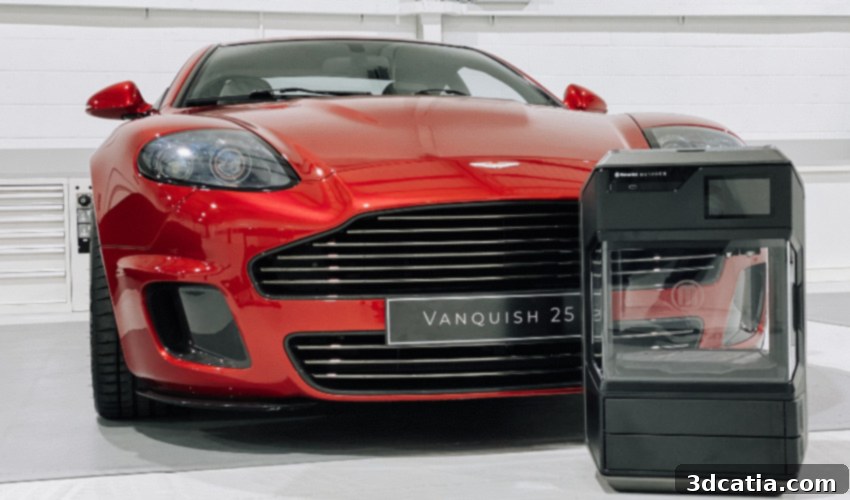
Revolutionizing Luxury Automotive Manufacturing: CALLUM Adopts MakerBot METHOD X for Aston Martin Vanquish 25 and Beyond
The automotive industry is in constant pursuit of innovation, pushing the boundaries of design, performance, and manufacturing. In a groundbreaking development that underscores the accelerating integration of additive manufacturing, particularly within the luxury automotive sector, the esteemed engineering design company CALLUM has made a significant announcement. CALLUM has officially installed MakerBot’s METHOD X 3D Printer, a move set to transform its production capabilities for functional prototypes, specialized tooling, and critically, final production parts for its exquisite luxury vehicles. This strategic adoption heralds a new era for bespoke automotive creation, directly impacting the much-anticipated, limited-edition Aston Martin CALLUM Vanquish 25 by R-Reforged.
This collaboration marks CALLUM’s first public venture, focusing on an exclusive run of only 25 meticulously crafted vehicles. Each of these limited-edition Aston Martin Vanquish 25 units is destined to incorporate 3D printed end-use parts, directly produced by the robust METHOD X system. This commitment by CALLUM is a powerful testament to the ever-expanding and increasingly vital role of additive manufacturing in the modern automotive landscape, a role that has witnessed a profound surge in importance and application in recent years.
MakerBot, a name initially synonymous with accessible desktop 3D printers, has strategically evolved its product line to bridge the critical gap between entry-level desktop machines and high-performance industrial systems. Their innovative Method series exemplifies this transition, leveraging advanced Fused Deposition Modeling (FDM) technology. What sets the Method series apart, especially the METHOD X, is its fully heated chamber, a crucial feature that enables the production of exceptionally strong, dimensionally stable, and truly manufacturing-grade parts. This controlled thermal environment mitigates warping and allows for the successful printing of advanced engineering materials, opening up a broader spectrum of applications suitable for industrial production demands.
The METHOD X 3D printer, in particular, boasts an extensive materials portfolio, including ABS, PC-ABS, and Nylon Carbon Fiber, offering greater versatility and application scope for demanding industrial environments. Nadav Goshen, CEO of MakerBot, expressed his enthusiasm regarding CALLUM’s choice to integrate the machine, remarking, “We are excited that the team at CALLUM will put its advanced capabilities to the test in some of the most demanding applications yet, and help accelerate the development of some truly next-generation vehicles.” This statement highlights the confidence in METHOD X’s ability to meet the rigorous standards of luxury automotive design and production, paving the way for unprecedented innovation.
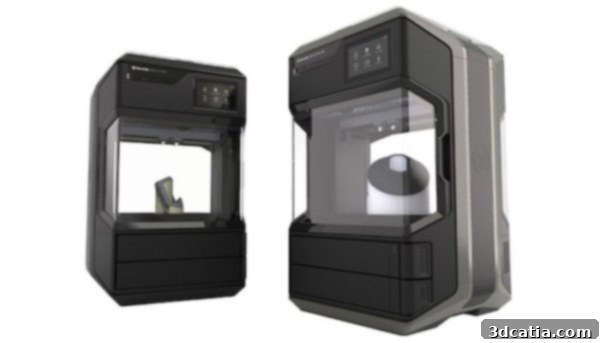
MakerBot’s METHOD and METHOD X 3D Printers. The METHOD X will be used by CALLUM for the new Aston Martin. (Photo Credits: MakerBot)
CALLUM and MakerBot METHOD X: Driving Design and Production Forward
Established in 2019 by the legendary automotive designer Ian Callum CBE, CALLUM has always championed innovation at its core. From its inception, the company has skillfully utilized additive manufacturing to translate abstract design concepts into tangible, representative models for meticulous internal review. This initial phase allowed designers and engineers to physically interact with their ideas, accelerating feedback loops and refining aesthetic and ergonomic aspects.
However, with the strategic installation of the MakerBot METHOD X, CALLUM is now poised to significantly broaden its application of additive manufacturing across three crucial areas, marking a pivotal shift towards industrial-grade implementation:
- Fully Functional Prototypes for Testing and Simulation: Beyond mere visual models, CALLUM will now produce prototypes that replicate the mechanical and thermal properties of final parts. This enables rigorous testing under realistic conditions, allowing engineers to validate designs for fit, form, and function before committing to expensive hard tooling. This capability drastically reduces development cycles and costs, while simultaneously enhancing the quality and performance of vehicle components, from aerodynamic elements to intricate interior mechanisms.
- Advanced Tooling for Componentry and Gauges: Additive manufacturing offers immense benefits for creating custom jigs, fixtures, and gauges. For low-volume, high-value luxury vehicles like the Aston Martin CALLUM Vanquish 25, traditional tooling can be prohibitively expensive and time-consuming. 3D printed tooling provides a cost-effective, rapid, and customizable solution, improving manufacturing accuracy, streamlining assembly processes, and ensuring consistent quality across all bespoke parts.
- Customizable, Low-Volume Production Parts for Final Use in Vehicles: This is arguably the most impactful application. The METHOD X empowers CALLUM to produce actual end-use components directly. For limited-edition supercars, this translates to unparalleled design freedom, allowing for complex geometries, lightweight structures, and personalized features that would be impossible or impractical with conventional manufacturing. These parts can range from interior trim components and console elements to specialized exterior details, each contributing to the vehicle’s unique identity and performance.
Ian Callum, the revered Design Director, elaborated on this transformative step: “MakerBot’s Method X 3D printer is our first true step into industrial-grade additive manufacturing, and we are excited to push the boundaries of automotive design and production with this technology.” This sentiment underscores the profound potential CALLUM sees in this partnership. The Aston Martin CALLUM Vanquish 25 by R-Reforged is not just a standalone project; it is envisioned as the vanguard in a series of bespoke, limited-edition supercars that CALLUM intends to design and produce, with the METHOD X serving as a cornerstone of their innovative manufacturing strategy.
Additive Manufacturing: A Growing Pillar of the Automotive Industry
CALLUM’s bold move places it in excellent company, joining a rapidly expanding cohort of automotive manufacturers who are deeply integrating 3D printing into their operations. The automobile industry is increasingly leveraging 3D printing not merely for initial prototyping and tool creation, but, crucially, for the direct production of end-use parts that bear the brunt of vehicle performance and aesthetics. This past year alone has witnessed several prominent examples highlighting this transformative trend.
For instance, Fiat Chrysler Automobiles (FCA) famously utilized additive manufacturing to design a highly optimized wheel carrier with an integrated brake caliper. This innovative approach allowed for significant weight reduction, improved structural integrity, and consolidated multiple components into a single, complex 3D printed part, demonstrating AM’s capability to enhance both design freedom and functional performance. Similarly, General Motors (GM) solidified its commitment to this technology with the inauguration of its new Additive Industrialization Center (AIC). This dedicated facility is a testament to GM’s long-term strategy to integrate additive manufacturing across its entire product lifecycle, from rapid prototyping and tooling to the direct manufacturing of production-ready components for a wide range of vehicles, from everyday cars to high-performance models.
These examples, coupled with CALLUM’s latest venture, underscore the compelling advantages offered by additive manufacturing. The inherent flexibility and agility of AM allow for rapid design iterations and on-demand production, significantly reducing lead times and fostering greater innovation. Furthermore, advancements in materials science have introduced robust, industrial-grade filaments and powders that deliver increased strength, durability, and performance suitable for demanding automotive applications. From lightweighting components to improving aerodynamic efficiency and enabling hyper-personalization, additive manufacturing is rapidly cementing its position as a crucial and indispensable aspect across a variety of industries, with the automotive sector leading the charge.
The ability to produce complex geometries without the constraints of traditional manufacturing, coupled with the potential for supply chain optimization through localized production, makes AM an incredibly attractive proposition. For luxury manufacturers like CALLUM, this means offering bespoke solutions and unique design elements that cater to the discerning tastes of their clientele, pushing the boundaries of what’s possible in vehicle customization and exclusivity. One thing is for certain: these are incredibly exciting times for 3D printing and its profound impact on automobile manufacturing, promising a future of unprecedented innovation and tailor-made vehicle experiences.
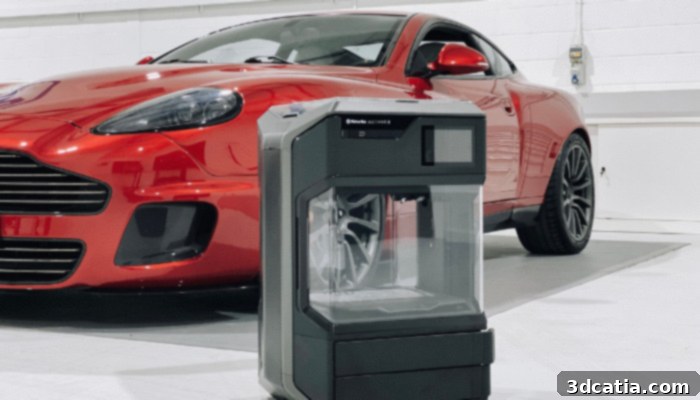
A side view of CALLUM’s Aston Martin with the METHOD X (Photo Credits: MakerBot)
What are your thoughts on the new Aston Martin CALLUM Vanquish 25 and the transformative role of the MakerBot Method X in its production? We’d love to hear your insights! Let us know in a comment below or join the conversation on our Facebook and Twitter pages! To stay updated with the very latest in 3D printing news, innovations, and industry trends, be sure to sign up for our free weekly Newsletter here, delivered straight to your inbox!
*thumbnail image photo credits: MakerBot