

Honda’s Stance on 3D Printed Car Parts: Navigating IP, Customization, and the Maker Community
The landscape of automotive innovation has been significantly reshaped by additive manufacturing, more commonly known as 3D printing. This transformative technology empowers creative individuals globally to solve problems, personalize their vehicles, and even fabricate essential spare parts. The ability to produce bespoke components has made 3D printing an invaluable tool in the automotive world, fostering a vibrant community of makers and enthusiasts. Many leading automotive companies have actively supported this movement, going as far as to provide official drawings and digital files to facilitate the creation and sharing of custom parts. A prime example of this collaborative spirit was Ford, which released a comprehensive collection of files for 3D printing accessories tailored for its Maverick model. This proactive engagement highlights a forward-thinking approach to customer empowerment and community building. However, not all automakers share this open sentiment, leading to significant friction and debate within the industry.
A recent incident involving automaker Honda has brought these differing philosophies to the forefront. Honda formally requested Prusa, a prominent 3D printer manufacturer and operator of the “Printables” platform, to remove all digital files associated with the Honda brand name. A spokesperson from Prusa elaborated on the situation to The Drive, confirming the receipt of a legal communication: “I can confirm that we have received a letter from a lawyer representing Honda, informing us that we were required to remove any model which used ‘Honda’ in the listing, the model itself, or one of several trademarks/logos also associated with Honda. This will also be related to the naming of the files itself, as for Honda this would be considered as a violation of their trademark/patents.” This directive underscores Honda’s firm stance on intellectual property rights, extending to not just explicit branding but also potentially to designs that are merely compatible with their vehicles or bear a resemblance to trademarked shapes.
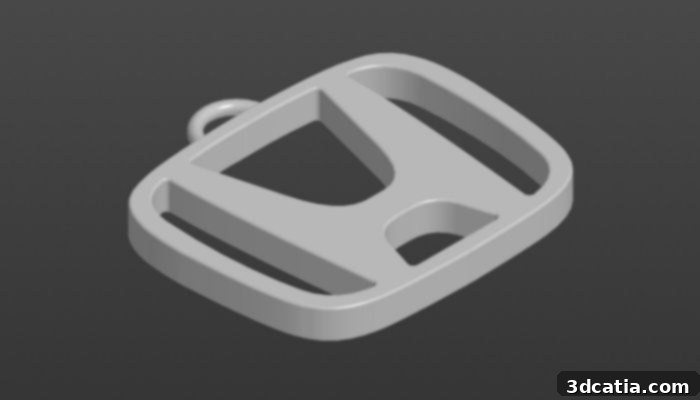
Example file for 3D printing a part by Thingiverse (Image credits: Thingiverse).
Diverging Paths: Open-Source Collaboration vs. Strict IP Enforcement
The additive manufacturing community has long thrived on the principle of open-source collaboration, with countless designs and files for fixtures, modifications, and even replacement parts from well-known brands being made freely available. This collaborative ecosystem fosters rapid innovation and provides practical solutions for users worldwide. For instance, global electronics giant Panasonic has embraced this model by making over 75,000 free CAD files accessible to its customers for various electronic components. This not only supports their user base but also encourages broader application and understanding of their products. Similarly, as previously mentioned, automaker Ford took a progressive step by releasing CAD files for its Maverick pickup truck, allowing owners to print their own accessories and truly customize their vehicles. This approach cultivates strong brand loyalty and positions companies as facilitators of creativity rather than strict enforcers of intellectual property.
The Purge on Printables: Honda Models Removed
In the wake of Honda’s legal notice, reports began surfacing on Reddit from 3D model creators who noticed the abrupt removal of their Honda-related designs from Printables without prior warning. This widespread deletion affected a variety of useful and often simple parts, including windshield washer fluid caps, key fob covers, interior trim pieces, and other functional accessories. Crucially, many of these files did not explicitly feature Honda branding or logos. Instead, their removal stemmed from their compatibility with Honda vehicles or their design dimensions matching specific Honda components, which the automaker deemed an infringement. Prusa’s swift compliance with Honda’s request was a practical decision to avoid engaging in a costly and protracted legal battle, especially given the tight timeframe provided to respond to the legal letter. The implications of this broad interpretation of trademark and patent infringement are significant for the entire 3D printing community, setting a precedent that even functional, unbranded parts compatible with a specific vehicle could be considered off-limits.
The scope of the affected 3D files was not limited to those overtly displaying Honda logos or trademarks. Prusa clarified that the deletion extended to specific elements exhibiting certain shapes, dimensions, or design characteristics that Honda perceived as an infringement of its intellectual property. This broad interpretation raises critical questions about what constitutes a proprietary design in the context of spare or compatible parts. If the mere dimensional accuracy required for a part to fit a Honda vehicle is considered an infringement, it challenges the very premise of creating replacement or custom components. This expansive claim touches upon the complex intersection of functional design, brand identity, and intellectual property law in the digital age, forcing creators to reconsider the boundaries of what they can design and share.
The “Right to Repair” vs. Intellectual Property Rights in Automotive 3D Printing
One of the most compelling aspects of the decision by Honda, as highlighted by numerous discussions on Reddit, is its impact on the availability of community-created spare parts. It is a well-known challenge in the automotive industry that manufacturers frequently discontinue parts for older vehicle models after a certain period. This often occurs due to factors such as dwindling demand, the high costs associated with maintaining manufacturing lines for obsolete components, or a strategic push towards newer models. For owners of classic or even just older vehicles, this practice can lead to significant difficulties in maintenance and repair, often forcing them to scour junkyards or pay exorbitant prices for rare parts. In this context, 3D printing has emerged as a revolutionary solution, offering a pathway to produce otherwise unavailable spare parts, thereby extending the lifespan of vehicles and empowering owners to perform their own repairs.
Honda’s demand for the removal of these files appears to clash directly with the spirit of the growing “right to repair” movement, which advocates for consumers’ ability to repair their own products using parts and information from independent sources. While manufacturers undeniably have a right to protect their intellectual property, the application of these rights to generic or discontinued spare parts created by the community for personal use raises ethical and practical dilemmas. It suggests that Honda prefers that any components, even non-branded ones, for its vehicles originate exclusively from the company itself or its authorized channels. This stance, while potentially aimed at maintaining quality control, ensuring safety, and protecting revenue from official parts sales, also effectively creates a monopoly on parts, potentially limiting consumer choice and the longevity of their products. Honda has, so far, remained notably silent on the deeper reasoning behind this decision, leaving the community to speculate on the balance between brand protection and consumer rights.
The Future of Customization and IP in Additive Manufacturing
Despite the mass deletion of files from Printables, the resilient 3D printing community continues to find ways to share and access Honda-related 3D models on other platforms, such as Thingiverse and Thangs. This persistence underscores the inherent difficulty in fully controlling the flow of digital designs once they enter the public domain, even in a limited capacity. The incident with Honda and Prusa is a significant touchstone in the ongoing global debate concerning intellectual property rights in the age of digital fabrication. It forces a critical examination of where the line should be drawn between protecting a company’s brand, design, and commercial interests, and fostering innovation, customization, and the consumer’s right to maintain and repair their property. The resolution of such conflicts will inevitably shape the future of both the automotive industry and the burgeoning 3D printing ecosystem.
What are your thoughts on Honda’s decision and the broader implications for intellectual property within the additive manufacturing industry? Do you believe manufacturers should provide open access to CAD files for spare parts, especially for discontinued models? Share your opinions in a comment below or engage with us on our LinkedIn, Facebook, and Twitter pages! Don’t forget to sign up for our free weekly Newsletter here to get the latest 3D printing news delivered straight to your inbox! You can also find all our videos and interviews on our YouTube channel.
*Photo Credits: Sourav Mishra