
Revolutionizing Additive Manufacturing: Ai Build’s Real-Time AI Inspection for Flawless 3D Printing
The landscape of additive manufacturing (AM), commonly known as 3D printing, is undergoing a profound transformation. What was once primarily a technology for rapid prototyping and low-volume production is now rapidly evolving into a viable solution for large-scale, industrial manufacturing. This shift, while promising, introduces a new set of challenges, particularly concerning production consistency and defect management. Ensuring part quality and process reliability at scale is paramount for widespread adoption. In this context, artificial intelligence (AI) and machine learning (ML) are emerging as critical enablers, offering unprecedented capabilities for real-time process control and defect detection. We recently highlighted Inkbit’s innovative 3D printer, which leverages machine vision to correct errors and predict material behavior in real time. Following a similar, yet distinct, path, the London-based startup Ai Build has just unveiled its cutting-edge real-time inspection technology, specifically designed for additive manufacturing, integrating advanced computer vision and machine learning algorithms.
One of the most significant hurdles to the widespread adoption of large-scale 3D printing is the persistent issue of production defects. These imperfections, which can range from minor cosmetic flaws to critical structural weaknesses, can significantly impact part performance, increase material waste, and escalate overall production costs. Common issues like material shrinkage, warping, overextrusion, underextrusion, layer delamination, and stringing often plague complex 3D printing processes. Ai Build’s new technology addresses this head-on by providing an automated solution to detect these most common printing issues, such as material shrinkage and warping, in real time as they occur. This proactive approach is a game-changer, moving beyond post-production inspection to prevent errors before they compromise an entire build. As recent reports on the state of AM have consistently predicted, the industry is transitioning from niche applications to mainstream manufacturing. We are now entering an age where large-scale 3D printing could become the norm for certain demanding industries and high-value products, including aerospace, automotive, and medical devices. To facilitate this transformation, new technologies that ensure reliability, consistency, and efficiency are absolutely necessary, and artificial intelligence is poised to play an increasingly important role in achieving these objectives.
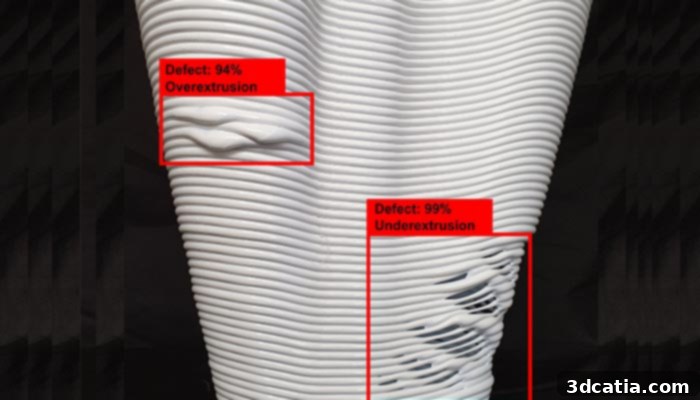
Example of production defects such as overextrusion or underextrusion | Photo Credits: AiBuild
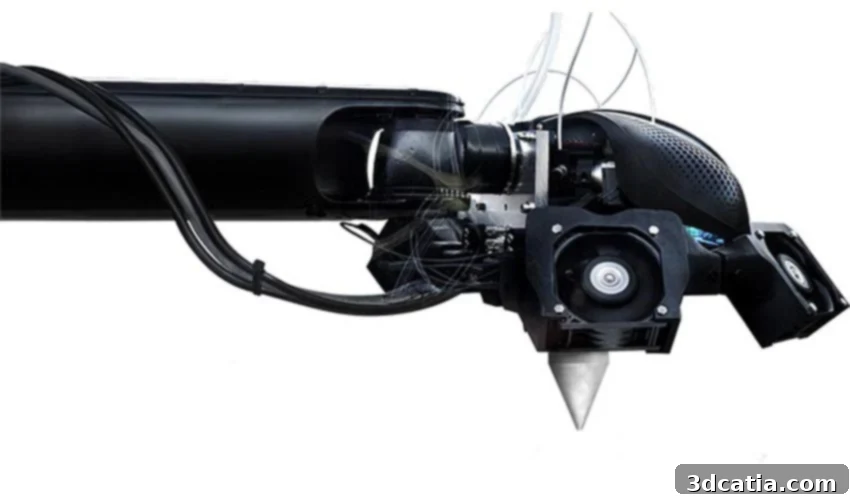
Ai Build is a pioneering startup dedicated to providing a completely autonomous large-scale 3D printing technology, allowing businesses to produce their designs efficiently within their own facilities. Beyond their internal production capabilities, Ai Build also offers comprehensive support to other enterprises, assisting them in setting up their advanced additive manufacturing environments, providing initial training, and ensuring ongoing technical support. But what truly defines the benefits of this new, groundbreaking technology? At its core, it offers real-time detection of 3D printing defects, powered by sophisticated artificial intelligence. This capability is expected to significantly increase productivity and elevate the level of automation across various additive manufacturing facilities. Simultaneously, it promises substantial reductions in production costs and minimization of material waste, making AM more economically viable and environmentally friendly. Their flagship product, the AiMaker, is a high-precision robotic end-effector specifically designed to attach to industrial robotic arms. This device is now intricately embedded with a high-resolution camera and a powerful GPU module. This integrated system continuously monitors the printing process, detecting manufacturing defects by meticulously comparing its real-time camera view of the part being built against previously recorded, ideal images of perfectly 3D printed components. The AI algorithms quickly identify deviations, flagging potential issues instantly and allowing for immediate intervention or process adjustment.
The implementation of real-time defect detection through AI has far-reaching implications for the entire additive manufacturing workflow. Traditionally, quality control in 3D printing has often relied on post-process inspection, which means identifying issues only after a part, or even an entire batch, has been printed. This often leads to significant waste of expensive materials, valuable machine time, and human labor for inspection and rework. By contrast, Ai Build’s technology allows for immediate feedback. If a critical defect is detected early in the print, the process can be paused, corrected, or even aborted, saving considerable resources. This level of responsiveness transforms production from a reactive model to a proactive one. Furthermore, the data collected by the AiMaker system during its real-time monitoring can be invaluable. It provides rich insights into common failure modes, material behaviors under different printing conditions, and the effectiveness of various print settings. This data can then be fed back into the machine learning models, creating a continuous improvement loop that not only detects defects but also learns to predict and prevent them over time, leading to increasingly robust and reliable printing processes. The shift towards such intelligent, self-optimizing manufacturing systems is what will truly unlock the full potential of industrial-scale 3D printing.

Other examples of 3D printing defects | Photo Credits: AiBuild
Daghan Cam, the insightful CEO of Ai Build, articulates the company’s core philosophy with a simple yet profound statement: “We have a simple rule at Ai Build: If a product is faulty, we repeat production. If it has a small defect, we repeat. If we are slightly in doubt, we repeat. This level of perfection in additive manufacturing usually comes at a high cost, in the form of excessive labour and material waste. The milestone we are announcing today is a result of our obsession for flawless production and a major leap towards fully automated, autonomous factories of the future. We are excited to see how the productivity of our users will increase with this advanced technology”. This dedication to perfection underscores the immense value of real-time inspection. Achieving such high quality through manual means or traditional post-processing would indeed be prohibitively expensive and time-consuming, making large-scale AM impractical for many applications. Ai Build’s technology aims to democratize this “flawless production” by making it automated and cost-effective, paving the way for truly lights-out manufacturing environments where human intervention is minimized, and efficiency is maximized.
The advanced capabilities of the new AiMaker are further enhanced by its seamless integration with the AiSync cloud software. Users will receive instant notifications regarding the quality of their 3D printed parts, providing immediate transparency and control over the production process. This cloud-based approach also facilitates remote monitoring and data analysis, which is crucial for modern industrial operations. Leonidas Leonidou, AiBuild’s Head of Applied Research, expanded on the multifaceted benefits, adding, “By detecting printing defects in real time, our AI technology offers the potential of automating quality control, while at the same time acting as a form of feedback to the designer about the printability of their design and how such printing issues could be eliminated in future prints.” This highlights another critical aspect of Ai Build’s innovation: the creation of an intelligent feedback loop. Beyond merely detecting errors, the system provides actionable insights. This feedback is invaluable for designers, allowing them to refine their designs for additive manufacturing (DfAM) by understanding which geometries, orientations, or features are prone to defects. Such iterative design improvement, guided by real-time data, accelerates product development cycles and ensures higher success rates in subsequent prints. It transforms the manufacturing process into a truly intelligent ecosystem, where both machines and human designers learn and adapt for optimal outcomes.
The impact of such technology extends beyond individual parts. By ensuring consistent quality across large batches, Ai Build’s solution significantly boosts confidence in additive manufacturing for critical applications where reliability is non-negotiable. Industries like aerospace, which require stringent certification and traceability, can particularly benefit from verifiable, automated quality control. The reduction in material waste also contributes to more sustainable manufacturing practices, aligning with global efforts for greener industrial processes. The continuous learning capability of the AI system means that the technology will only get better over time, adapting to new materials, printer types, and design complexities. This future-proofing aspect makes Ai Build a formidable player in the evolving landscape of digital manufacturing. With such innovations, the dream of fully autonomous production lines, capable of manufacturing complex parts on demand with minimal human oversight and maximum efficiency, moves ever closer to reality.
Ai Build is set to begin shipping its new generation of 3D printers, complete with integrated computer vision capabilities, in the second half of the year. This rollout marks a significant milestone, making this transformative technology accessible to a wider industrial audience. For those eager to delve deeper into the specifics of this revolutionary approach to additive manufacturing, more detailed information can be found HERE on their official website. The arrival of these intelligent printers promises to accelerate the adoption of industrial 3D printing, mitigating the risks associated with scaling production and unlocking new possibilities for design and manufacturing innovation. It’s a clear indicator that the future of manufacturing is smart, automated, and driven by artificial intelligence.
What are your thoughts on this groundbreaking new technology and its potential to reshape the future of manufacturing? We invite you to share your perspectives and insights in the comments section below. Alternatively, join the conversation on our social media channels; you can find us on Facebook and Twitter. Don’t miss out on the latest advancements and news in the dynamic world of 3D printing; sign up for our free weekly Newsletter to receive all the essential updates delivered straight to your inbox!