
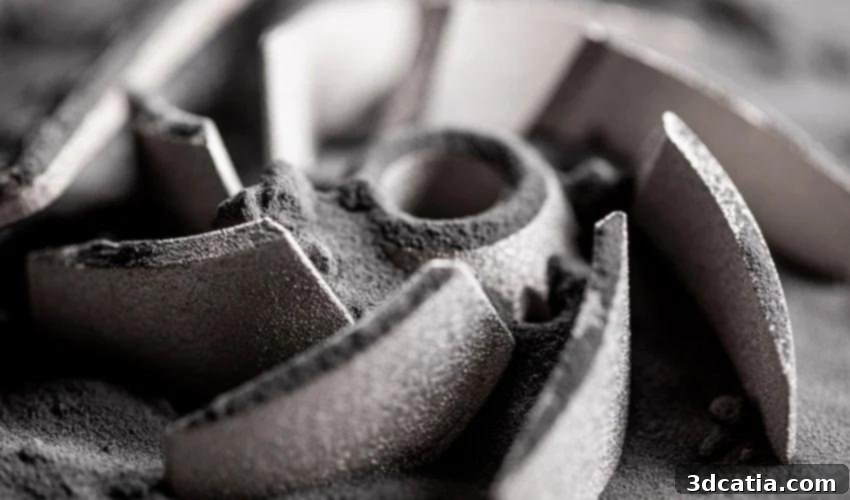
Cold Metal Fusion (CMF): Revolutionizing Affordable Metal 3D Printing with SLS Technology
The manufacturing industry is undergoing a significant transformation, with an increasing shift towards metal additive manufacturing (AM) solutions. While offering unparalleled design freedom and performance benefits, the substantial cost of metal 3D printers often presents a formidable barrier for companies looking to adopt these advanced technologies. This high initial investment can deter smaller businesses and even larger enterprises from exploring the full potential of metal AM. However, a promising counter-trend is emerging with the development of more affordable, polymer powder-based additive manufacturing systems. Among these, Selective Laser Sintering (SLS) technology stands out as a highly versatile and cost-effective method for producing robust polymer parts across a vast array of applications. What if the distinct advantages of metal 3D printing, such as superior mechanical properties and functional integration, could be seamlessly combined with the inherent cost-efficiency and accessibility of SLS manufacturing? This innovative fusion is precisely what Cold Metal Fusion (CMF) technology now makes possible, offering a compelling solution to the cost conundrum in metal additive manufacturing.
Pioneered by the German company Headmade Materials, Cold Metal Fusion (CMF) 3D printing introduces an indirect method for fabricating high-quality metal parts. Headmade Materials’ primary focus is on developing advanced powder materials specifically engineered for this groundbreaking system, with no immediate plans to manufacture 3D printers themselves. This strategic approach allows them to leverage existing hardware infrastructure. The innovative CMF materials are composed of fine metal particles meticulously encapsulated within a protective polymer binder layer. Utilizing a powder bed process, the CMF system empowers companies already equipped with conventional SLS machines to transition to creating intricate and durable final metal parts. This capability effectively bridges the gap between polymer and metal additive manufacturing, opening new avenues for production. Let’s explore the intricacies of this technology in greater detail, dissecting its properties and understanding the significant advancements it brings to the broader additive manufacturing landscape.
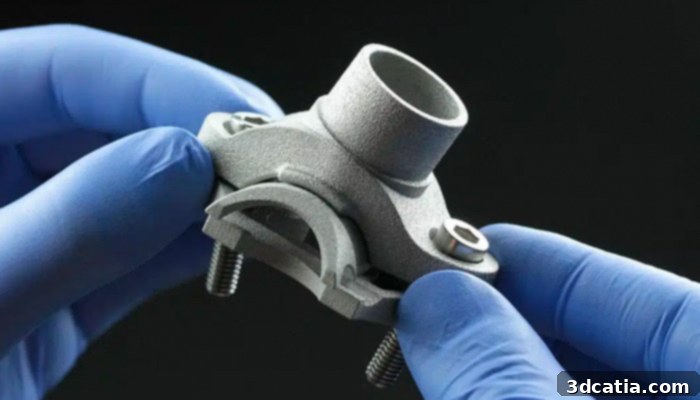
A titanium part 3D printed using Cold Metal Fusion technology.
Understanding the Cold Metal Fusion Process
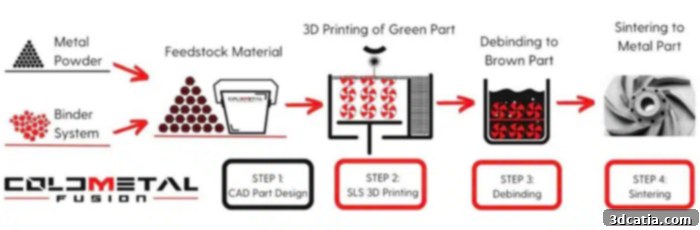
As with virtually any additive manufacturing workflow, the journey with Cold Metal Fusion begins in the digital realm, with the meticulous design of models using CAD software. A crucial consideration during the design phase for CMF parts – and indeed, for any sintering-based process – is the phenomenon of material shrinkage that occurs during subsequent fabrication steps. In the CMF process, parts are engineered to achieve a high density, which inherently minimizes the extent of shrinkage during the final sintering stage. Nonetheless, when utilizing metal powder as the raw material, designers must account for a predictable, uniform shrinkage in all three spatial directions (XYZ), typically around 14%. Precisely factoring in these few millimeters of contraction is paramount to ensure the final part dimensions meet strict engineering specifications. Once the digital model is finalized, it is transferred to specialized slicer software. This software’s role is to meticulously segment the part into numerous digital layers and define a comprehensive set of manufacturing parameters, including laser power, scan speed, layer thickness, and build orientation, all optimized for the CMF material and process.
With the design and slicing processes meticulously completed, the system is ready to proceed with part creation. CMF technology is compatible with a growing range of advanced materials, including robust 316L stainless steel, high-performance cobalt-chromium, the widely used Ti6Al4V titanium alloy, and durable tungsten. Headmade Materials is also actively developing additional materials, such as Inconel (known for its high-temperature strength), lightweight aluminum, and various tool steels, which will further expand the technology’s application scope. A common inquiry regarding CMF technology revolves around its designation as a “cold” method, given that it ultimately involves a hot sintering step. The key distinction lies in the printing phase itself. During this stage, the polymer binder, which encases the metal particles, is selectively melted at remarkably low temperatures, typically up to 50°C (122°F). These low temperatures are well within the operating power range of standard, low-cost polymer laser sintering systems. Therefore, while final sintering is indeed hot, the initial deposition and binding process is performed at relatively low temperatures, classifying it as a “cold” printing process and allowing for the use of readily available SLS equipment.
Leveraging the established principles of SLS 3D printing, CMF utilizes a laser to selectively sinter the polymer binder around the metal particles. This process occurs layer by layer, with fresh powder being spread across the build platform after each layer is solidified. A significant advantage of this powder bed-based method is that, much like traditional SLS, it eliminates the need for cumbersome support structures. The surrounding unsintered powder inherently acts as a natural support for overhanging features and complex geometries, simplifying post-processing. Furthermore, this method facilitates “stacking,” allowing for the efficient superposition of multiple parts within a single print job, thereby maximizing build volume utilization and increasing throughput. Crucially, because the metal particles are meticulously protected by the polymer binder, they are not directly exposed to ambient air during the printing phase. This clever design prevents the oxidation of the metal, which can compromise material properties in other metal AM processes. An additional benefit of the “cold” printing process is that the unsintered powder, which does not undergo thermal degradation, can be collected and reused in subsequent prints, leading to significant material cost savings and reduced waste.
The Indispensable Role of Post-Processing in CMF
In the Cold Metal Fusion workflow, post-processing is not merely an optional step but a critical series of procedures essential for transforming “green” parts into fully dense, functional metal components. After the “green” parts – components consisting of metal particles held together by the sintered polymer binder – are carefully removed from the SLS printer’s build chamber, the initial step involves cleaning the build plate to remove any residual unsintered powder. This can be efficiently accomplished using methods such as pressurized air or a water jet, a process made straightforward by the remarkable stability and integrity of the green parts. This stability is a key advantage, allowing for robust handling without damage.
Following the cleaning stage comes debinding, a crucial process during which the polymer binder, which initially held the metal particles together, is meticulously removed. The green models are typically immersed in a specialized solvent, which dissolves or degrades the sintered plastic, leaving behind a highly porous metal structure. The efficiency and completeness of this debinding step are vital for the quality of the final part. Once debinding is complete and the solvent is fully removed, the resulting “brown” parts are ready for the ultimate transformation – the final sintering of the metal. This final stage involves placing the parts in a specialized furnace or oven. During this high-temperature process, any remaining trace amounts of binder are completely burned out, and the individual metal particles begin to fuse together at their contact points. As the temperature rises to near the melting point of the metal, atomic diffusion occurs, causing the particles to coalesce and densify, forming a solid, homogenous metallic structure. It is imperative to note that this final sintering step requires a highly specialized oven capable of achieving and precisely controlling the extremely high temperatures necessary for metal sintering, often under a controlled atmosphere to prevent oxidation. This controlled environment ensures the desired mechanical properties and microstructure of the final metal part.
Industry Advantages and Diverse Applications
The paramount advantage of Cold Metal Fusion technology lies in its revolutionary ability to produce high-performance final metal parts using readily available and significantly more affordable SLS 3D printers. Unlike expensive laser powder bed fusion (LPBF) solutions, which often require substantial capital investment, SLS machines are more prevalent in the market and represent a much lower entry cost for businesses venturing into metal additive manufacturing. In fact, CMF 3D printing can be seamlessly integrated with even basic SLS machines, such as those manufactured by Sintratec, further driving down the initial investment for companies. Headmade Materials powerfully articulates this economic benefit on its website, stating, “This is the lowest investment cost of any metal 3D printing process for mass production of up to 100,000 parts.” This assertion underscores CMF 3D printing as an exceptionally cost-effective alternative, not only to LPBF but also to traditional manufacturing methods like Metal Injection Molding (MIM) or die casting, particularly for medium-volume production where tooling costs can be prohibitive. This accessibility democratizes metal additive manufacturing, making it available to a broader range of industries and businesses.
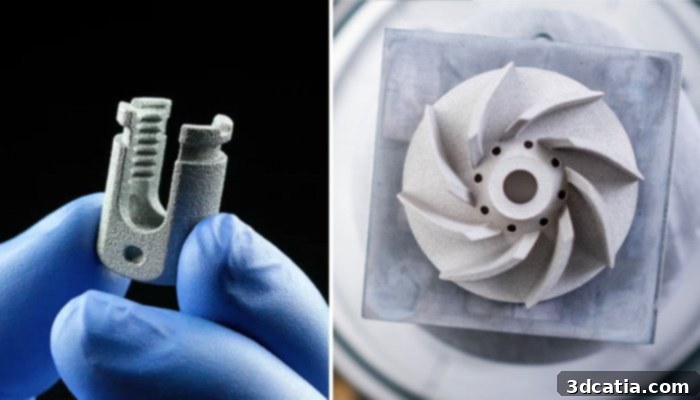
Examples of parts created using the CMF process.
Beyond its cost advantages, CMF also presents a compelling alternative to binder jetting 3D printing, another method capable of producing metal parts. Consequently, many of the applications for CMF technology will overlap with those traditionally served by LPBF and binder jetting, leveraging similar benefits such as design complexity, lightweighting, and functional integration. Industries poised to benefit most from this innovative manufacturing method include the automotive sector, where lightweight and complex components are crucial for efficiency; aerospace, demanding high-performance parts with tight tolerances; the medical field, requiring custom implants and surgical tools made from biocompatible materials; and consumer goods, enabling rapid prototyping and mass customization. CMF’s versatility allows for the production of parts with intricate geometries and high material density, meeting stringent industry requirements.
Numerous real-world examples already highlight the transformative potential of CMF technology. Sturdy Cycles, a renowned bicycle manufacturer, has enthusiastically adopted CMF 3D printing for the production of its high-performance titanium bike parts. This strategic move has dramatically improved the efficiency of sports equipment development, significantly reduced manufacturing costs, and facilitated on-site production, leading to greater agility and control over their supply chain. Another remarkable success story emerged from the international Formula Student competition, where Headmade Materials proudly sponsored a participating team. The team representing Esslingen University of Applied Sciences (Germany) received a meticulously engineered air/oil separator, fabricated using Cold Metal Fusion. This critical component, crafted from Ti6Al4V titanium alloy, showcased exceptional optimized weight alongside impressive load-bearing capacity, demonstrating CMF’s capability for demanding applications. Lastly, German tool manufacturer Utilis AG has also embraced CMF, developing an innovative steel cutting tool holder featuring a unique internal cooling channel. This advanced design, made possible by CMF’s geometric freedom, has been proven to increase cutting tool performance by an astounding 185%, leading to enhanced productivity and tool longevity in industrial operations. These diverse examples underscore CMF’s ability to drive innovation across various sectors.
The Promising Future of CMF in 3D Printing
While Cold Metal Fusion technology is a relatively recent innovation, its adoption rate is experiencing rapid acceleration across a broad spectrum of industries. The compelling idea of a selective metal laser sintering process, which combines the best attributes of polymer SLS with the benefits of metal, is quickly gaining traction in the additive manufacturing market, prompting many forward-thinking companies to actively consider its integration. A significant catalyst behind this burgeoning growth is the strategic initiative known as the “ColdMetalFusion Alliance.” This alliance was spearheaded by Headmade Materials following its emergence as part of the AM Ventures venture capital fund, which is owned by EOS, a global leader in high-end additive manufacturing solutions. The alliance has attracted a formidable roster of industrial companies, including material specialists like mimPlus and Element22, as well as component manufacturers such as Miba. Crucially, it also includes prominent 3D printer manufacturers like Farsoon Technologies, a key developer of advanced SLS solutions. This broad-based collaboration signifies a collective commitment to the success and industrialization of CMF technology.
The overarching objective of the ColdMetalFusion Alliance is to industrialize this groundbreaking technology by establishing common standards and best practices that seamlessly integrate conventional sintering processes with additive manufacturing workflows. Alliance member companies are not only committed to sharing technical standards but also fostering a similar culture and mindset, promoting collaboration and innovation across the entire value chain. This collaborative approach ensures interoperability and consistency, which are critical for widespread industrial adoption. The continuous progress in refining the CMF system and the ongoing development of new compatible materials are poised to significantly expand this technology’s reach. As the material portfolio grows to include an even wider range of alloys and composites, CMF will inevitably extend its applicability to many more industries and a vast array of challenging applications, further solidifying its position as a truly transformative force in metal additive manufacturing.
Did you know about the Cold Metal Fusion process before reading this article? What are your thoughts on its distinct advantages and potential? Let us know in a comment below or connect with us on our LinkedIn, Facebook, and Twitter pages for further discussion! Don’t forget to sign up for our free weekly newsletter here to receive the latest 3D printing news directly to your inbox. You can also explore all our informative videos and content on our YouTube channel.
*All Photo Credits: Headmade Materials