
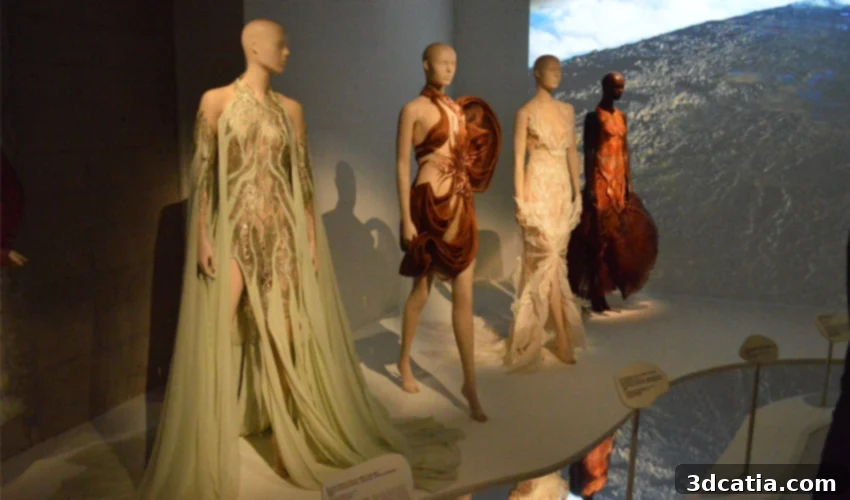
Iris van Herpen’s ‘Sculpting the Senses’: A Dazzling Fusion of Haute Couture and 3D Printing Innovation in Paris
Since November 29, 2023, the illustrious Musée des Arts Décoratifs in Paris has been captivating visitors with a groundbreaking new exhibition dedicated to the visionary work of Dutch designer Iris van Herpen. Our team recently had the privilege of experiencing this extraordinary showcase firsthand, immersing ourselves in a world where fashion transcends traditional boundaries and merges seamlessly with cutting-edge technology. The exhibition, aptly titled “Sculpting the Senses,” unveils hundreds of exquisite collection pieces, ranging from breathtaking haute couture dresses to intricate accessories. It also offers an intimate glimpse into the designer’s innovative working laboratory, revealing the meticulous process behind her creations. Notably, a significant portion of these remarkable garments and accessories are brought to life using advanced additive manufacturing technologies, positioning van Herpen at the forefront of fashion innovation.
At the very core of Iris van Herpen’s groundbreaking methodology is her unparalleled ability to harness new technologies, ingeniously combining them with more traditional artisanal methods to forge what can only be described as incredible works of art. Indeed, to label her designs merely as “fashion showpieces” would be an understatement; her creations are profound artistic expressions, as meticulously demonstrated in this latest Parisian exhibit. “Sculpting the Senses” is far more than a simple display of garments; it is an immersive journey through the artist’s multifaceted sources of inspiration, eloquently showcasing her immense talent and undeniable genius. This exhibition powerfully underscores how 3D printing continues to revolutionize the fashion industry, pushing the limits of what is conceivable in textile and form.
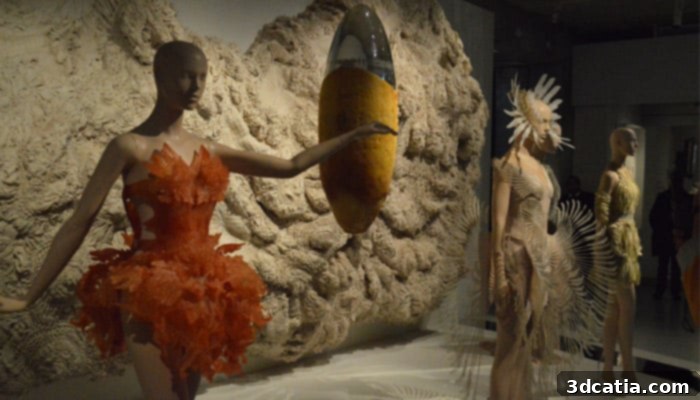
More than 100 stunning dresses are on display in the Iris van Herpen exhibit, showcasing her unique vision.
The exhibition is thoughtfully structured into 11 distinct rooms, each guiding the visitor along a precise, thematic path. This captivating journey begins at a micro-level, exploring intricate details and cellular structures, gradually expanding to the macro-level before culminating in the awe-inspiring theme of space exploration. Iris van Herpen is an artist profoundly influenced by the natural world, scientific principles, and profound literary works. She stands out as one of the very few designers who not only embraces but masterfully integrates cutting-edge digital technologies with time-honored craft techniques. Her distinctive process bypasses the conventional drawing stage entirely. Instead of putting pencil to paper, van Herpen consistently begins with a material, meticulously studying its properties and potential from every conceivable angle. It is through this tactile and investigative approach that she envisions and ultimately fabricates each new dress or accessory, truly “sculpting” them into existence.
“Sculpting the Senses” features an astonishing collection of approximately 100 of her iconic dresses and 40 meticulously crafted accessories. Among these are pieces that have graced the world’s most prominent stages and red carpets, famously worn by global icons such as Shakira, Beyoncé, Natalie Portman, and Lady Gaga. While not every piece on display is 3D printed, each creation profoundly embodies a strong technological dimension and frequently showcases a dynamic collaboration with another artist—be it a painter, sculptor, author, or even a sound designer. This interdisciplinary approach is a hallmark of van Herpen’s work, allowing her to push creative boundaries and imbue her designs with multifaceted artistic narratives.
A leisurely stroll through the exhibition rooms quickly unveils the designer’s extraordinary artistic potential and her relentless pursuit of innovation. Van Herpen brilliantly orchestrates a symphony of materials, colors, and inspirations, breathing life into unique dresses that boast astonishing shapes and unparalleled textures. The seamless integration of digital fabrication methods, particularly additive manufacturing, is evident in many of these marvels. For instance, the captivating Hybrid Holism dress was meticulously produced using stereolithography (SLA), a technology renowned for its ability to create exceptionally fine details and smooth surfaces. The organic intricacies of the Foliage dress were realized through the advanced capabilities of PolyJet technology, which allows for multi-material and multi-color printing. Another striking example, “The Cathedral,” is a testament to the versatility of Selective Laser Sintering (SLS) 3D printing, known for producing durable and complex geometries. Iris van Herpen frequently collaborates closely with industry leaders like Materialise, a pioneer in 3D printing solutions, to bring her intricate visions to fruition. A notable instance of this partnership is her “Futurama” piece, which was innovatively 3D printed using the Belgian company’s cutting-edge Bluesint PA 12 powder, highlighting a commitment to both advanced aesthetics and sustainable practices.
In each instance, the strategic application of 3D printing has been a game-changer, empowering Iris van Herpen to conceptualize and execute novel shapes, dynamic movements, and unprecedented material combinations that would be utterly impossible through conventional textile fabrication techniques. This digital freedom allows her to defy gravity and traditional silhouettes, creating ethereal and often otherworldly forms. It’s crucial to acknowledge that van Herpen frequently augments additive manufacturing with other sophisticated techniques, such as electroplating. This process enables her to deposit a thin, uniform layer of metal—be it silver or copper, depending on the specific aesthetic of the dress—onto the 3D printed structure. This hybrid approach is instrumental in achieving desired effects, such as a lustrous metallic finish, enhanced rigidity, or unique haptic qualities. Furthermore, it skillfully overcomes some of the inherent limitations of 3D printing, such as the monochrome nature of many SLS powders, allowing for a broader palette of visual and textural expression.
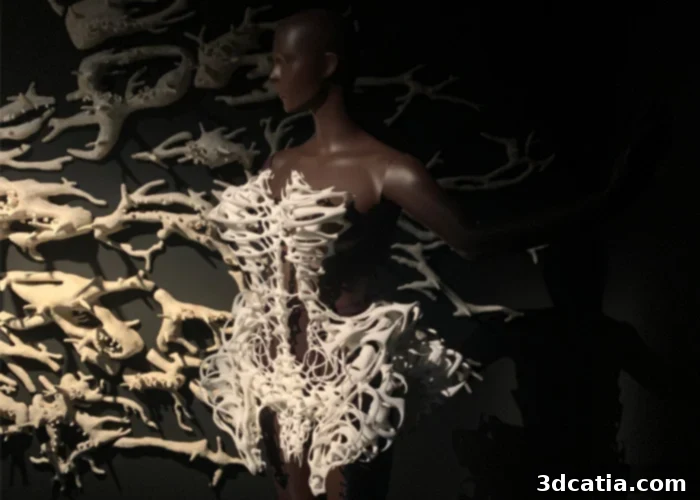
The mesmerizing detail of the ‘Skeleton’ dress, a marvel of 3D printed haute couture.
Among the many captivating sections of the exhibition, the “Skeleton Incarnate” room deserves particular recognition. Here, visitors are greeted by her iconic “Skeleton” dress, a masterpiece meticulously 3D printed on an SLS machine using durable polyamide material. Iris van Herpen, deeply fascinated by the living world, the intricate complexities of human anatomy, and the mesmerizing process of morphogenesis, envisioned a collection that intricately focuses on the structure of muscles, tissues, and bones. The result is a dress that strikingly resembles an exoskeleton, characterized by its incredibly intricate, highly detailed, and profoundly original forms. This piece not only redefines the human silhouette but also artfully explores the delicate and profound connections between the organic forms found in nature and the architectural beauty of the human body. It is a powerful statement on the biological origins of design and the potential of technology to mimic and enhance natural structures.
Beyond the finished garments, one of the most enriching experiences for our team was exploring her workshop – an invaluable area within the exhibition that showcases hundreds of material samples, ongoing projects with other artists, and various experimental prototypes. This dedicated space allowed us to fully immerse ourselves in the illustrious career of the Dutch designer, providing profound insight into her unconventional way of working. It becomes abundantly clear that Iris van Herpen does not adhere to the conventional rules and established codes of the fashion industry; for instance, she completely foregoes the traditional method of sketching her dresses or garments. As previously mentioned, her creative process invariably begins with a tangible material. She interacts with it, manipulates it, and from this tactile engagement, she begins to imagine forms, movements, and textures. It is this foundational material study, combined with her masterful command of advanced technologies—including, but not limited to, 3D printing—that allows her to create her truly unique and boundary-pushing designs.
In conclusion, Iris van Herpen’s “Sculpting the Senses” exhibition is exceptionally comprehensive and thoughtfully curated, serving as a profound reflection on contemporary art rather than merely a display of fashion. While not every piece is 3D-printed, there are more than enough groundbreaking creations on show to deeply appreciate the transformative role of new technologies in the artist’s work. We candidly admit that some of the exhibition spaces are quite surprising, even delightfully eccentric, challenging perceptions of beauty and form. However, the visit is unequivocally well worth the detour if you find yourself passing through Paris before its closing date. This unforgettable exhibition runs until April 28, 2024, offering a limited window to witness this extraordinary convergence of art, science, and fashion. For those inspired to explore more of her groundbreaking collections, you can find all of Iris van Herpen’s remarkable work on her official website HERE.
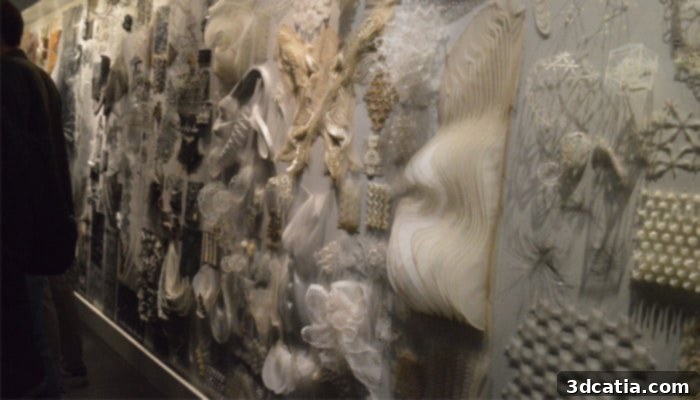
A glimpse into Iris van Herpen’s innovative workshop, featuring numerous material samples and collaborative projects.
What are your thoughts on the groundbreaking Iris van Herpen exhibition? Will you make it a point to visit if you have the opportunity to be in Paris before the end of April 2024? We invite you to share your insights and comments below, or connect with us on our Linkedin, Facebook, and Twitter pages! Don’t miss out on the latest advancements in 3D printing; remember to sign up for our free weekly Newsletter here to receive all the essential 3D printing news directly in your inbox! You can also discover a wealth of insightful content and videos on our YouTube channel, where we explore the evolving landscape of additive manufacturing and its profound impact on industries worldwide.
*All Photo Credits: 3Dnatives