
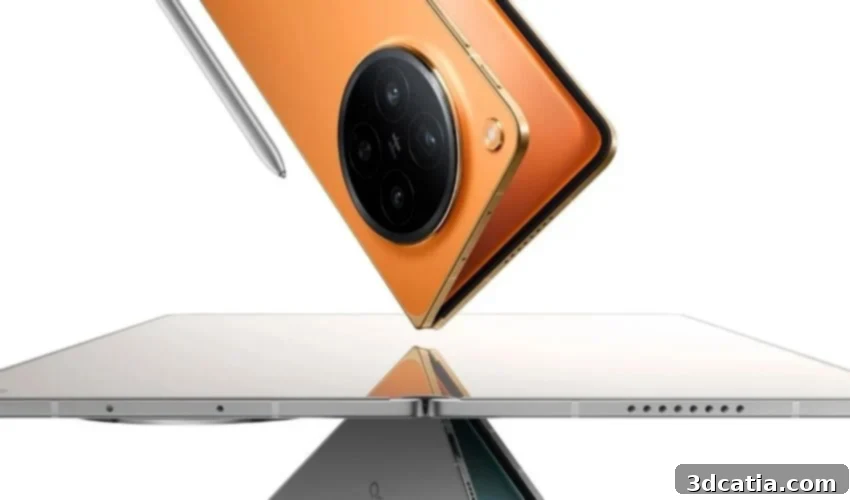
OPPO Leverages 3D Printing for Zero-Crease Foldable Smartphone: A Revolution in Mobile Technology
The world of additive manufacturing continues to evolve, showcasing its versatility and impact across diverse industries. Following Apple’s recent integration of 3D printing in its new product lines, Chinese manufacturer OPPO has now unveiled its groundbreaking foldable smartphone, the Find N6, utilizing 3D printing technology to address a critical challenge in foldable devices. Officially launched on March 17th in the Asia-Pacific region and select global markets, the Find N6 represents a significant leap forward in foldable phone design and user experience.
Since the inception of foldable phones, the prominent crease in the center of the display has been a persistent issue, hindering the overall user experience and deterring wider consumer adoption. Many users of foldable phones have experienced the aggravation of the crease becoming more noticeable over time, detracting from the seamless visual experience. OPPO has tackled this issue head-on with its innovative “Zero-Feel Crease” technology, a solution that leverages 3D printing to create a perfectly flat internal support surface, effectively eliminating the visibility and feel of the crease.
The core of this technological breakthrough lies in the strategic application of 3D printing in the hinge manufacturing process. Additive manufacturing plays a crucial role in two distinct stages of production. First, the hinge mechanism itself and the accompanying side plates are meticulously 3D printed using grade 5 titanium, a material known for its high strength-to-weight ratio and durability. This ensures the hinge can withstand the repeated folding and unfolding actions without compromising its structural integrity. Secondly, OPPO employs a technique known as “Liquid 3D Printing,” which is essentially a refined form of stereolithography. This process is used to further enhance and fine-tune the hinge system, ensuring optimal performance and eliminating any imperfections.
The Liquid 3D Printing process begins with a high-resolution laser scan of the 3D-printed hinge. This scan meticulously detects even the most subtle irregularities and imperfections on the surface. Subsequently, a specialized 3D printer precisely applies micro-droplets of a custom-formulated photopolymer, each measuring a mere 5 picoliters, to fill in any uneven areas with surgical precision. This intricate cycle is repeated approximately 20 times, gradually building up an ultra-precise and perfectly smooth support base for the foldable screen. This level of precision and control was previously unattainable using traditional manufacturing methods, making the Zero-Feel Crease technology a truly innovative achievement.
The meticulous engineering and advanced manufacturing techniques have resulted in a device that has earned TÜV Rheinland certification, demonstrating its ability to maintain a perfectly flat display even after undergoing 600,000 folds. This rigorous testing and certification provide consumers with assurance of the device’s durability and long-term performance. These impressive results clearly demonstrate that additive manufacturing is increasingly being utilized as a precision technology within mass production environments, extending beyond prototyping and niche applications. This raises the intriguing possibility of seeing more and more smartphones incorporating 3D-printed components in the future, driving innovation and improving device performance.
The Benefits of 3D Printing in Foldable Smartphone Manufacturing
The integration of 3D printing into the manufacturing process of the OPPO Find N6 offers several key advantages over traditional methods:
- Enhanced Precision: 3D printing enables the creation of highly precise components with intricate geometries that are difficult or impossible to achieve using conventional manufacturing techniques. This precision is crucial for the hinge mechanism, which requires tight tolerances to ensure smooth and reliable folding.
- Material Optimization: The use of grade 5 titanium, a lightweight yet exceptionally strong material, is facilitated by 3D printing. This allows OPPO to create a durable hinge that can withstand the stresses of repeated folding without adding excessive bulk to the device.
- Customization and Flexibility: 3D printing allows for greater customization and flexibility in the design and manufacturing process. OPPO can easily modify the hinge design to optimize performance and address specific challenges without incurring significant tooling costs or delays.
- Reduced Waste: Additive manufacturing is a more sustainable manufacturing process compared to subtractive methods, as it minimizes material waste. Only the necessary material is used to create the component, reducing the environmental impact of production.
- Faster Prototyping and Development: 3D printing enables rapid prototyping and iterative design improvements. OPPO can quickly test different hinge designs and refine the manufacturing process, accelerating the development cycle and bringing the product to market faster.
The Future of 3D Printing in Mobile Technology
The success of OPPO’s Find N6 suggests a promising future for 3D printing in the mobile technology sector. As manufacturers continue to push the boundaries of smartphone design and functionality, 3D printing is likely to play an increasingly important role in enabling innovation. Potential applications of 3D printing in smartphones include:
- Customizable Phone Cases: 3D printing could allow consumers to design and create personalized phone cases that perfectly fit their devices and reflect their individual style.
- Internal Components: 3D printing could be used to manufacture a wider range of internal components, such as antennas, speakers, and connectors, optimizing their performance and minimizing their size.
- Advanced Cooling Systems: 3D printing could enable the creation of complex and efficient cooling systems that dissipate heat more effectively, improving the performance and longevity of smartphones.
- Integrated Sensors: 3D printing could be used to integrate sensors directly into the smartphone’s structure, enabling new functionalities such as environmental monitoring and gesture recognition.
- Biodegradable Components: 3D printing could be used to create biodegradable components from sustainable materials, reducing the environmental impact of smartphone production and disposal.
Beyond Smartphones: The Broader Impact of 3D Printing
The advancements in 3D printing demonstrated by OPPO’s Find N6 extend beyond the realm of smartphones and have implications for various industries. The ability to create highly precise and durable components with complex geometries opens up new possibilities in fields such as aerospace, automotive, healthcare, and consumer goods.
In aerospace, 3D printing is being used to manufacture lightweight aircraft components, reducing fuel consumption and improving performance. In the automotive industry, 3D printing is enabling the creation of customized car parts and prototypes, accelerating the design and development process. In healthcare, 3D printing is revolutionizing personalized medicine, allowing for the creation of customized implants, prosthetics, and surgical tools.
As 3D printing technology continues to advance, its impact on manufacturing and product development will only continue to grow. The OPPO Find N6 serves as a compelling example of how 3D printing can be used to overcome technical challenges and create innovative products that enhance the user experience.
To delve deeper into the features of OPPO’s innovative Find N6, explore HERE.
Share your thoughts on the integration of 3D printing in OPPO’s groundbreaking smartphone! Leave a comment below or connect with us on LinkedIn or Facebook. Don’t forget to subscribe to our complimentary weekly Newsletter for the latest 3D printing news delivered directly to your inbox. Explore our comprehensive video content on our YouTube channel.
*All Photo Credits: OPPO