
Revolutionary 3D Printed Smart Fibers: Enhancing Mask Safety and Advanced Health Monitoring
In a groundbreaking development that promises to redefine personal health monitoring and public safety, a pioneering research group at the University of Cambridge has successfully created and 3D printed electronic fibers. These innovative fibers possess the remarkable capability to meticulously monitor an individual’s health status and, crucially, detect potential leaks in protective masks. Functioning as incredibly tiny, transparent, and highly conductive devices, these sophisticated fibers operate as advanced sensors, adept at capturing vital physiological data such as breath patterns, acoustic signals (sound), and even microscopic biological cells. The findings of this significant project, detailed in the prestigious journal Science Advance, underscore its immense utility for a wide array of health monitoring and biosensitivity applications, a necessity that has been particularly amplified by the global health challenges of our current era.
The ongoing health crisis, primarily spearheaded by the COVID-19 pandemic, served as a stark reminder of the critical importance of adaptable and rapidly deployable manufacturing technologies. During this period, numerous 3D printing companies swiftly mobilized their resources to produce essential protective gear and medical equipment. Over recent months, the world witnessed the incredible agility of this technology, which facilitated the rapid development and production of much-needed items like respirators, specialized swabs for widespread virus testing, and various other vital equipment indispensable for the healthcare sector. Simultaneously, the universal adoption of masks transitioned from an exceptional measure to the “new normal” across societies worldwide. This ubiquitous use, however, brought to light a critical challenge: the varying quality and effectiveness of masks. Ensuring the integrity and protective capacity of these masks is paramount to curbing the further spread of airborne viruses, making innovations like the Cambridge fibers more relevant than ever.
The Scientific Breakthrough: Engineering Advanced 3D Printed Fibers for Superior Protection
It was within this urgent context of heightened public health awareness and the imperative for superior personal protective equipment that the brilliant research team at Cambridge initiated this groundbreaking project. Their primary objective was to devise an innovative method to accurately identify and pinpoint leaks within protective masks, thereby significantly enhancing their efficacy. These advanced 3D printed fibers, often referred to as “smart fibers,” demonstrate an astonishing range of sensory capabilities, akin to being able to “smell, hear, and touch.” This means they are not only capable of capturing nuanced breath patterns but also of guiding and monitoring the biological movements of cells, hinting at a vast potential for sophisticated bio-interfacing applications. To achieve the required conductivity and sensitivity, the researchers strategically employed a precise 3D printing process utilizing a blend of silver and specialized semiconductor polymers for the creation of the conductive core of these minuscule fibers.
This conductive core, ingeniously encased within an incredibly thin polymer sheath, bears a conceptual resemblance to conventional electrical wiring. However, the true marvel lies in its scale: the diameter of these functional fibers measures merely a few micrometers. This microscopic dimension is critical, allowing for seamless integration into fabrics and devices without adding significant bulk or altering the material’s inherent properties. The choice of materials—silver for its excellent conductivity and semiconductor polymers for their tunable electronic properties—is central to the fibers’ ability to act as highly sensitive sensors. These materials enable the fibers to detect minute changes in electrical resistance or capacitance in response to chemical compounds (smell), pressure waves (sound), or even physical contact and movement (touch), providing an unprecedented level of insight into both the wearer’s physiology and the external environment.
Advanced Health Monitoring and Mask Leak Detection Capabilities
Leveraging the remarkable sensitivity of these newly developed fibers, the Cambridge team conducted a series of successful experiments, demonstrating their versatile capabilities. They were able to reliably detect distinct physiological indicators such as signs of rapid breathing, instances of shortness of breath, and even simulated coughing events. More critically for public health, these sensors proved exceptionally effective in tracking and precisely locating leaks within the fabric of various types of surgical masks, thereby pinpointing the exact origin of these breaches in protection. Dr. Yan Yan Shery Huang, a distinguished researcher from Cambridge’s Department of Engineering, provided invaluable insight into the significance of their innovation. She stated, “Sensors made of small conductive fibers are especially useful for volumetric detection of fluids and gases in 3D, compared to conventional thin-film techniques, but it has been a challenge so far to print and incorporate them into devices, and to manufacture them on a large scale.” This statement highlights both the inherent advantages of fiber-based sensors—their ability to detect phenomena within a three-dimensional space, offering a more comprehensive analysis—and the formidable technical hurdles the team had to overcome in their manufacturing and integration processes.
The development of these 3D printed electronic fibers represents a significant leap forward in sensor technology. Unlike two-dimensional thin-film sensors, which are restricted to detecting changes on a surface, these fibrous sensors can penetrate materials and provide a volumetric analysis. This enhanced capability allows for a more accurate and nuanced detection of phenomena such as gas diffusion, moisture accumulation, and subtle movements, all of which are critical for effective mask monitoring and broader health diagnostics. The intricate process of 3D printing these micro-scale conductive fibers, integrating them into flexible substrates, and ensuring their scalability for mass production were formidable engineering challenges. The Cambridge team’s success in overcoming these obstacles paves the way for a new generation of smart textiles and wearable technologies that offer unprecedented levels of sensitivity and diagnostic precision. Their method demonstrates a viable pathway for transforming a cutting-edge laboratory concept into a practical and scalable solution for real-world applications, addressing the urgent need for more robust and reliable protective gear in a post-pandemic world.
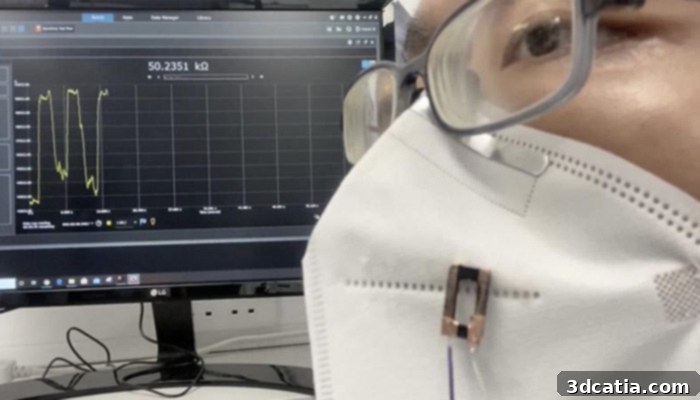
These invisible 3D printed fibers possess a remarkable range of sensory capabilities, allowing them to “smell, hear, and touch” their environment. (Image credits: University of Cambridge )
Practical Applications: Identifying Mask Vulnerabilities and Future Potential
To thoroughly assess the practical utility of their innovation, the Cambridge researchers meticulously applied their advanced sensor technology to both conventional cloth masks and standard surgical masks. Their comprehensive analysis yielded critical insights into the common points of failure in these widely used protective devices. They unequivocally found that for both cloth and surgical masks, the vast majority of leaks originated from the front of the mask, a vulnerability that became particularly pronounced during activities such as coughing, which generate stronger air expulsion. This finding is profoundly important for guiding design improvements and educating the public on how to better wear and maintain these common mask types to maximize their protective benefits. Furthermore, when the sensors were applied to KN95 masks, which are designed for a higher level of filtration and a tighter fit, the researchers observed a different pattern of leakage. In these masks, the leaks were predominantly detected along the sides, suggesting that issues with achieving a proper seal around the facial contours are the primary concern for KN95 users.
These specific findings are invaluable for both manufacturers and the general public, providing concrete data that can inform more effective mask designs and improve user practices. Armed with this knowledge, individuals can be more vigilant about ensuring a snug fit, especially around the areas prone to leakage. Dr. Huang concluded her remarks with an optimistic outlook on the broader impact of their work: “Our fiber sensors are lightweight, inexpensive, small, and easy to use, so they could be converted into home test devices to allow the general public to perform self-administered tests to obtain information about their environments.” This vision points towards a future where sophisticated health monitoring and environmental sensing tools are no longer confined to clinical settings but are readily accessible for everyday personal use. The team’s ambitious long-term goal is to further develop this 3D printing with fiber technique to create a comprehensive series of multifunctional sensors. These next-generation sensors could eventually detect an even wider array of “breath species”—chemical compounds and biological markers present in exhaled breath—paving the way for advanced mobile health monitoring systems or sophisticated bio-machine interface applications. The implications for personalized medicine, early disease detection, and interactive smart environments are immense. We are committed to keeping you informed on all the latest and most exciting developments emerging from this pioneering research.
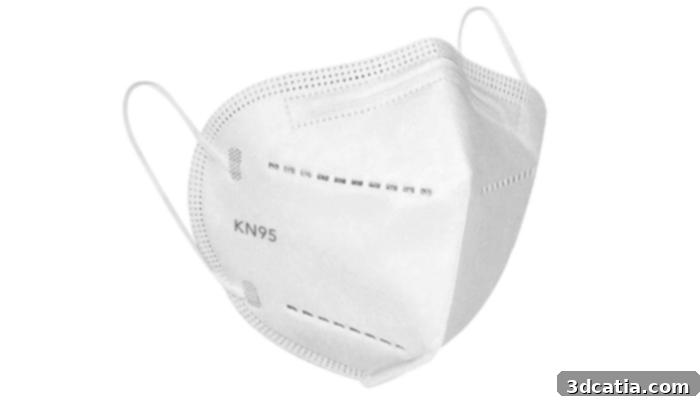
Specifically, in the widely used KN95 masks, the research consistently indicated that leaks predominantly originate from the sides, underscoring the critical need for an optimal facial seal.
What are your thoughts on these invisible yet incredibly powerful 3D printed fibers that can detect leakage in our protective masks and offer unprecedented health insights? We invite you to share your perspectives and comments below, or engage with us on our Facebook and Twitter pages! Don’t miss out on the cutting-edge of additive manufacturing—make sure to sign up for our free weekly Newsletter, delivering all the latest news and innovations in 3D printing directly to your inbox!