
Algae-Based Bioink: Revolutionizing Cultured Meat and 3D Bioprinting for a Sustainable Future
In an era defined by a growing urgency for sustainable solutions and groundbreaking innovation, researchers from Pohang University of Science and Technology (POSTECH) have unveiled a discovery with transformative potential. By masterfully combining the inherent power of algae with visible light, they have successfully engineered a novel bioink that promises to fundamentally change the landscape of cultured meat production. This pioneering, eco-friendly ink, derived from alginate – a natural carbohydrate abundant in various species of algae – is poised to significantly boost cell viability and enhance printing resolution in the rapidly evolving field of 3D bioprinting. This development represents a crucial stride towards addressing global food security challenges and minimizing environmental impact. Let’s explore the intricacies of this exciting innovation and its far-reaching implications for both ecological preservation and the future of our food systems.
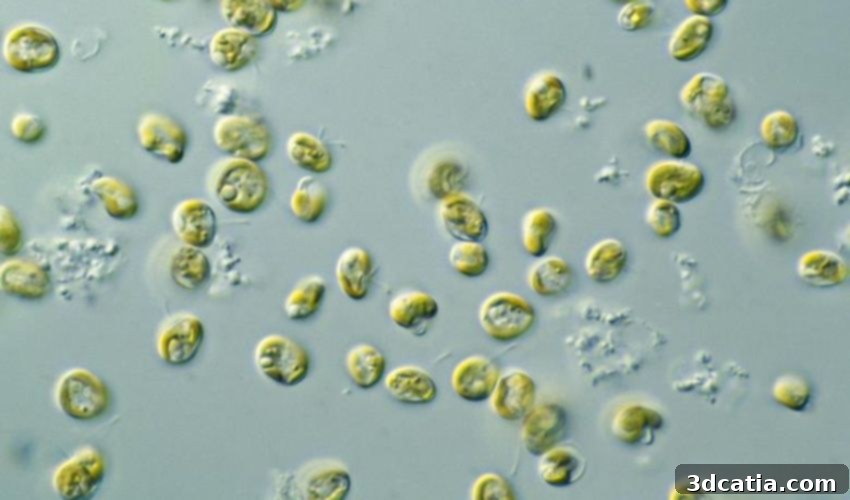
Algae, often underestimated due to its unassuming, soft, and pulpy consistency, possesses extraordinary ecological benefits that are increasingly being recognized. Beyond its well-known capacity to absorb substantial amounts of atmospheric carbon dioxide, algae cultivation generates significantly fewer carbon emissions compared to traditional agricultural practices. Its rapid growth rate, minimal land and freshwater requirements, and ability to thrive in diverse environments make it an incredibly efficient and sustainable biomass source. Researchers worldwide have been intensifying efforts to harness algae’s versatile properties for a myriad of applications, ranging from biofuel production to wastewater treatment and, notably, environmental preservation. In addition to its burgeoning role in sustainable food production, particularly in cultivated meat, algae holds immense promise in advanced biomedical fields, including the engineering of artificial organs and complex tissues for patients suffering from organ failure or debilitating injuries. This extensive potential highlights algae as a cornerstone for future sustainable technologies.
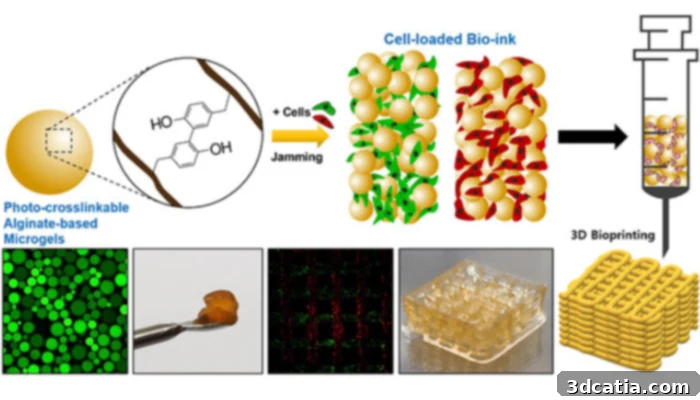
3D printed bioink made from photocrosslinkable natural carbohydrate alginate (Photo credits: POSTECH)
At the forefront of this pioneering research is Professor Hyung Joon Cha and his dedicated team at Pohang University. Their work has primarily centered on overcoming the persistent limitations of conventional bioinks used in 3D bioprinting. Traditional bioinks frequently present significant hurdles, including frustratingly low cell viability, which hinders the survival and proliferation of printed cells, and restricted cell mobility, complicating the formation of intricate tissue structures. To systematically tackle these critical challenges, Professor Cha’s team embarked on developing an innovative microgel utilizing a photocrosslinkable alginate meticulously derived from algae. This ingenious approach involves creating a material that solidifies and stabilizes upon exposure to light, offering precise control over the printing process. The introduction of this novel algae-based bioink has led to a dramatic and statistically significant improvement in cell proliferation, demonstrating a remarkable four-fold increase compared to the performance observed with traditional bioinks. This breakthrough signifies a monumental leap in the efficiency and reliability of bioprinting, paving the way for more complex and functional biological constructs.
The advanced alginate-based bioink developed by the POSTECH team has showcased an array of exceptional material properties crucial for high-fidelity bioprinting. A key characteristic is its shear-thinning behavior, meaning its viscosity decreases under external forces (like those experienced during extrusion through a printer nozzle), allowing for smooth flow and precise deposition. Crucially, the material then rapidly recovers its original shape and structural integrity even after undergoing deformation, a property known as thixotropy. This unique rheological behavior is instrumental in significantly enhancing both the resolution and the lamination capacity of the 3D-printed outcomes. High resolution ensures that intricate details and fine structures can be accurately reproduced, while superior lamination capacity guarantees strong interlayer adhesion, preventing delamination and producing robust, integrated biological constructs. The groundbreaking findings from Professor Cha’s team, meticulously documented and published in the esteemed journal *Carbohydrate Polymers*, are opening up incredibly exciting and diverse possibilities. These range from advancing the frontiers of tissue engineering, enabling the creation of functional biological tissues for repair and replacement, to revolutionizing regenerative medicine through bespoke organ scaffolds, and most notably, accelerating the industrial-scale production of high-quality cultivated meat products.

Research team leader Professor Hyung Joon Cha (Photo credits: POSTECH)
Beyond its superior performance, the newly formulated alginate bioink directly addresses critical concerns regarding the cost and environmental sustainability associated with conventional bioinks. Many traditional bioinks rely on expensive, often animal-derived components, or require complex, energy-intensive synthesis processes. By expertly utilizing alginate derived from readily available algae and employing harmless visible light for crosslinking, the researchers have successfully created a truly eco-friendly and sustainable solution. Furthermore, the economic advantages extend even further: this innovative bioink can be produced affordably and efficiently from abundant food waste streams, such as cereal husks. This remarkable circular economy approach drastically reduces the overall production cost of cultivated meat, making it a more economically viable and accessible alternative to conventional animal agriculture. Moreover, this process offers a compellingly sustainable and ethical alternative to animal-derived products like gelatine and collagen, which are commonly used in tissue engineering and food applications. By minimizing reliance on animal inputs, this algae-based bioink not only reduces environmental footprint but also aligns with growing consumer demand for ethical and cruelty-free products, propelling cultivated meat closer to widespread acceptance and market adoption.
The surging global interest in 3D printed meat and sustainable seafood alternatives underscores a significant shift in consumer preferences and industry direction. Projections indicate that the global 3D printing market is poised for exponential growth, with forecasts predicting it will reach an impressive $44.5 billion by 2026. Within this expanding market, the foodtech industry is experiencing a particularly dynamic transformation. The advent of this algae-based bioink unlocks unprecedented opportunities for this sector, enabling the precise production of cultivated meat with specific, desired textures, complex structures, and nutritional profiles. This level of control allows for the creation of intricate muscle fibers, marbling, and even bone-like structures that mimic conventional cuts of meat. Companies across the globe are intensely engaged in the development of sophisticated 3D-printed meat and seafood options, leveraging these innovative bioprinting technologies to meet the escalating demand for sustainable, ethical, and customized food choices. This technology promises to deliver a new generation of food products that are not only environmentally responsible but also cater to diverse dietary preferences and nutritional needs, driving a paradigm shift in how food is produced and consumed.
The ingenious combination of algae and visible light in the development of this advanced bioink represents a monumental leap forward in the relentless quest for sustainable food production systems. The transformative breakthrough achieved by Professor Cha and his brilliant team at Pohang University emphatically demonstrates the immense, largely untapped potential of algae to revolutionize not only the production of cultivated meat but also the engineering of complex artificial organs and advanced biomedical implants. This environmentally conscious solution offers a comprehensive suite of advantages, including substantially improved cell viability, unparalleled printing resolution, and significantly enhanced cost-effectiveness, thereby addressing critical barriers to widespread adoption. As we collectively embrace this novel, disruptive, and profoundly impactful idea, we move ever closer to realizing a future where eco-friendly and ethically produced food becomes not just an aspiration, but the established norm. This innovation promises to yield profound benefits, positively impacting both human health and the long-term vitality of our precious planet. For a deeper dive into the technical specifics of this research, we encourage you to explore the original source HERE.
What are your thoughts on this incredible 3D printed bioink innovation and its potential impact on the future of food? We invite you to share your perspectives and engage with us in the comments section below, or connect with our community on ourLinkedIn,Facebook, andTwitter pages! To stay updated with all the latest advancements in 3D printing and related technologies, don’t forget to sign up for our free weeklyNewsletter here, delivering the most relevant news directly to your inbox! You can also discover a wealth of insightful content and videos on our dedicatedYouTube channel.
*Cover photo credits: CSIRO