
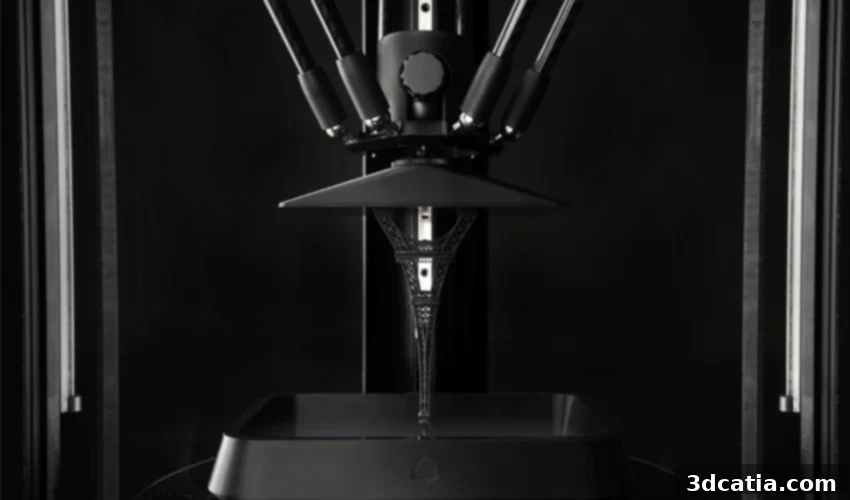
Layer One Atom 3: The Revolutionary Hybrid 3D Printer Fusing FDM and SLA Technologies
The world of additive manufacturing is constantly evolving, pushing the boundaries of what’s possible. Leading this charge is Layer One, an innovative 3D printer manufacturer, which has just unveiled its groundbreaking creation: the Atom 3. This pioneering machine stands out by masterfully combining two distinct and powerful 3D printing technologies: Fused Deposition Modeling (FDM) and Stereolithography (SLA). This strategic integration promises to deliver an unprecedented level of versatility and capability to users, allowing for the creation of parts that demand both robust mechanical properties and exquisite surface detail. For those intrigued by advanced resin printing, be sure to explore our Top 10 resin 3D printers to discover other high-performance machines.
Headquartered in Taiwan, Layer One has a notable history of innovation in the 3D printing space. Several years ago, the company introduced its original 3D delta FDM printer, simply named the Atom, which garnered attention for its design and performance. However, through continuous research and user feedback, Layer One recognized a fundamental limitation in FDM technology when aiming for exceptionally high levels of detail. While FDM excels at producing strong, functional components and rapid prototypes due to its material properties and manufacturing process, it inherently struggles to achieve the ultra-fine features and smooth surface finishes often required for complex or aesthetic applications.
In stark contrast, Stereolithography (SLA) technology offers a pathway to stunning precision and intricate details. SLA printers produce thinner layers, resulting in superior surface quality, higher accuracy, and the ability to capture incredibly fine geometric features. Recognizing the distinct advantages of both methods, Layer One embarked on an ambitious journey to merge these capabilities. With the Atom 3, the company has successfully decided to combine the FDM and SLA processes into a single, cohesive system. This hybrid approach empowers designers, engineers, and hobbyists alike to seamlessly create everything from large, structurally sound parts to small, highly detailed components, eliminating the need for multiple specialized machines and streamlining workflows.
The Imperative for Hybrid 3D Printing: Bridging Performance Gaps
The additive manufacturing landscape is characterized by a diverse array of technologies, each with its unique strengths and weaknesses. For years, users have been forced to choose between the robustness and affordability of FDM and the precision and detail of SLA. This often meant compromising on design freedom or investing in multiple expensive machines. The Atom 3 directly addresses this challenge by offering a compelling “best of both worlds” solution. It’s a testament to Layer One’s commitment to pushing technological boundaries and responding to the evolving needs of the 3D printing community.
Understanding FDM: The Workhorse of 3D Printing
Fused Deposition Modeling (FDM) is perhaps the most widely recognized and accessible 3D printing technology. It operates by extruding a thermoplastic filament, heating it to its melting point, and then depositing it layer by layer onto a build plate. As each layer cools and solidifies, it fuses with the previous one, gradually building up the desired object. FDM printers are renowned for their ease of use, relatively low cost of operation, and the wide range of engineering-grade thermoplastics available, such as PLA, ABS, PETG, and Nylon. These materials offer excellent mechanical properties, including high tensile strength, impact resistance, and thermal stability, making FDM ideal for functional prototypes, jigs, fixtures, and end-use parts where strength and durability are paramount. However, the nature of filament extrusion and layer deposition typically results in visible layer lines and limitations in achieving extremely fine details or perfectly smooth surfaces, which can be a significant drawback for applications requiring aesthetic precision or intricate geometries.
Unveiling Stereolithography (SLA): The Art of High Resolution
Stereolithography (SLA) represents a fundamentally different approach to 3D printing, utilizing a liquid photopolymer resin that cures and hardens when exposed to a specific wavelength of light. In the Atom 3’s implementation, this process is based on a liquid crystal display (LCD) that precisely masks and projects UV light onto a resin vat, solidifying each layer of the part. SLA is celebrated for its ability to produce incredibly smooth surfaces, exceptional detail, and high accuracy, often down to microns. This precision makes it invaluable for creating intricate models, dental aligners, jewelry prototypes, highly detailed figurines, and functional parts where tight tolerances and aesthetic appeal are critical. The smooth finish often requires less post-processing compared to FDM, though parts typically need to be cleaned and post-cured after printing. The trade-offs often include higher material costs, the need for careful handling of liquid resins, and generally more brittle finished parts compared to FDM thermoplastics, depending on the resin type.
Stereolithography offers an exceptional level of detail and surface finish, crucial for intricate designs.
Layer One’s Innovation Journey: From Atom to Atom 3
The evolution from the original Atom FDM printer to the Atom 3 hybrid system showcases Layer One’s continuous drive for innovation. Their initial foray into the 3D printing market with the Atom provided a solid foundation, establishing their expertise in robust machine design. However, the company recognized that simply refining an FDM printer could only go so far in meeting the diverse demands of advanced manufacturing. Lawrence Lee, founder and CEO of Layer One, articulates this realization perfectly:
“Even with our ultra-rigid design and a .2 mm nozzle, it’s impossible to achieve super high detail with FDM, no matter how hard you try. SLA is the only way we can offer this capability to our customers.”
This candid statement underscores the core philosophy behind the Atom 3: to provide users with a truly comprehensive solution that doesn’t force a compromise between strength and detail. By integrating SLA, Layer One is not just adding a feature; they are unlocking new possibilities for product development, prototyping, and customized manufacturing across numerous industries. This strategic move positions the Atom 3 as a potential game-changer, appealing to professionals who require the best of both worlds without the complexity and expense of maintaining separate systems.
Key Features and Specifications of the Atom 3 Hybrid Printer
While Layer One has not yet disclosed all the intricate specifications and advanced features of its highly anticipated hybrid printer, some crucial details have already emerged, giving us a tantalizing glimpse into its capabilities. The Atom 3 is designed to offer a practical and versatile build volume suitable for a wide range of applications, measuring 65 x 120 x 250 mm. This generous print area ensures that users can produce a variety of parts, from small, intricate components to moderately sized functional prototypes. Furthermore, the SLA technology within the Atom 3 will support an impressive layer thickness range of between 25 to 100 microns, allowing for an optimal balance between print speed and the desired level of surface finish and detail. A 25-micron layer height is indicative of truly exceptional resolution, capable of rendering incredibly smooth surfaces and capturing minute features with remarkable fidelity.
Dual-Technology Architecture: Seamless Transition
The essence of the Atom 3 lies in its elegant integration of FDM and SLA. This isn’t just about having two printers in one box; it’s about a thoughtfully engineered system that allows users to switch between technologies with ease. The modular design, as hinted by Layer One, suggests a user-friendly experience that minimizes downtime and complexity. Imagine printing a robust, functional core with FDM for structural integrity, and then adding incredibly detailed features or a smooth outer shell using SLA, all within the same machine and potentially even the same print job (though details on simultaneous printing are yet to be fully revealed). This level of integration has the potential to redefine multi-material and multi-technology additive manufacturing workflows.
Modular Design for Enhanced Usability
Layer One has indicated that its new 3D printer will incorporate a clever modular tray system. This innovative design allows users to easily install a dedicated resin tank when they wish to utilize the SLA printing capabilities. Crucially, it is also on this modular tray that the specialized SLA print head can be quickly and securely fixed, likely by means of powerful magnets, enabling a swift transition between FDM and SLA modes. This magnetic attachment system speaks to a design philosophy focused on user convenience, ensuring that switching technologies is a straightforward and intuitive process, rather than a cumbersome mechanical overhaul. This modularity not only simplifies operation but also enhances the overall versatility and adaptability of the Atom 3, making it a powerful tool for a diverse array of projects requiring different levels of detail and material properties.
The Atom 3 3D printer features a modular tray, allowing for the easy installation of a resin tank for SLA printing.
The Technical Prowess Behind the Atom 3’s SLA
The SLA technology integrated into the Atom 3 will leverage a cutting-edge liquid crystal display (LCD) system. This LCD acts as a dynamic mask, allowing precisely controlled ultraviolet (UV) light to pass through and selectively solidify layers of the liquid photopolymer resin. This method offers several advantages, including faster print speeds for full layers compared to laser-based SLA systems, and a consistent level of detail across the entire build plate. By carefully controlling the exposure of each pixel on the LCD, the Atom 3 can cure intricate geometries with exceptional accuracy, forming the complex shapes desired by the user. This sophisticated yet user-friendly approach to resin curing is central to the Atom 3’s ability to deliver high-resolution prints, setting a new standard for hybrid additive manufacturing solutions.
Anticipated Market Impact and Applications
The introduction of the Atom 3 could genuinely disrupt the current 3D printing market landscape. By offering an all-in-one solution that expertly handles both robust functional parts and finely detailed aesthetic models, Layer One is poised to attract a broad spectrum of users. This includes small businesses and individual creators who previously faced the prohibitive costs and operational complexities of owning and maintaining two separate types of 3D printers. The Atom 3 promises to democratize access to advanced additive manufacturing capabilities, fostering innovation and reducing barriers to entry for high-quality production.
Democratizing Advanced 3D Printing
For many years, achieving both strong, functional prototypes and high-resolution, detailed models required significant investment in multiple machines and expertise in different software ecosystems. The Atom 3 simplifies this by consolidating these capabilities into a single, cohesive unit. This accessibility means that product designers can iterate faster, creating initial functional prototypes with FDM and then refining intricate details or producing presentation-ready models with SLA. Educational institutions can offer a more comprehensive understanding of additive manufacturing technologies to their students, while small businesses can expand their service offerings without a massive capital outlay. This fusion represents a significant leap forward in making versatile 3D printing technology available to a wider audience, fostering creativity and driving innovation at all levels.
Potential Across Industries
The applications for a hybrid FDM/SLA printer like the Atom 3 are incredibly vast and diverse. In **product design and engineering**, it enables the creation of complex prototypes that require both structural integrity and intricate surface features, speeding up the development cycle. For **jewelry makers**, it could mean quickly printing master patterns with high detail for casting, alongside functional tools or fixtures using FDM. The **dental industry** might utilize FDM for robust models and SLA for highly accurate surgical guides or aligner molds. **Hobbyists and artists** will find unparalleled freedom in creating models that combine strong bases with delicate, artistic details. Even in **medical applications**, such as patient-specific anatomical models for surgical planning, the ability to print both sturdy and highly detailed components from a single machine offers immense advantages. The Atom 3’s ability to switch seamlessly between technologies opens up new horizons for customized manufacturing, enabling complex, multi-functional parts that were previously difficult or costly to produce.
A Glimpse into the Future: Atom 3’s Expected Release
Layer One has optimistically announced that deliveries of the Atom 3 printer are expected to commence within one year. Although the machine is currently in its prototype stage, the ambition and potential it represents are clear. The successful realization of this project could indeed revolutionize the market, solidifying the Atom 3’s position as a pioneering all-in-one solution that sets new benchmarks for versatility and performance in the additive manufacturing industry. The anticipation surrounding its release is palpable, and the 3D printing community eagerly awaits the opportunity to experience its capabilities firsthand.
Explore Further: Video and Official Resources
To delve deeper into the innovative features and potential of this hybrid machine, we encourage you to watch the insightful video presentation below. For the most up-to-date information, technical specifications, and news directly from the manufacturer, be sure to check out the Layer One official website. This resource will provide comprehensive details as they become available, keeping you informed about this exciting development in 3D printing technology.
Join the Conversation
What are your thoughts on the groundbreaking Layer One Atom 3 and its potential to transform 3D printing workflows? We’d love to hear your opinions, predictions, and any questions you might have about this innovative hybrid printer! Share your insights by leaving a comment below, or join the discussion on our vibrant Facebook or Twitter page. Don’t miss out on the latest advancements and breaking news in the additive manufacturing sector; be sure to sign up for our free weekly Newsletter, delivering all the essential updates directly to your inbox!