
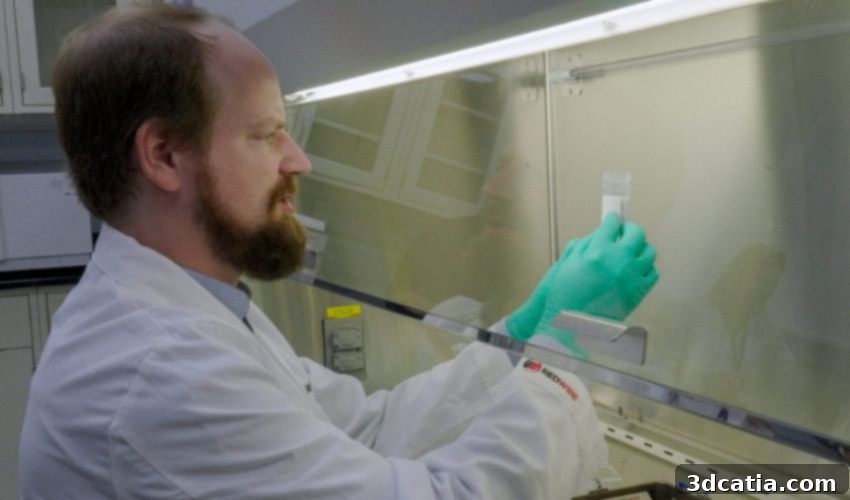
Redwire Achieves Historic Breakthrough: First Human Knee Meniscus 3D Bioprinted Aboard the ISS
The relentless pursuit of innovation in outer space continues to push the boundaries of human achievement, and at the forefront of this revolution is additive manufacturing. Its inherent flexibility and unparalleled ability to facilitate local production have cemented its role in space exploration, offering solutions from 3D printed habitats to customized sustenance for astronauts. Now, a new chapter in this exciting journey has unfolded with a groundbreaking announcement from Redwire. The company has successfully 3D bioprinted the first-ever human knee meniscus in orbit, a monumental feat accomplished within the advanced 3D BioFabrication Facility (BFF) aboard the International Space Station (ISS).
This pioneering project, known as the BFF-Meniscus-2 Investigation, represents a critical collaboration with the Uniformed Services University of the Health Sciences Center for Biotechnology (4D Bio3). 4D Bio3 stands as a dedicated biomedical research center, committed to exploring and adapting cutting-edge biotechnologies – including, but not limited to, bioprinting – specifically for the benefit and well-being of warfighters. This partnership underscores a shared vision for leveraging advanced manufacturing in space to address pressing medical challenges, both in orbit and on Earth.
Pioneering In-Space Manufacturing: Redwire’s Legacy and Vision
Redwire is no stranger to the unique environment of the ISS, having established itself as a leading innovator in microgravity research and development. The company has developed an impressive portfolio of 20 research facilities for the ISS, with 10 currently operational and consistently delivering groundbreaking results. Their previous work spans a diverse range of applications, from investigating the potential use of regolith – lunar dust – to 3D print structures on the Moon and Mars, to earlier forays into bioprinting.
Indeed, this recent achievement marks a significant evolution in Redwire’s bioprinting endeavors. In 2019, the BFF successfully 3D printed a meniscus-shaped scaffold using a bioink derived from human tissue proteins. While that was a notable step, the BFF-Meniscus-2 experiment elevates the game entirely. This latest mission represents the very first instance of a full human knee meniscus being bioprinted in space, crucially utilizing living cells. This distinction is vital, as it moves beyond structural replication towards true biological reconstruction. The implications of this milestone are vast, offering new hope for improved treatments for meniscal injuries, which are not only among the most widespread knee injuries globally but also disproportionately affect U.S. service members, impacting their readiness and quality of life.
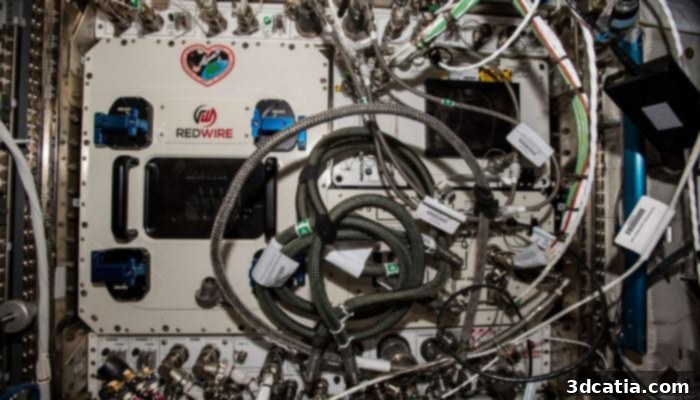
The 3D bioprinted meniscus was created using Redwire’s specialized bioprinter, recently installed on the ISS, showcasing the potential for in-space regenerative medicine.
Understanding Meniscal Injuries: A Global Health Challenge
Making the 3D Bioprinted Meniscus a Reality
Meniscal injuries, particularly torn menisci, stand as some of the most pervasive and debilitating knee ailments. The knee joint houses two crucial crescent-shaped pieces of cartilage, the menisci, which serve as vital shock absorbers, distributing weight and stabilizing the knee during movement. When damaged, often due to twisting motions or direct impact, the consequences can be severe. Symptoms frequently include persistent pain, swelling, stiffness, and alarmingly, the catching or locking of the knee joint, along with a significant reduction in the ability to fully extend or bend the leg. These limitations can profoundly impact an individual’s mobility and overall quality of life.
Current treatments for meniscal tears range from conservative management and physical therapy to surgical interventions such as repair or partial removal (meniscectomy). However, these approaches often face challenges. Meniscal repair can be complex and not always successful, especially for certain types of tears or in older patients. Meniscectomy, while offering immediate relief, can accelerate the onset of osteoarthritis due to the loss of the meniscus’s shock-absorbing capabilities. The long-term prognosis for many meniscal injury patients can therefore be grim, highlighting an urgent need for more effective and regenerative solutions.
This is precisely why Redwire views the successful bioprinting of a human knee meniscus in space as an incredible milestone with profound implications for human health, not only for astronauts but also for millions on Earth. The ability to biofabricate functional, living tissue replacements could revolutionize orthopedic medicine, offering a path to truly regenerate damaged knee structures rather than merely repairing or removing them. This innovation holds particular promise for U.S. service members, for whom meniscal injuries are a leading cause of medical discharge and long-term disability, directly impacting military readiness and veteran health.
The Microgravity Advantage: How Space Enables Breakthrough Bioprinting
The process of creating the 3D bioprinted meniscus leveraged the unique environment of the ISS and Redwire’s specialized technology. The BFF meticulously constructed the meniscus by utilizing living human cells suspended within advanced bioinks. These bioinks were then precisely extruded layer-by-layer by a sophisticated bioprinter, a critical piece of equipment specifically designed and installed on the ISS for such groundbreaking experiments. The precision afforded by additive manufacturing in this context allows for the intricate architecture of the meniscus to be replicated with high fidelity.
Following the successful printing, the nascent meniscus underwent a crucial 14-day culturing period within Redwire’s Advanced Space Experiment Processor (ADSEP) on the ISS. This extended culturing phase allowed the living cells to proliferate, differentiate, and begin forming the complex extracellular matrix that gives the meniscus its structural integrity and biological function. The choice to conduct this entire process in microgravity is not arbitrary; it offers distinct advantages over terrestrial bioprinting. On Earth, gravity can cause cells to settle unevenly within bioinks, leading to structural inconsistencies and limitations in fabricating complex, three-dimensional tissues without extensive scaffolding. In microgravity, however, cells can self-assemble and aggregate more uniformly, potentially leading to denser, more organized tissue structures with enhanced biological function and mechanical properties. This environment facilitates the creation of complex tissue constructs that might be difficult, if not impossible, to produce with the same quality and scale under normal gravitational conditions.
From Orbit to Operating Room: The Journey of the First Space-Bioprinted Meniscus
Upon the completion of its 14-day culturing period, the bioprinted meniscus embarked on its journey back to Earth, carefully transported aboard the SpaceX Crew-6 Mission. This critical return allowed for comprehensive analysis and investigation by a team of esteemed experts, including NASA astronauts Frank Rubio, Warren “Woody” Hoburg, and Stephen Bowen, alongside UAE astronaut Sultan Al Neyadi. Their meticulous examination on Earth will provide invaluable data, confirming the viability, structural integrity, and cellular functionality of the space-bioprinted tissue. The findings from this analysis are expected to unlock deeper insights into the effectiveness of in-space bioprinting and pave the way for future advancements in regenerative medicine.
Looking ahead, Redwire is already charting an ambitious course for future projects. An upcoming SpaceX CRS-29 resupply mission, scheduled for November, will carry additional microgravity research payloads from Redwire. These experiments will focus on vital areas such as pharmaceutical drug development and further advancements in regenerative medicine. In a particularly exciting development, a press release indicates that one of these upcoming experiments will aim to bioprint cardiac tissue, signifying Redwire’s commitment to tackling complex organ structures and broadening the scope of what is possible through in-space biomanufacturing. This sustained effort promises to unlock even more potential for treating a wide array of human ailments, both in space and on our home planet.
Pioneering the Future of Regenerative Medicine: Redwire’s Vision
Reflecting on the successful completion of the 3D bioprinted knee meniscus, Redwire Executive Vice President John Vellinger encapsulated the profound significance of this achievement. He stated, “This is a groundbreaking milestone with significant implications for human health. Demonstrating the ability to successfully print complex tissue such as this meniscus is a major leap forward toward the development of a repeatable microgravity manufacturing process for reliable bioprinting at scale.” Vellinger’s words highlight not just the immediate success but the broader strategic vision: establishing a robust and scalable manufacturing process in space. This capability would allow for the routine production of bioprinted tissues and organs, transforming the landscape of medical treatment.
The long-term implications of Redwire’s work extend far beyond individual meniscal repairs. By demonstrating the feasibility of bioprinting complex, living tissues in microgravity, Redwire is laying the foundation for a future where organs and tissues could be fabricated on demand for transplant patients, addressing critical shortages and reducing reliance on donors. Furthermore, this technology is indispensable for long-duration space missions, where astronauts face unique health challenges and need on-site medical solutions. Imagine a future where vital organs or complex tissues can be bioprinted directly in space to treat injuries or illnesses during deep-space exploration. Redwire is at the forefront of making this vision a tangible reality, shaping the future of regenerative medicine both on Earth and in the cosmos. You can learn more about Redwire’s innovative work and ambitious goals on their official website HERE, or gain further insights into the motivations behind this project from Dr. Aaron R. in the informative video below.
What are your thoughts on this incredible achievement in 3D bioprinting a human knee meniscus in space by Redwire? We invite you to share your comments below or engage with us on our LinkedIn, Facebook, and Twitter pages! Don’t miss out on the latest advancements in additive manufacturing – sign up for our free weekly Newsletter here to get the freshest 3D printing news delivered straight to your inbox! You can also explore all our insightful videos and interviews on our dedicated YouTube channel.
*All Photo Credits: Redwire