
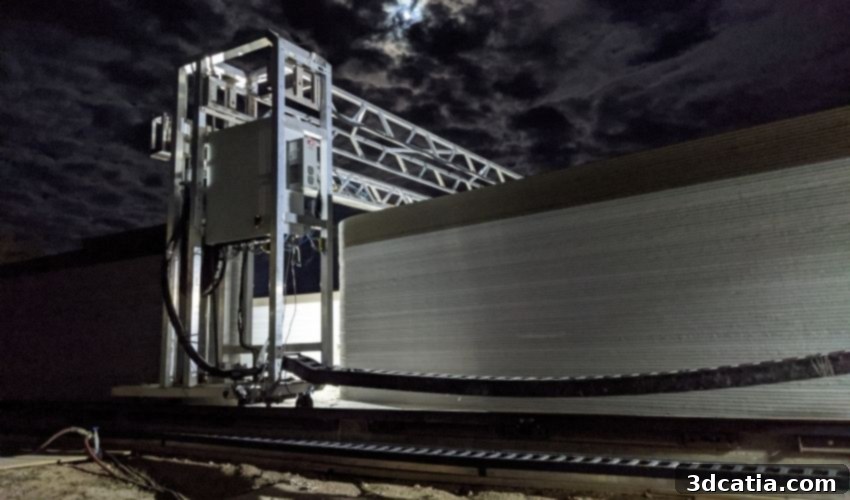
ICON Unveils North America’s Largest 3D-Printed Barracks: A Leap Forward for Military & Humanitarian Construction
Austin-based innovator, ICON, is once again making headlines, this time by bringing its groundbreaking 3D printing construction technology to Earth, specifically for the U.S. military. In a landmark collaboration, ICON has partnered with the Texas Military Department, Logan Architecture, and Fort Structures to complete North America’s largest 3D-printed structure: state-of-the-art training barracks at the Camp Swift Training Center in Bastrop, TX. This ambitious project, utilizing ICON’s revolutionary Vulcan construction system, marks a significant milestone as it represents the first time U.S. soldiers will reside in 3D-printed barracks, heralding a new era of rapid, resilient, and cost-effective military infrastructure. This initiative is not just about domestic training facilities; the U.S. military is actively exploring the potential of this technology for a wide array of future projects, including critical overseas deployments and crucial humanitarian aid buildings.
ICON’s recent activities demonstrate a relentless pursuit of innovation across diverse applications. Just a few months prior, in March, the company unveiled the first 3D-printed multi-home project in Texas, known as the East 17th Street Residences. These multi-story homes were not only designed for aesthetic beauty but also engineered for sustainability and durability, showcasing the potential of additive construction to address modern housing challenges. Building on this momentum, earlier this month, ICON was recognized as the innovator behind a 3D-printed “Mars Surface Habitat.” This extraordinary structure was specifically engineered to house participants for a year-long study meticulously designed to simulate the challenging conditions and daily life on Mars, highlighting ICON’s incredible versatility in applying its technology from terrestrial housing solutions to extraterrestrial exploration. At the heart of all these diverse and ambitious endeavors lies ICON’s renowned Vulcan construction system—a sophisticated, tablet-operated robotic printer capable of fabricating entire buildings and homes using a specially formulated, cement-based material. This system’s automation, speed, and precision are what empower ICON to undertake such diverse and impactful projects, pushing the boundaries of what is possible in construction.
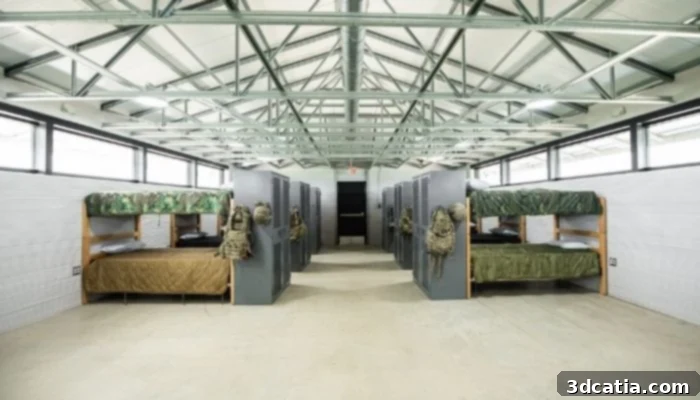
The inside of the barracks have been designed to fit up to 72 soldiers or airmen during their training (photo credits: ICON)
The recently completed barracks at Camp Swift represent a significant achievement in construction 3D printing. Spanning an impressive 3,800 square feet, this innovative building is designed to accommodate up to 72 soldiers or airmen, providing robust and efficient lodging during their essential training missions. The architectural design was skillfully handled by Logan Architecture, while Fort Structures provided critical structural engineering expertise, ensuring the building’s integrity and functionality. This groundbreaking project was made possible through a Strategic Fund Increase (STRATFI contract) via AFVentures, with an initial contribution from the Texas Military Department, underscoring the collaborative spirit driving this initiative. The military’s embrace of 3D printing is not entirely new; the U.S. military has increasingly explored additive manufacturing in recent years for various applications, from spare parts to specialized tools. However, this project takes the application of construction 3D printing to an unprecedented scale within military infrastructure. The primary advantage that construction 3D printing offers, and the fundamental reason why the Texas Military Department (TMD) opted for this advanced technology, is its unparalleled ability to deliver finished barracks significantly faster than traditional construction methods. This acceleration in construction allows the TMD to efficiently replace outdated temporary barracks with more durable, permanent, and modern structures, thereby enhancing the quality of life and readiness for service members. Beyond domestic training sites, this technology is also being actively considered as a game-changing solution for forward-deployed locations, where it could dramatically reduce construction timelines, lower overall costs, and mitigate the inherent risks associated with building in challenging or remote environments.
Looking ahead, the U.S. military envisions extending the application of this transformative technology beyond military installations to critical humanitarian purposes. Officials have specifically highlighted its immense potential for organizations like the National Guard, which frequently operates on the front lines of Humanitarian Assistance and Disaster Relief (HADR) missions. In the aftermath of natural disasters, communities often face an immediate and overwhelming need for robust infrastructure and dignified shelter. By leveraging 3D printing for construction, the U.S. military will be equipped with an unprecedented capability to rapidly erect essential infrastructure and provide vital support to communities grappling with the arduous task of rebuilding. This application holds particular relevance for the Southern states and U.S. territories, regions frequently impacted by severe natural phenomena such as hurricanes, earthquakes, and other catastrophic events. Since 1980, these disasters have inflicted over $1.975 trillion in damages across the country, with homelessness resulting from destroyed homes often emerging as one of the most pressing and heartbreaking issues in the wake of a crisis. The ability to quickly and efficiently construct resilient homes and community buildings using 3D printing could significantly alleviate suffering, accelerate recovery efforts, and provide long-term stability for affected populations, offering a truly impactful solution for humanitarian challenges.
The innovative approach to construction championed by ICON is seen as just the initial phase of a much broader transformation, a sentiment powerfully articulated by Evan Loomis, co-founder of ICON. He expressed, “It is an honor for the ICON team to work alongside TMD, AFWERX, and the Defense Innovation Unit to have created these resilient, energy-efficient 3D-printed barracks that soldiers can now call home during their training. ICON continues our missional work to deliver dignified, resilient shelter for social housing, disaster-relief housing, market-rate homes, and now, homes for those serving our country. We are scaling this technology across Texas, the U.S., and eventually the world. This is the beginning of a true paradigm shift in homebuilding.” Loomis’s statement underscores ICON’s overarching vision: to leverage advanced additive manufacturing for a diverse range of societal needs, from providing stable housing solutions for vulnerable populations to enabling rapid deployment for military and disaster relief efforts. This pioneering work with the Texas Military Department not only showcases the immediate practical benefits of construction 3D printing but also serves as a potent testament to its potential to fundamentally reshape the global construction landscape, making housing more accessible, sustainable, and resilient for everyone. The company’s commitment to scaling this technology signifies a future where rapid, on-demand construction could become the norm, addressing critical infrastructure gaps and housing shortages worldwide.
The transformative implications of ICON’s work extend far beyond individual projects. Construction 3D printing offers a compelling array of benefits that address some of the most pressing challenges in the modern world. Its ability to significantly reduce construction timelines means that essential infrastructure, whether military barracks or emergency shelters, can be deployed with unprecedented speed. This efficiency also translates into substantial cost savings by minimizing labor requirements, optimizing material usage, and reducing waste, making construction more economical and sustainable. Furthermore, the inherent versatility of ICON’s Vulcan system allows for the creation of structurally robust and resilient buildings capable of withstanding harsh environmental conditions, a critical factor for both military operations in diverse climates and humanitarian efforts in disaster-prone regions. By integrating automation and digital design, the technology enhances precision and consistency, leading to higher quality structures with less room for human error. This paradigm shift holds immense potential for addressing the global housing crisis, facilitating rapid urban development, and even enabling off-world habitation in the future. The collaboration between ICON and the U.S. military exemplifies how innovative technology can be harnessed to serve both national security interests and broader humanitarian goals, setting a new benchmark for what is achievable in the realm of modern construction.
You can find out more about the project in the video below or in the press release HERE.
What are your thoughts on these innovative 3D-printed military barracks and the broader potential of construction 3D printing? We invite you to share your insights in a comment below or join the conversation on our Facebook and Twitter pages! Don’t miss out on the latest advancements and news in additive manufacturing—be sure to sign up for our free weekly newsletter to receive all the essential 3D printing updates directly in your inbox!
*Thumbnail Photo Credits: ICON