
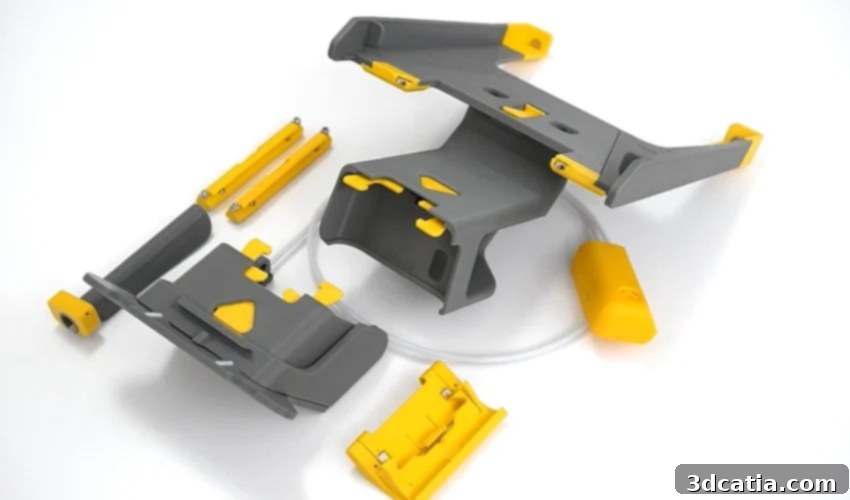
Transforming 3D Printing: The Swapmod Automation Kit for Bambu Lab A1 Mini Unlocks Unattended Production
The world of desktop 3D printing is experiencing a significant shift towards greater automation and efficiency, and leading this charge is an innovative solution known as Swapmod. Designed specifically for the highly popular Bambu Lab A1 Mini 3D printer, the Swapmod automation kit recently concluded a hugely successful Kickstarter campaign, far surpassing its initial financial targets. Originally setting a goal of $5,391, the project soared to an impressive $51,785, garnered from the enthusiastic support of 661 backers. This overwhelming success underscores a strong market demand for intelligent solutions that streamline the 3D printing workflow.
At its core, Swapmod aims to elevate the A1 Mini from a personal desktop printer to a semi-automated manufacturing powerhouse. The ambitious vision behind this project is to empower the A1 Mini with the capability to automatically change its build plates. This seemingly simple yet revolutionary feature opens up unprecedented possibilities for continuous, lights-out production, drastically reducing operational costs and minimizing the need for constant human supervision. For hobbyists looking to print large batches of parts or small businesses seeking to scale their production without significant capital investment, Swapmod presents a compelling and accessible solution.
Swapmod is more than just an accessory; it’s an ingeniously designed add-on that integrates seamlessly with the A1 Mini. Its promise of “easy-to-install” is a key selling point, making advanced automation accessible even to users with limited technical expertise. Once installed, the kit transforms the printer’s capabilities, enabling it to automatically load a fresh build plate, execute a print job, and then efficiently replace the printed plate with another. This cycle can continue autonomously, fundamentally altering the user experience. Whether a user is tackling an extensive, multi-part project that requires numerous build plates or simply mass-producing a single model multiple times, Swapmod eliminates the tedious and time-consuming necessity of manually monitoring and resetting the printer after each completed job. This intelligent automation solution is meticulously engineered to supercharge the efficiency of 3D printing operations. By automating the most repetitive aspect of the printing process – build plate management – Swapmod not only boosts overall productivity but does so without forcing users to incur the substantial costs associated with acquiring multiple new 3D printers or larger, industrial-grade machines. It democratizes serial production, bringing capabilities typically reserved for high-end facilities into the realm of desktop 3D printing.
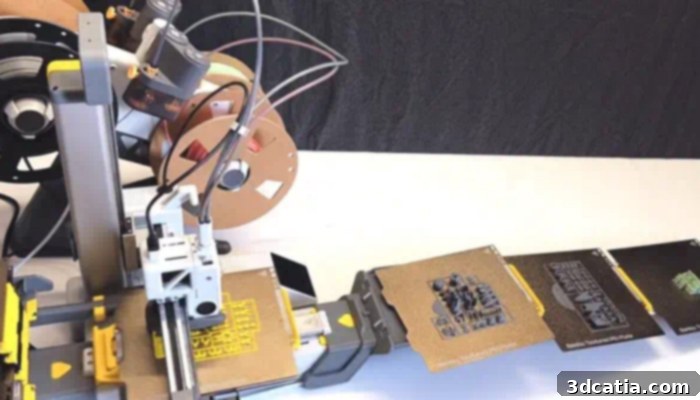
Swapmod system enables automatic serial printing on Bambu Lab’s A1 Mini
The Strategic Advantages of the Swapmod Multi-Plate System for Automated 3D Printing
The Swapmod system introduces a sophisticated approach to build plate management that delivers several profound advantages, setting a new benchmark for automated desktop 3D printing. These benefits cater to a wide range of users, from hobbyists eager to complete large projects to small businesses aiming for continuous, efficient production.
- Optimized Efficiency and Uninterrupted Production: Perhaps the most compelling advantage of Swapmod is its ability to facilitate truly continuous operation. By automating the build plate change process, Swapmod allows for a seamless series of prints without any manual intervention from the user. This means the printer can run 24 hours a day, 7 days a week, effectively turning an A1 Mini into a mini-factory capable of ‘lights-out’ manufacturing. Users can initiate a batch of prints before leaving for work, going to bed, or even for a weekend trip, returning to a collection of completed parts without ever having to touch the printer mid-process. This significant reduction in idle time and manual labor dramatically increases overall output and makes even the most ambitious projects more manageable.
- Enhanced Print Security and Error Isolation: In conventional 3D printing, a single print failure can often halt an entire project, potentially wasting significant amounts of filament and valuable time. Swapmod addresses this critical issue by enhancing print security through its individual tray management. If a print on one build plate fails due to bed adhesion issues, model corruption, or other unforeseen problems, only the parts on that specific tray are affected. The Swapmod system is designed to detect such failures (or proceed to the next plate based on predefined settings) and simply eject the problematic tray, then seamlessly load the next available plate. This isolation of failures ensures that the printer can continue to execute the remaining print jobs without compromising the integrity or progress of the entire production run, minimizing material waste and maximizing the successful completion rate of larger batches.
- Convenient Remote Control Capabilities: In today’s interconnected world, remote management is a highly coveted feature, and Swapmod delivers on this front. The system integrates intelligent automation scripts that allow users to control the tray change process remotely. This functionality is accessible via Bambu Handy, the intuitive mobile application developed by Bambu Lab. This means users can monitor print progress, initiate new print sequences, or even intervene in the tray change process from virtually anywhere, using their smartphone. This level of remote control offers unparalleled convenience and flexibility, allowing users to manage their 3D printing tasks even when they are not physically present next to the machine, further enhancing the system’s efficiency and user-friendliness.
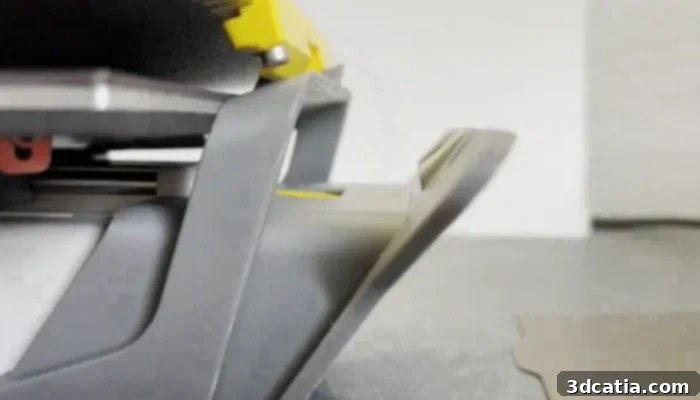
The Swapmod ejects plates using 3D-printed parts and a few additional components supplied in the kit.
One of Swapmod’s most compelling selling points lies in its profound ability to scale production capabilities with minimal financial investment. For small businesses, individual makers, or even educational institutions, the cost of acquiring multiple 3D printers or investing in large, industrial-grade machines for batch production can be prohibitive. Swapmod bypasses this barrier by allowing users to automate a significant portion of their printing workflow using their existing Bambu Lab A1 Mini. This approach not only dramatically reduces initial capital expenditure but also significantly lowers ongoing operational costs. By minimizing the need for constant manual oversight, it effectively reduces labor costs associated with print management. Furthermore, the ability to run prints continuously means less printer downtime, maximizing the return on investment for the A1 Mini itself. Swapmod empowers a new wave of localized, small-scale manufacturing, making serial production more accessible and economically viable for a broader audience.
Seamless Integration with BambuStudio and OrcaSlicer through Swaplist
A critical aspect of any 3D printer accessory is its compatibility with existing software ecosystems, and Swapmod excels in this regard. It integrates effortlessly with two of the most popular and powerful slicer software packages in the 3D printing community: BambuStudio and OrcaSlicer. These slicers are renowned for their advanced features, ease of use, and robust performance, and Swapmod ensures that users can continue to leverage their preferred slicing environment without interruption.
While BambuStudio and OrcaSlicer offer extensive functionalities for single-plate printing, they do not yet natively support multi-platform printing sequences. This is where Swapmod introduces its ingenious solution: a dedicated third-party application called “Swaplist.” Swaplist is specifically developed to bridge this gap, acting as the intelligent orchestrator for multi-plate print jobs. Its design prioritizes accessibility and user convenience; Swaplist is a lightweight application that runs directly in a standard web browser, eliminating the need for any complex installation processes or recurring subscription fees. This browser-based approach ensures universal accessibility, allowing users to manage their print queues from any device with an internet connection.
Swaplist offers a robust set of features tailored for automated serial printing. It empowers users to meticulously create a queue of build plates to be printed, defining the precise order of each print job. This granular control is essential for complex projects or when managing different materials and settings across multiple plates. Furthermore, Swaplist allows for the combination of several different 3D models or files within a single print sequence. This feature is invaluable for users who need to print various components of an assembly or multiple iterations of a design in a continuous flow, maximizing the efficiency of the Swapmod system.
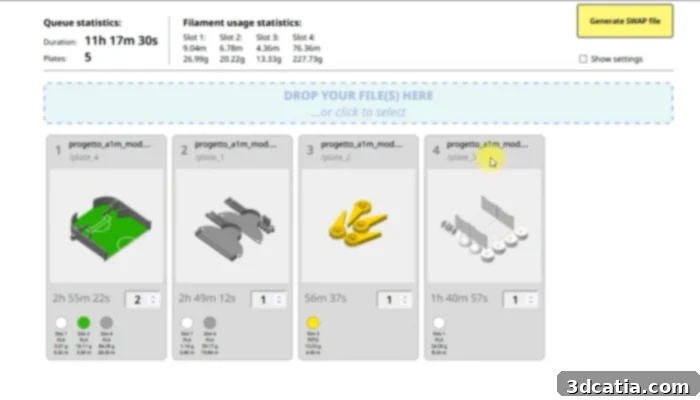
To use Swapmod, simply slice your prints on Bambu Studio or OrcaSlicer, then create a serial print file with automated tray changes on the dedicated web interface.
The operational workflow with Swapmod and Swaplist remains remarkably intuitive and closely mimics the process that seasoned BambuStudio and OrcaSlicer users are already accustomed to. After designing their 3D models and generating the essential G-code or 3mf files through their preferred slicer, users simply drag and drop these prepared files directly into the Swaplist web interface. This action queues up the print jobs, specifying the order and settings for each build plate. Once the print sequence is initiated via Swaplist, the Swapmod kit takes over completely, meticulously handling the automatic loading of fresh build plates, overseeing the printing process, and then efficiently replacing the completed plates. This streamlined approach ensures a smooth, largely hands-off operation, allowing users to focus on design and innovation rather than repetitive manual tasks.
Important Considerations: Limits and Warnings for Swapmod Users
While the Swapmod project presents an undeniably promising future for automated desktop 3D printing, it is crucial for potential users to be aware of certain limitations and warnings before committing to the system. Understanding these aspects will help set realistic expectations and inform responsible usage.
Firstly, geographical availability is currently a significant constraint. At present, Swapmod cannot be shipped to the USA due to undisclosed legal reasons. The project’s creator has openly communicated this limitation, estimating that a version specifically adapted and cleared for commercialization within the US market will become available by the first or second quarter of 2025. This suggests that the legal hurdles might be related to patents, intellectual property, or specific product certifications required for sales in the United States. Beyond the US, certain other regions of the world are also temporarily excluded from shipping, primarily due to logistical complexities that the team is actively working to resolve.
Secondly, a very important consideration for any Bambu Lab A1 Mini owner is the potential impact on their printer’s warranty. It is highly probable that installing the Swapmod kit will void the existing warranty of the A1 Mini 3D printer. Bambu Lab, the manufacturer, specifies particular space requirements and operational guidelines around their printers, and the physical footprint and operational mechanics of Swapmod likely contravene these recommendations. Users must carefully weigh the benefits of enhanced automation against the risk of losing their manufacturer’s warranty and the associated support for their A1 Mini.
Finally, while Swapmod has undergone extensive testing and development, as with any automated mechanical system, there is always a potential risk of failure during the critical loading or unloading sequences of the build plates. Such failures could range from a plate not ejecting cleanly, a new plate failing to seat correctly, or minor mechanical hitches. While these risks are inherent in automation and often addressed through robust design, users should be prepared for occasional troubleshooting and ensure the system is monitored, especially during initial runs or when printing critical parts.
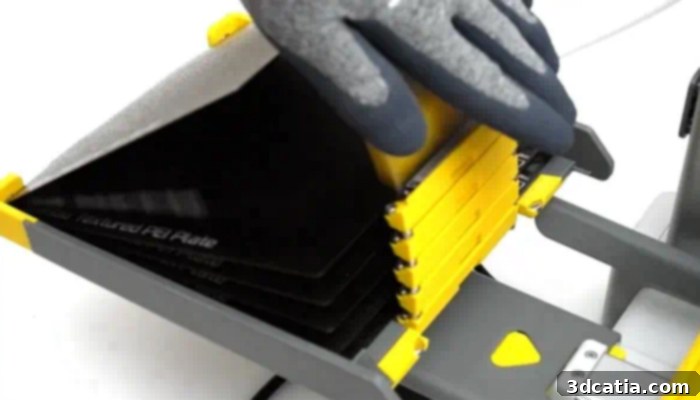
Swapmod can store up to 10 build plates in its storage bay
The Highly Anticipated Launch and Future Impact of Swapmod
The anticipation surrounding Swapmod’s launch is palpable within the global community of makers and 3D printing enthusiasts. The project has already garnered significant attention, backed by several positive early reviews and numerous demonstration videos available online, all highlighting its innovative capabilities and robust performance. These early insights have solidified Swapmod’s reputation as a game-changer, generating considerable excitement for its widespread release.
Designed primarily as a do-it-yourself (DIY) assembly kit, Swapmod promises a quick and straightforward installation process. This DIY approach not only makes the technology more accessible but also taps into the maker community’s preference for hands-on engagement and customization. Despite its DIY nature and consumer-friendly price point, Swapmod is engineered to deliver performance levels that are remarkably comparable to far more expensive industrial automation solutions. This extraordinary value proposition means that sophisticated, continuous 3D printing is no longer the exclusive domain of large corporations or high-budget operations.
The introduction of this kit could very well herald the beginning of a new, transformative trend in semi-automated home 3D printing. By democratizing access to continuous, multi-plate printing, Swapmod makes small-batch mass production more accessible and economically viable than ever before for individuals, small businesses, and educational institutions. This paradigm shift has the potential to empower creators and entrepreneurs, enabling them to produce complex prototypes, customized products, or small manufacturing runs with unprecedented efficiency and reduced labor. Swapmod is not just an upgrade for a 3D printer; it represents a significant leap towards a future where sophisticated automated manufacturing is within reach of anyone with a desktop 3D printer. To delve deeper into the innovative features and potential of the Swapmod kit, interested individuals are encouraged to visit their successful Kickstarter page HERE.
What are your thoughts on Swapmod’s potential to revolutionize desktop 3D printing? Let us know in a comment below or join the conversation on our LinkedIn, Facebook, and Twitter pages! Don’t forget to sign up for our free weekly newsletter here for the latest 3D printing news straight to your inbox! You can also find all our videos on our YouTube channel.