
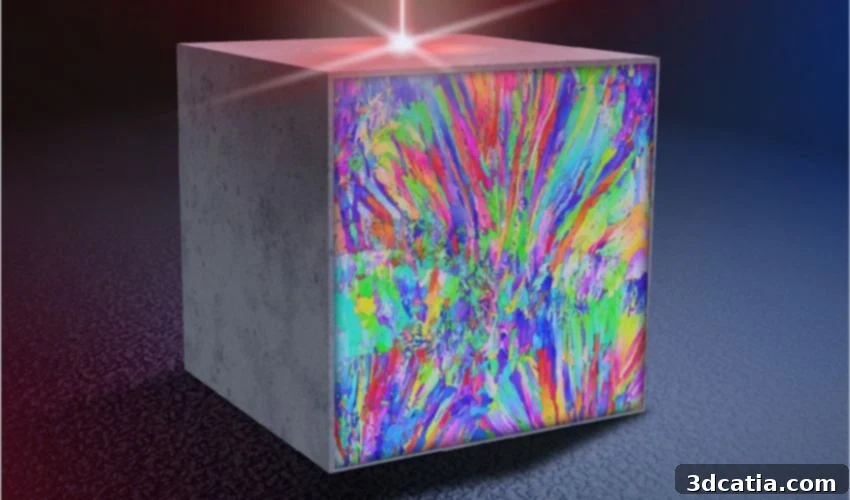
Customizing Metal Properties with Additive Manufacturing: Tailoring High-Entropy Alloys for Advanced Applications
Imagine having the ability to fine-tune the properties of metals, making them either incredibly strong yet brittle, like a ceramic tile, or flexible and easily bendable, like a paperclip. Achieving this level of control requires meticulous manipulation of a material’s internal structure during its formation process. Now, scientists have demonstrated a groundbreaking method to accomplish precisely that by tailoring high-entropy alloys (HEAs) through the innovative process of additive manufacturing (AM), also known as 3D printing. This innovative approach opens doors to creating materials with unprecedented properties, paving the way for advancements across various industries.
Researchers from the esteemed Lawrence Livermore National Laboratory (LLNL) in the United States, in collaboration with other experts, conducted a comprehensive investigation into how processing conditions can be strategically employed to customize next-generation high-entropy alloys. Their work focuses on leveraging the unique capabilities of additive manufacturing to control the solidification process and ultimately influence the microstructure and mechanical properties of these advanced materials.
This study specifically aimed to unravel the intricate relationship between solidification rate and the evolution of microstructure and phase transformation pathways in laser additively manufactured HEAs. The research focused on a specific eutectic HEA composition, AlCrFe₂Ni₂, showcasing the potential for tailoring properties in this material system. The researchers skillfully controlled the solidification rate by precisely adjusting laser scanning speeds during the additive manufacturing process. By manipulating the laser speed, they were able to alter the rate at which the metal cooled, which in turn had a profound impact on its internal structure and the resulting material properties. To gain a deeper understanding of the underlying mechanisms, the team employed sophisticated thermodynamic modeling and molecular dynamics simulations to model the 3D printing process of these HEAs.
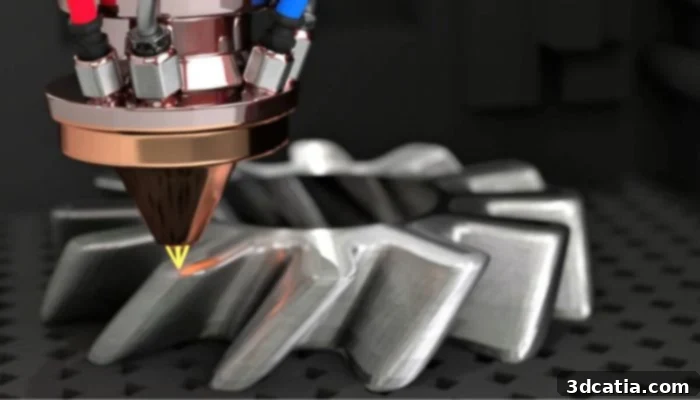
The researchers leveraged rapid cooling during the AM process to dictate how the atoms settle as the metal solidifies. (Photo: Needpix.com)
The groundbreaking research, published in the prestigious journal Advanced Materials, revealed a fascinating phenomenon. When the laser moves at a slower pace, the molten metal cools at a relatively low rate. This slower cooling rate provides the atoms in the liquid metal with ample time to move through diffusion and naturally separate into distinct components, or “phases.” This process leads to the formation of a complex microstructure with distinct regions of different compositions. In contrast, when the laser scan speed is significantly increased, the metal experiences extremely rapid cooling. This rapid cooling effectively suppresses diffusion, meaning that atoms do not have sufficient time to move or separate into different phases. As a consequence, the material effectively “freezes” in a single, uniform solid phase, rather than separating into the complex mixture that would typically form under slower cooling conditions.
“By increasing the laser speed, the cooling rate increases,” explained Deputy Group Lead Thomas Voisin. “And as the material cools down faster, it has less time to rearrange to a low energy configuration. This freezes the material in a non-equilibrium state, which can be used to tune atomic structures and resulting mechanical properties.” This precise control over the cooling rate unlocks the potential to create materials with customized properties, optimized for specific applications.
Equipped with this newfound knowledge, the scientists can now harness the remarkable versatility of high-entropy alloys, tailoring their properties to precisely match specific application requirements. It’s akin to unlocking a multitude of distinct materials within a single alloy by simply adjusting the laser speed during the additive manufacturing process. In the case of the AlCrFe₂Ni₂ eutectic HEA, the researchers successfully created an entire spectrum of material properties, ranging from high strength to high ductility, demonstrating the remarkable potential of this approach. This study highlights the power of precisely tuning manufacturing techniques to customize the mechanical strength, durability, and other critical properties of advanced metal components, enabling the creation of materials optimized for demanding applications.
The Implications for Additive Manufacturing
Researchers have long recognized that the inherent rapid cooling rates associated with additive manufacturing processes lead to the formation of unique microstructures in HEAs. These unique microstructures often result in finer grain sizes, altered phase distributions, and ultimately, enhanced mechanical properties compared to conventionally manufactured materials. The insights gained by LLNL researchers contribute significantly to a rapidly expanding research area focused on systematically investigating how laser AM processing parameters can be leveraged to precisely tune microstructures and, consequently, customize the mechanical behavior of high-entropy alloys and other advanced materials. This research is paving the way for a new era of materials design, where the manufacturing process itself becomes an integral part of tailoring material properties.
Could this innovative approach signify a paradigm shift in additive manufacturing, transforming it from a mere production tool to a powerful platform for scientific discovery and materials engineering? Rather than relying on trial-and-error approaches with multiple recipes, additive manufacturing could be harnessed to engineer materials with properties that are precisely programmed into them during the manufacturing process. “We are now at a place where we can effectively design new materials that take full advantage of the additive manufacturing features like the very rapid cooling rate,” Voisin stated. This signifies a move towards a future where materials are designed and manufactured in a closed-loop system, allowing for unprecedented control over their final properties. The ability to fine-tune the cooling rate during additive manufacturing unlocks new possibilities for creating materials with superior performance and tailored functionalities.
The implications of this research extend far beyond the laboratory, potentially impacting a wide range of industries, including aerospace, automotive, energy, and biomedical engineering. By enabling the creation of customized materials with optimized properties, this approach could revolutionize the design and manufacturing of critical components in these sectors. For example, in the aerospace industry, lightweight, high-strength HEAs could be used to create more efficient and durable aircraft. In the automotive industry, tailored HEAs could be used to improve the performance and safety of vehicles. In the energy sector, these materials could be used to enhance the efficiency and longevity of power generation systems. And in the biomedical field, customized HEAs could be used to create biocompatible implants with enhanced functionality.
Moreover, this research highlights the importance of interdisciplinary collaboration in driving innovation in materials science. The collaboration between researchers at LLNL and other institutions, combining expertise in additive manufacturing, materials science, thermodynamics, and molecular dynamics, has been crucial in achieving these breakthroughs. This underscores the need for continued collaboration and knowledge sharing to accelerate the development and adoption of advanced materials and manufacturing technologies.
As additive manufacturing technology continues to evolve and become more sophisticated, the ability to control and manipulate material properties at the microstructural level will only become more refined. This will open up even more possibilities for creating customized materials with unprecedented performance characteristics, paving the way for a future where materials are designed and manufactured to meet the specific needs of any application. The research conducted at LLNL represents a significant step towards realizing this vision, demonstrating the transformative potential of additive manufacturing for materials engineering and scientific discovery.
To delve deeper into the details of this fascinating project, you can access the full research study HERE.
What are your thoughts on LLNL’s innovative metal 3D printing project and its potential impact on materials science and manufacturing? Share your opinions and insights in the comments section below or connect with us on our LinkedIn or Facebook pages! Furthermore, don’t forget to subscribe to our complimentary weekly Newsletter to stay up-to-date on the latest advancements and news in the world of 3D printing. You can also explore our comprehensive collection of videos on our YouTube channel.
*Cover Image: Artist rendering of LLNL’s new additively manufactured high-entropy alloys. (Graphic: Daniel Herchek/LLNL)