
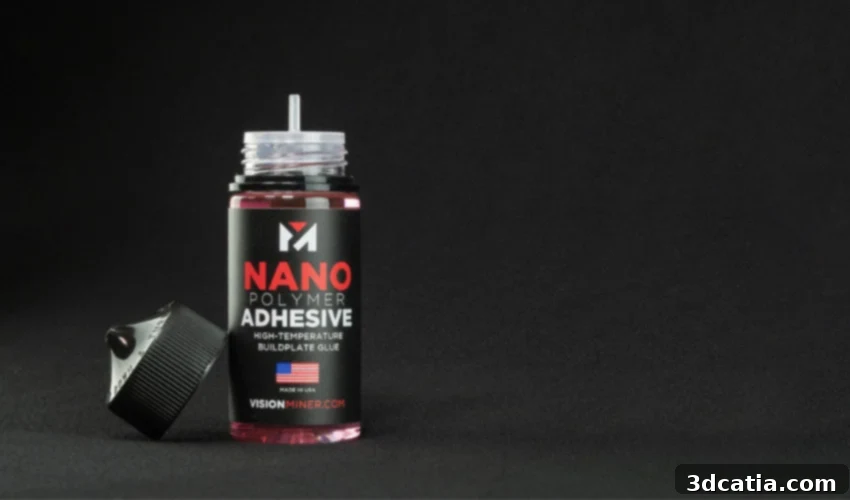
Revolutionizing 3D Printing: Master Build Plate Adhesion with Vision Miner’s Nano Polymer Adhesive
Achieving successful 3D prints begins long before the first layer is extruded. Among the myriad factors influencing print quality and success, one stands out as fundamentally critical: build plate adhesion. The relationship between your printed part and the printer’s build surface dictates whether your project will take shape flawlessly or succumb to common pitfalls like warping, shifting, or even complete detachment. This issue is not merely an inconvenience; it can lead to wasted materials, lost time, and considerable frustration, especially when working with expensive, high-performance filaments.
Poor build plate adhesion is, regrettably, one of the most pervasive challenges faced by 3D printing enthusiasts and professionals alike. A part that fails to bond correctly to the print bed is highly susceptible to lifting from the edges (a phenomenon known as warping), which can deform the entire model. In more severe cases, the part might break free entirely, causing a “spaghetti monster” of failed filament or even damaging the printer itself. This critical failure can occur at any stage of the printing process, from the first layer to the final moments, making consistent adhesion an absolute necessity for reliable production.
The Unique Adhesion Challenges of High-Performance Polymers
The complexity of build plate adhesion is amplified exponentially when dealing with advanced, high-performance polymers. Materials such as PEEK (Polyether Ether Ketone), PEI (Polyetherimide, often known by the brand name ULTEM), and PPSU (Polyphenylsulfone) are engineered for demanding applications requiring exceptional mechanical strength, chemical resistance, and thermal stability. While these properties make them invaluable for aerospace, medical, and industrial sectors, they also present significant challenges for FDM/FFF 3D printing.
High-performance polymers typically require extremely high printing temperatures for both the nozzle and the build plate. This inherent thermal characteristic, coupled with their often high glass transition temperatures and coefficients of thermal expansion, means they exert far greater warping forces during cooling compared to standard materials like PLA or ABS. Their intrinsically low surface energy also makes them notoriously difficult to bond securely to traditional print surfaces. Without robust adhesion, the internal stresses that develop as these materials cool will inevitably pull the print off the bed, rendering an otherwise perfect design into a costly failure.
Recognizing this critical gap in the market for reliable adhesion solutions for these advanced materials, Vision Miner, an American 3D printing company renowned for its deep expertise in FDM/FFF polymers, embarked on a mission to innovate. Their commitment to solving real-world printing problems led to the development of Nano Polymer Adhesive, a groundbreaking solution specifically formulated to tackle the unique adhesion requirements of high-temperature, high-performance FDM filaments.
Nano Polymer Adhesive: A Breakthrough in Print Bed Bonding
Prior to Nano Polymer Adhesive, users often resorted to a patchwork of inadequate solutions, from common glue sticks and hairspray to specialized tapes or custom build surfaces. While some of these methods might offer limited success for basic filaments, they frequently fell short or proved cumbersome when confronted with the extreme demands of materials like PEEK, ULTEM, or PPSU. The search for an effective, consistent, and user-friendly adhesive for these challenging polymers was a persistent frustration within the advanced 3D printing community.
Vision Miner’s approach was deliberate and scientific. Instead of adapting existing general-purpose adhesives, they hired a dedicated material scientist specializing in adhesives to engineer a product from the ground up. The specific goal was to create an adhesive that would bond exceptionally well with PEEK, ULTEM, and PPSU – some of the most critical high-performance FDM polymers in industrial applications. After an intensive nine-month development period in 2018, their efforts culminated in a working formula: Nano Polymer Adhesive.
What the Vision Miner team discovered during their testing phase was nothing short of revolutionary. While primarily developed for the most demanding polymers, the adhesive demonstrated remarkable versatility, working effectively with almost every material they tested. This unexpected compatibility extended to widely used filaments such as PLA, ABS, ASA, Nylon, and PC. The only exceptions noted were PP (Polypropylene) and POM (Polyoxymethylene), which are famously difficult to bond with any adhesive due to their inherently inert surfaces. This broad spectrum of compatibility makes Nano Polymer Adhesive an indispensable tool for nearly any FDM 3D printing scenario, dramatically minimizing print failures caused by inadequate bed adhesion across a vast range of materials.
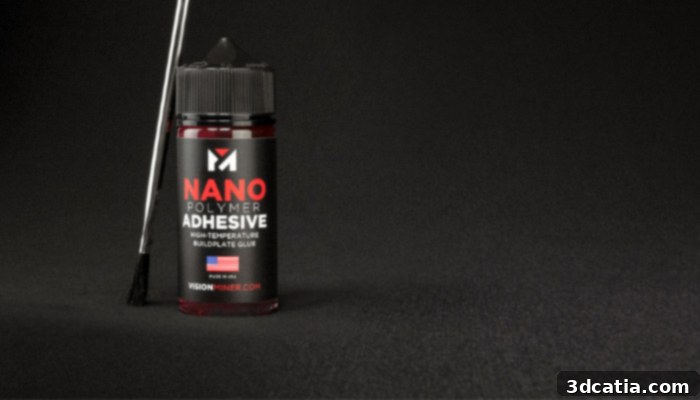
The Nano Polymer Adhesive and its applicator
About the Nano Polymer Adhesive: Features and Benefits
The appeal of Nano Polymer Adhesive extends beyond its impressive material compatibility. Its design prioritizes ease of use, safety, and efficiency, making it a superior choice for both hobbyists and industrial users. One of its most attractive properties is its ability to work on a multitude of different build surfaces. Whether your printer uses a glass plate, carbon fiber sheet, or resin-coated surface, this adhesive forms a strong bond. Vision Miner proudly states that it is compatible with virtually every 3D printer equipped with a heated bed currently on the market, offering unparalleled flexibility.
Application and maintenance are remarkably straightforward. Unlike messy sprays or solid glue sticks that can leave residue, Nano Polymer Adhesive is designed for a clean experience. The recommended preparation simply involves cleaning your glass build plate with water to remove any dust or previous adhesive traces. Once dry, the adhesive is applied in a simple “X” pattern across the build area and then evenly spread with the provided brush. For optimal results, Vision Miner suggests spreading the adhesive in one direction, then cross-hatching by spreading it in the opposite direction. This ensures a consistent, thin, and even layer, crucial for reliable adhesion and easy part removal. The brush itself is easily cleaned with water, further simplifying the post-printing cleanup process.
Part removal, a common source of frustration with many adhesives, is another area where Nano Polymer Adhesive shines. Vision Miner asserts that most parts will naturally detach from the build plate as soon as it cools down to room temperature. This “cool-down release” mechanism eliminates the need for prying tools, reducing the risk of damaging delicate parts or the build surface itself. This feature is particularly valuable for complex prints or those made from brittle materials, ensuring a smooth and hassle-free conclusion to your printing process.
Safety, Economy, and Global Availability
Safety is a paramount concern, and Vision Miner has ensured that Nano Polymer Adhesive is made from safe, non-toxic, organic compounds. This commitment to non-hazardous ingredients makes it a more environmentally friendly and user-safe option compared to many industrial adhesives. Furthermore, a little goes a long way. Each 100ml bottle is incredibly economical, especially when printing with lower-temperature filaments like PETG and PLA. For a standard 7”x7” (approximately 178x178mm) build plate, a single bottle can provide at least 200 coatings, translating to a significant number of prints.
The longevity of a single application is particularly impressive for low-temperature materials. Extensive testing by Vision Miner revealed that with PLA, for instance, users could achieve more than 50 successful prints on a single coating before reapplication was necessary. This reusability drastically reduces material consumption and saves valuable time. However, when working with premium, high-temperature filaments such as PEEK, PEI, or other specialized engineering polymers, it is recommended to reapply the adhesive to the specific area of the part before each new build. This ensures maximum adhesion and mitigates the intense warping forces characteristic of these advanced materials, safeguarding expensive prints.
Vision Miner takes great pride in the fact that their Nano Polymer Adhesive is 100% Made in the USA. This reflects their dedication to quality control and supporting local manufacturing. The development of this adhesive directly addresses the everyday challenges faced by their customers who work with high-temperature materials, ultimately passing on the benefits of enhanced reliability and success to the end-user. The popularity of the product quickly led to its global demand. It is now readily available worldwide, including in Canada, the UK, across Europe, Asia, and Australia, ensuring that advanced 3D printing solutions are accessible to a global audience.
The Nano Polymer Adhesive has made significant waves in the 3D printing community. It is not just one of the few viable options for successfully adhering challenging polymers like PEEK to a build plate, but its overall efficacy, ease of use, and broad material compatibility have garnered widespread acclaim. By solving a fundamental problem that has plagued 3D printing for years, Vision Miner has empowered users to explore new possibilities with advanced materials, reduce print failures, and increase their overall productivity. This innovative adhesive represents a crucial step forward in making high-performance FDM 3D printing more reliable and accessible.
To learn more about the Nano Polymer Adhesive and to explore its full capabilities, you can visit Vision Miner’s official website HERE. For those interested in trying it out before committing to a full bottle, $5 (plus shipping!) samples are available directly on the website, as well as through Vision Miner’s network of authorized resellers. Experience the difference that a truly reliable build plate adhesive can make for your 3D printing projects.
What are your thoughts on the Nano Polymer Adhesive? Have you struggled with build plate adhesion for high-performance polymers? Share your experiences and insights in the comments section below, or connect with us on our Facebook, Twitter, and LinkedIn pages! Don’t forget to sign up for our free weekly Newsletter here to receive the latest 3D printing news directly to your inbox!