
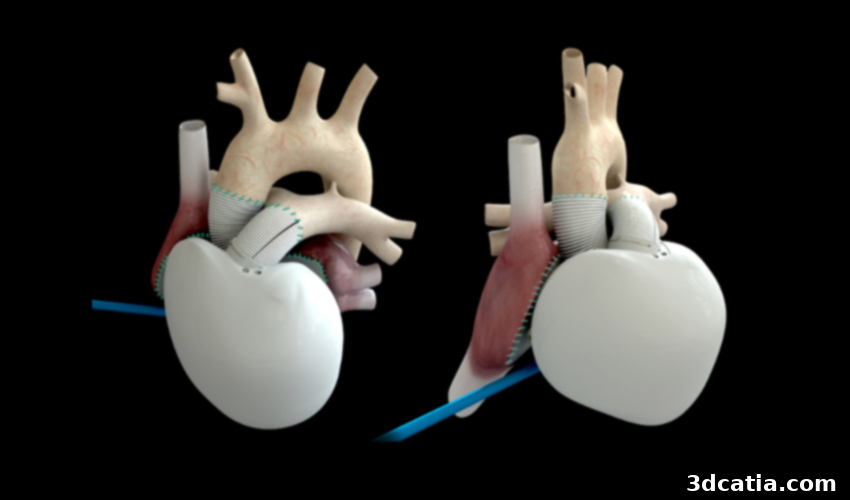
Revolutionizing Cardiovascular Care: CARMAT and AddUp Partner to Advance Artificial Heart Technology with 3D Printing
CARMAT, a pioneering company renowned globally for its relentless work on developing the most advanced artificial heart, has officially announced a groundbreaking strategic partnership with AddUp, a leading manufacturer in the field of industrial 3D printing. This significant collaboration, unveiled recently, is poised to dramatically accelerate the development timeline for CARMAT’s innovative artificial heart and substantially enhance its production capabilities. The ultimate goal of this alliance is to enable the widespread manufacturing of these life-saving cardiac devices, making them more accessible to a broader patient population in dire need of advanced cardiovascular solutions.
While AddUp is primarily recognized for its expertise in designing and selling cutting-edge metallic 3D printers for various demanding industrial applications, this partnership marks their pivotal entry into the highly specialized medical sector. AddUp will leverage its advanced additive manufacturing technologies to assist CARMAT in producing critical, complex components for these intricate cardiac devices. This venture not only signifies AddUp’s first client within the medical field but also powerfully underscores the immense opportunities that industrial 3D printing presents, particularly its unparalleled ability to achieve high levels of precision, customization, and material integrity for complex parts essential to artificial hearts and other biomedical implants.
The Genesis of an Artificial Heart: CARMAT’s Vision for Life
The story of CARMAT is intrinsically linked to its visionary founder, world-renowned cardiologist Professor Alain Carpentier, who spearheaded the development of a bio-prosthetic artificial heart designed to offer a genuine alternative for patients suffering from end-stage biventricular heart failure. This devastating condition often leaves individuals with limited treatment options, making a fully implantable artificial heart a monumental leap in medical technology. CARMAT’s device is not merely a mechanical pump; it aims to mimic the functionality of a human heart, featuring auto-regulation capabilities that adapt to the patient’s physical activity levels and needs, ensuring a more natural physiological response. The inherent complexity and critical nature of such a device necessitate extreme precision in manufacturing, robust material science, and an unwavering commitment to innovation, making the integration of advanced technologies like 3D printing an inevitable and crucial strategic step for the company.
AddUp’s Industrial Prowess Meets Medical Innovation
AddUp, a joint venture forged between two industrial giants, Michelin and Fives, has rapidly established itself as a global leader in designing, manufacturing, and operating industrial metallic 3D printing solutions. Their extensive experience spans across various demanding sectors such as aerospace, automotive, and tooling, where absolute precision, superior durability, and uncompromised performance are paramount. The seamless transition of AddUp’s deep engineering expertise from these heavy industries into the delicate and highly regulated realm of medical devices is a profound testament to the versatility and transformative potential of additive manufacturing. Their robust knowledge in advanced material science, stringent process control, and meticulous quality assurance for producing complex metallic components will be invaluable in crafting the next generation of artificial heart parts, ensuring both structural integrity and critical biocompatibility within the human body.
3D Printing Hearts: Unlocking Revolutionary Advantages for Medical Devices
While the full scope of specific applications within the CARMAT project is still unfolding and details are being kept proprietary, the adoption of additive manufacturing fundamentally introduces a host of unparalleled benefits. Beyond the initial mentions, 3D printing offers significant advantages that can redefine the entire production paradigm of medical implants, particularly for intricate and life-sustaining organs like the artificial heart.
Enhanced Anatomical Compatibility and Surgical Precision
One of the most compelling and transformative advantages of 3D printing is its inherent capacity to produce parts with “greater anatomical compatibility and surgical comfort.” This means that components can be precisely designed and manufactured to perfectly match the unique anatomical structures and specific requirements of individual patients. Traditional manufacturing methods often rely on standardized sizes and mass production, which can lead to compromises in fit and function, potentially impacting long-term outcomes. With advanced 3D printing, patient-specific data derived from detailed medical imaging (such as CT or MRI scans) can be directly translated into custom-designed components, ensuring a snugger, more natural, and highly personalized fit within the body. This unparalleled precision minimizes stress on surrounding tissues, significantly reduces the likelihood of post-operative complications, and can dramatically improve the longevity and overall efficacy of the implant. For surgeons, this translates to easier, more predictable implantation procedures and ultimately leads to better post-operative outcomes, enhancing overall patient comfort and accelerating recovery.
Consolidation of Components for Improved Reliability and Efficiency
Another critical benefit of additive manufacturing lies in its ability to significantly reduce the overall number of required components within a complex device. Additive manufacturing processes allow for the creation of incredibly intricate geometries and complex internal structures that would be impossible or prohibitively expensive to achieve with conventional subtractive manufacturing techniques. This capability enables the seamless consolidation of multiple discrete parts, traditionally assembled from numerous separate pieces, into a single, cohesive, and monolithic unit. Fewer components mean inherently fewer potential points of failure, vastly simpler assembly processes, and a valuable reduction in the overall weight and size of the device. For an artificial heart, where absolute reliability and compact design are paramount, minimizing complexity while maximizing functionality is a game-changer, contributing directly to increased safety, enhanced performance, and a more streamlined manufacturing process.
Rapid Prototyping and Accelerated Innovation Cycles
Beyond the immediate production benefits, 3D printing significantly shortens the cycles of design, prototyping, and iteration, which are critical in medical device development. Medical device engineering is an inherently arduous and time-consuming process, requiring extensive testing, validation, and refinement to meet rigorous safety and efficacy standards. Additive manufacturing empowers engineers to quickly produce and test new designs or modifications, drastically reducing the time and cost associated with traditional manufacturing methods that often require expensive tooling. This newfound agility is crucial for CARMAT as it continues to refine its artificial heart, enabling faster improvements, quicker progression through necessary clinical trials, and ultimately, accelerated wider patient access to this life-saving technology.
Advanced Material Capabilities and Biocompatibility Assurance
Modern metallic 3D printers, such as those developed and deployed by AddUp, are capable of processing a wide range of advanced materials, including highly biocompatible alloys like medical-grade titanium and stainless steel. These materials are absolutely critical for medical implants due to their exceptional strength, long-term durability, and inertness within the complex biochemical environment of the human body. The precise control over material deposition and microstructure offered by additive manufacturing processes ensures that these materials retain their optimal properties, producing components that can withstand the demanding physiological environment of the human circulatory system for extended periods. This capability opens exciting new doors for exploring novel material combinations, composite structures, and advanced internal geometries previously unattainable, pushing the boundaries of what is possible in implant design.
In a previous interview conducted a few months prior on our French platform, AddUp CEO Vincent Ferreiro articulated the company’s profound enthusiasm for this monumental venture. He stated, “As a pioneer in the development of industrial 3D printing solutions, we are delighted to be able to combine our unique additive manufacturing technology with a medical project as innovative as that of CARMAT. We have know-how in the accompaniment of our partners of the phases of opportunity to the industrial concretization of the concepts. Therefore, we are excited to be able to apply it, for the first time, to the field of health.” Ferreiro’s remarks powerfully highlight AddUp’s strategic expansion, bringing their industrial-grade precision, reliability, and innovative spirit directly to the humanitarian mission of saving lives through the advancement of medical devices. This collaboration underscores their commitment to pushing the boundaries of what additive manufacturing can achieve across diverse, high-impact sectors.
A Legacy of Cross-Industry Collaboration Drives Innovation
Stéphane Piat, General Manager of CARMAT, emphasized that the company’s very foundation is a testament to the enduring power of astute inter-industry cooperation. He notably recalled CARMAT’s origins as a merger with the aeronautical giant Airbus Group, a partnership that brought unparalleled engineering rigor to biomedical challenges. This strong historical context provides a clear precedent and robust framework for the current partnership with AddUp, showcasing CARMAT’s consistent strategic vision to integrate cutting-edge expertise from diverse high-tech sectors into the complex world of biomedical engineering. Piat articulated, “The CARMAT project has been, since its origins, a perfect example of cooperation between the industrial and medical worlds. The partnership concluded today with AddUp is a new demonstration that allows us, in parallel with our ongoing clinical development, to anticipate changes in our industrial and technical needs in the longer term. With a partner as prestigious as AddUp, I am confident in our ability to accelerate our industrialization and secure our project.” His statement powerfully reinforces the idea that true innovation in highly complex medical devices thrives on a multidisciplinary approach, where advanced engineering principles and manufacturing techniques from one field can be ingeniously applied and adapted to solve critical challenges in another. This proactive anticipation of future industrial needs is absolutely vital for successfully scaling up production once clinical trials are fully successful and the device moves towards broader market adoption.
The Future of Cardiovascular Medicine Through Additive Manufacturing
The strategic partnership between CARMAT and AddUp represents more than just a business deal; it symbolizes a significant milestone in the convergence of advanced manufacturing technologies and the life sciences. The potential for industrial 3D printing to fundamentally transform the landscape of medical device production is immense, extending far beyond artificial hearts to encompass a wide array of personalized implants, highly specialized surgical tools, and even the ambitious frontier of bioprinted tissues and organs. This collaboration is set to pave the way for a future where highly complex, perfectly customized, and incredibly reliable medical devices can be manufactured with unprecedented efficiency, precision, and scalability. As CARMAT moves ever closer to making its revolutionary artificial heart a widely available and life-sustaining solution, AddUp’s state-of-the-art additive manufacturing capabilities will prove instrumental in overcoming the formidable challenges of scaling production while consistently maintaining the highest possible standards of quality, safety, and patient-specific efficacy.
The implications of this partnership for patients suffering from severe heart failure globally are profound and filled with hope. Increased production capacity means that more lives can potentially be saved and significantly improved, offering a genuine alternative where traditional treatments have fallen short or are no longer viable. This collaboration not only accelerates the journey of CARMAT’s artificial heart from critical clinical development to widespread adoption but also cements 3D printing’s indispensable role as a transformative technology in the future of personalized healthcare and advanced biomedical engineering. It’s a powerful testament to human ingenuity and the potential of cross-industry collaboration to tackle humanity’s most pressing health challenges.
Are you as excited as we are about the prospect of advanced 3D printed hearts revolutionizing cardiovascular medicine and offering new hope to millions? We invite you to share your valuable thoughts and insights in a comment below, or join the ongoing conversation on our Facebook and Twitter pages! Don’t miss out on the latest advancements, groundbreaking stories, and pivotal partnerships in the dynamic world of additive manufacturing. Be sure to sign up for our free weekly Newsletter, delivering all the essential news and expert insights in 3D printing directly to your inbox!