
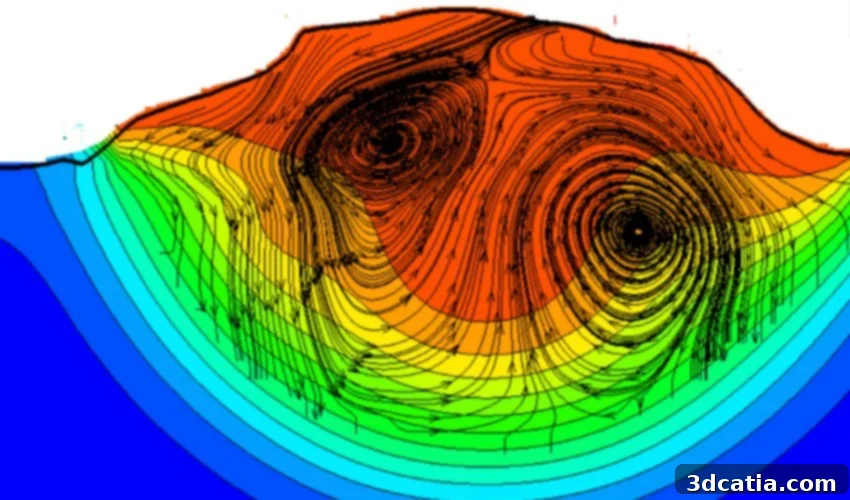
Unraveling Porosity: A Deep Dive into Bubble Formation in Directed Energy Deposition (DED) 3D Printing
Directed Energy Deposition (DED) stands as a cornerstone in the realm of advanced additive manufacturing, particularly renowned for its capabilities in repairing and coating high-value metal components. This sophisticated 3D printing process is indispensable across critical sectors such as aerospace, automotive, marine, and biomedicine, where the integrity and performance of metal parts are paramount. DED operates by precisely melting materials, typically in powder or wire form, and fusing them layer by layer onto a substrate or existing part. This method allows for the fabrication of complex geometries, the repair of damaged components like jet aircraft turbine blades, and the application of protective coatings, thereby extending the lifespan and improving the functionality of vital engineering structures.
Despite its numerous advantages and widespread adoption, the DED process is not without its challenges. A significant hurdle that has long plagued the industry is the formation of internal defects, specifically air bubbles or pores, within the fabricated material. These microscopic voids can severely compromise the mechanical properties of the final product, leading to reduced tensile strength, fatigue resistance, and overall ductility. Consequently, the presence of porosity can detrimentally affect the long-term performance, service life, and, most critically, the safety of DED-manufactured parts. For components used in safety-critical applications, such as aircraft engines or medical implants, even minor defects can have catastrophic consequences.
For years, the exact mechanisms governing bubble formation in DED have remained largely elusive, presenting a complex problem for researchers and engineers striving to optimize the process. However, a groundbreaking new study has finally shed light on these previously unexplained phenomena. This pioneering research has meticulously investigated the root causes and dynamic behavior of bubble formation during the Directed Energy Deposition process, promising to unlock new avenues for improving material quality and reliability.
Understanding the DED Process and the Pervasive Problem of Porosity
Before delving into the specifics of the recent findings, it’s essential to grasp the fundamental nature of DED and why porosity poses such a formidable challenge. DED systems typically utilize a high-power laser or electron beam to create a melt pool on the workpiece surface. Simultaneously, a nozzle delivers metallic powder or wire into this melt pool. As the energy source moves, the material melts, fuses with the substrate, and rapidly solidifies, building up layers. This precise, localized melting and solidification cycle is what enables DED to create dense, functional metal parts, often with superior material properties compared to conventionally manufactured components.
The quality of DED parts is intrinsically linked to their density and the absence of internal defects. Porosity, referring to the presence of voids or pores, is one of the most common and critical types of defects. These pores can originate from various sources: gas trapped within the feedstock powder, atmospheric gases dissolved in the melt pool, or even localized evaporation of alloying elements. Regardless of their origin, pores act as stress concentrators within the material. Under cyclic loading conditions, these stress concentrations can initiate cracks, leading to premature fatigue failure. In static loading, they reduce the effective load-bearing cross-section, diminishing ultimate tensile strength and yield strength. Moreover, interconnected porosity can create pathways for environmental degradation, such as corrosion, further compromising part longevity.
The impact of porosity extends beyond mechanical performance. It can also affect post-processing steps, such as machining or polishing, and may require extensive and costly inspection methods to detect. Therefore, understanding and mitigating porosity is not merely an academic exercise but a practical necessity for enhancing the viability and widespread industrial adoption of DED technology, especially for applications where part integrity is non-negotiable.
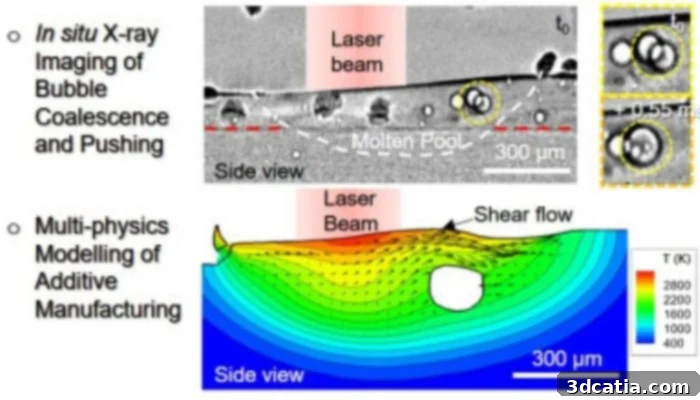
A graphical representation illustrating the dynamic formation and behavior of bubbles within the melt pool during DED processing.
A Landmark Study: Uncovering the Dynamics of Bubble Formation
To address the persistent challenge of porosity, Dr. Chinnapat Panwisawas, a distinguished researcher at Queen Mary University of London, spearheaded an extensive investigation into the elusive causes of bubble formation in DED materials. His team’s work has successfully demystified the complex dynamics occurring within the melt pool, identifying five critical processes that dictate the formation, movement, and growth of these detrimental bubbles or pores. This breakthrough is particularly significant because it provides a foundational understanding that was previously lacking, offering a clear pathway for developing effective mitigation strategies.
The researchers employed cutting-edge methodologies to achieve these insights. A cornerstone of their approach was the use of in-situ X-ray imaging. This advanced technique allowed for real-time observation of the melt pool dynamics and bubble behavior during the DED process itself. Unlike ex-situ analysis, which only examines solidified parts, in-situ X-ray imaging provides an unprecedented view into the transient phenomena occurring at high temperatures and rapid solidification rates. This direct visualization was crucial for capturing the dynamic stages of bubble evolution. Furthermore, the findings from the in-situ experiments were rigorously validated through multi-physics modeling. This computational approach enabled the team to simulate and predict the interactions between heat transfer, fluid flow, and solidification, providing a robust theoretical framework that corroborates the experimental observations. The synergy between real-time imaging and sophisticated modeling has yielded an unparalleled understanding of porosity mechanisms.
How Do Bubbles Form and Evolve During the DED Process?
The study meticulously elucidated the various stages and contributing factors to bubble and pore development within the DED material. The process initiates with the ingress of bubbles, primarily derived from gas-atomized powder, into the molten metal pool. Gas atomization, a common method for producing fine metallic powders, often results in inert gas (like argon) being entrapped within the individual powder particles. When these particles melt in the DED process, the trapped gas is released, forming nascent bubbles within the high-temperature melt pool.
Once present in the melt pool, these microscopic bubbles are far from static. They begin to migrate dynamically, exhibiting both lateral and circular movements. This motion is largely driven by thermal gradients and surface tension gradients within the molten material, a phenomenon known as Marangoni convection. As these bubbles move, they inevitably encounter each other. The study revealed that individual bubbles tend to coalesce, joining together to form larger, more significant voids. This merging process exacerbates the problem, as larger bubbles are more difficult to expel from the melt pool.
A critical insight from the research concerns the interaction of these growing bubbles with the solidification front. As the melt pool cools and solidifies, the solid/liquid interface advances. The study found that larger bubbles are frequently “pushed” by this advancing solidification front. This occurs due to differences in surface tension and density between the molten metal and the gas bubbles. This pushing effect allows the bubbles to remain in the melt pool for a much longer period than smaller ones, increasing their chances of further growth and eventual entrapment.
Furthermore, the study highlighted a crucial factor preventing the escape of these larger bubbles: the Marangoni surface shear flow. The Marangoni effect describes the mass transfer along an interface between two fluids due to a gradient of surface tension. In the DED melt pool, temperature variations create surface tension gradients, generating a shear flow on the melt pool’s surface. This flow acts as a barrier, effectively preventing the larger bubbles from bursting out and releasing their gas. Instead, this powerful surface tension gradient traps the bubbles beneath the surface, driving them back into the molten volume. Consequently, as the DED track solidifies, these large, entrapped bubbles become permanent pores within the material structure, leading to the internal defects that compromise performance.
“This knowledge is crucial for unlocking the full potential of DED. By minimising porosity, we can improve the mechanical properties of components, making DED a viable option for safety-critical applications ultimately leading to the production of stronger, safer, and more reliable components across various industries,” concluded Dr. Chinnapat Panwisawas, Senior Lecturer in Materials and Solid Mechanics at Queen Mary’s School of Engineering and Materials Science.
Implications and Future Directions for DED Optimization
The profound insights garnered from this study have far-reaching implications for the future of Directed Energy Deposition and metal additive manufacturing as a whole. By precisely understanding the mechanisms of bubble formation, migration, growth, and entrapment, engineers and researchers can now develop targeted strategies to significantly reduce or even eliminate porosity in DED-fabricated parts. This knowledge is not merely academic; it is directly actionable, paving the way for the optimization of current processes and the development of next-generation DED technologies.
Potential areas for improvement include:
- **Parameter Optimization:** With a clearer understanding of melt pool dynamics, DED process parameters such as laser power, scan speed, powder feed rate, and gas flow rates can be fine-tuned to minimize bubble nucleation and promote their expulsion before solidification.
- **Material Development:** The insights can guide the development of new feedstock materials, including gas-atomized powders with lower entrapped gas content or alternative powder production methods that reduce initial bubble sources.
- **Atmosphere Control:** Enhancements in inert gas shielding techniques and chamber atmosphere control can further prevent the absorption of atmospheric gases into the melt pool.
- **Real-time Monitoring and Control:** The foundational understanding gained could lead to the development of advanced in-situ monitoring systems that detect bubble formation in real-time, allowing for immediate process adjustments to mitigate defects.
Ultimately, the hope is that this study will result in vastly improved technologies for regeneration, repair, and advanced manufacturing. By consistently producing DED parts with minimal porosity, industries can significantly enhance the mechanical properties, durability, and reliability of components, making DED an even more viable and trusted option for highly demanding, safety-critical applications. This progress will directly contribute to the production of stronger, safer, and more reliable components across diverse industries, from lightweight aerospace structures and high-performance automotive parts to custom medical implants and durable tooling.
This pivotal research represents a significant leap forward in our quest to fully harness the transformative potential of Directed Energy Deposition. It underscores the critical role of fundamental scientific inquiry in solving complex engineering challenges and driving innovation in additive manufacturing. By addressing one of the most persistent issues in DED, the study not only improves the integrity of printed parts but also expands the horizons of what can be achieved with metal 3D printing, promising a future of enhanced performance and greater confidence in additive manufactured components.
You can delve deeper into the full findings of this remarkable study HERE. We invite you to share your thoughts on this groundbreaking research concerning bubble formation in DED materials. Let us know what you think in a comment below or join the conversation on our LinkedIn, Facebook, and Twitter pages! Don’t forget to sign up for our free weekly newsletter here for the latest 3D printing news delivered straight to your inbox! You can also find all our compelling videos on our YouTube channel.
*All Photo Credits: Queen Mary University of London