
Continuous Composites Revolutionizes Additive Manufacturing with Advanced CF3D Technology and New Idaho Facility
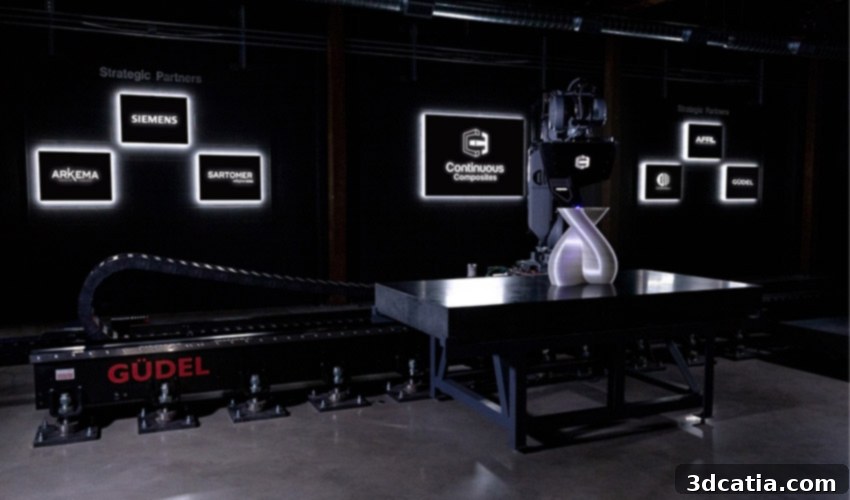
Pioneering the next generation of advanced manufacturing, Continuous Composites, founded in 2015, is making significant strides in the world of composite 3D printing. The company has officially opened an expansive 7,500-square-foot facility in Idaho, dedicated to accelerating research, development, and high-volume additive manufacturing. This state-of-the-art building serves as a pivotal showcase for their patented Continuous Fiber 3D Printing (CF3D) technology, demonstrating its capabilities at an unprecedented scale. Notably, this new expansion dramatically increases their previous build volume by a staggering 25 times, signaling a major leap forward for the industry. This breakthrough positions continuous composite 3D printing as a formidable contender, potentially replacing traditional metal 3D printing in applications where superior strength-to-weight ratios are paramount. Unlike many existing additive manufacturing techniques, Continuous Composites’ CF3D process stands out by precisely soaking a continuous dry fiber with a photopolymer resin, which is then instantaneously hardened using targeted UV light. This innovative layer-by-layer method enables the creation of exceptionally high-performance parts, pushing the boundaries of what is achievable with additive manufacturing.
Unveiling the Power of CF3D Technology: Innovation in Continuous Fiber 3D Printing
The Continuous Fiber 3D Printing (CF3D) technology developed by Continuous Composites represents a paradigm shift in how advanced composite materials are fabricated. At its core, CF3D is an additive manufacturing process that integrates high-strength continuous fibers directly into a polymer matrix during printing. This method bypasses many limitations of conventional manufacturing and even other composite 3D printing techniques, which often rely on chopped fibers or pre-impregnated filaments that can compromise material integrity and performance. The CF3D process ensures that fibers are laid down continuously, following optimal load paths, thereby maximizing the part’s structural integrity and strength. This is crucial for applications demanding robust yet lightweight components, such as those found in aerospace, defense, and high-performance automotive sectors. The ability to precisely control fiber placement and orientation, combined with the rapid UV light curing of the photopolymer, allows for the creation of complex geometries with anisotropic properties tailored to specific engineering requirements. This level of control and material performance is what sets CF3D apart, enabling the production of parts that are not only stronger and lighter but also possess enhanced durability and functional characteristics.
Strategic Partnerships Fueling Commercialization and Growth
Over the past five years, Continuous Composites has meticulously cultivated a network of strategic relationships and partnerships with key industry leaders. This concerted effort has been instrumental in accelerating the commercialization of its groundbreaking CF3D technology. These collaborations are not merely transactional; they are deep, symbiotic alliances aimed at integrating CF3D into existing industrial ecosystems and pushing its capabilities to new frontiers. Among these critical partners are global giants like Siemens and Arkema, alongside industrial automation specialists Comau and high-precision component manufacturer Güdel.
Enhancing Automation and Precision with Siemens
The partnership with Siemens is particularly significant, as it addresses the need for unparalleled accuracy and control in automated manufacturing. Siemens is leveraging its sophisticated Sinumerik 840D CNC system and the innovative Run MyRobot/Direct Control platform to augment the intrinsic capabilities of CF3D. This integration provides Continuous Composites with high-accuracy, multi-axis robotic control, essential for manipulating continuous fibers with precise deposition and orientation. The Sinumerik 840D CNC system is renowned for its reliability and precision in complex machining operations, and its application to CF3D ensures that the additive manufacturing process can achieve industrial-grade repeatability and quality. This synergy between advanced robotics and precise motion control is vital for scaling CF3D technology from research and development to high-volume production, making it a viable solution for demanding industrial applications.
Advanced Material Science with Arkema (Sartomer)
Meanwhile, Arkema’s Sartomer business plays a crucial role on the materials front. Sartomer, a leading developer of cutting-edge resin solutions, is actively developing N3xtDimension thermosetting resins specifically tailored for Continuous Composites’ technology. These custom-engineered resins are designed to optimize the performance characteristics of CF3D-printed parts, catering to a diverse range of customer-specific applications. The chemical properties of the photopolymer resin are critical for achieving rapid curing times, excellent adhesion to continuous fibers, and desired mechanical properties in the final component. Arkema’s expertise in polymer science ensures that Continuous Composites has access to advanced material formulations that can unlock new possibilities in terms of strength, temperature resistance, chemical inertness, and other critical performance metrics. This materials-centric approach is fundamental to expanding the applicability of CF3D technology across various industries.
Industrial Integration with Comau and Güdel
Beyond Siemens and Arkema, Continuous Composites has also forged alliances with industrial automation leader Comau and high-precision machine component manufacturer Güdel. Comau contributes its extensive expertise in robot kinematics and motion controls, providing robust and agile robotic systems that are integral to the CF3D printing process. These systems enable the dynamic and precise manipulation of print heads and fiber delivery mechanisms, critical for manufacturing complex parts efficiently. Güdel, with its reputation for manufacturing high-precision machine components, ensures that the mechanical foundations of Continuous Composites’ printing systems are robust, reliable, and capable of maintaining the tight tolerances required for continuous fiber placement. These partnerships collectively form a powerful ecosystem, ensuring that CF3D technology is not only innovative but also industrially viable, scalable, and capable of delivering consistent, high-quality results.
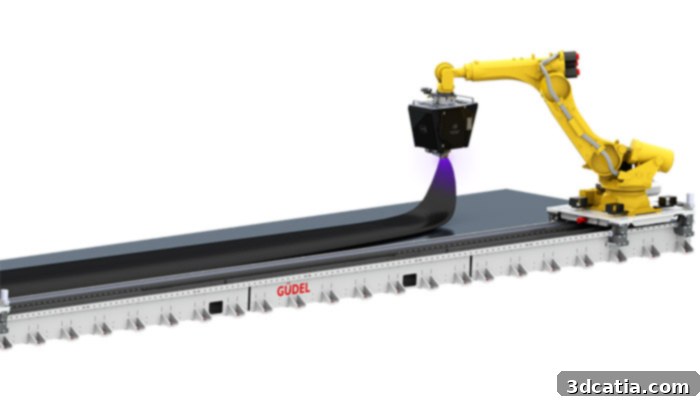
Continuous Composites 3D printing technology in action, showcasing its innovative fiber deposition process.
Tyler Alvarado, CEO of Continuous Composites, emphasized the strategic nature of these collaborations, stating, “These partnerships were mutually selected, us choosing them and them choosing us, knowing that by joining efforts, CF3D technology will rapidly scale to the next phase of its capabilities.” Alvarado further highlighted the importance of their new facility: “Our new facility allows us essential access to research and development that is completely in stride with a powerhouse team of strategic partners and customers.” His comments underscore the synergistic approach the company is taking, where each partner brings specialized expertise that collectively accelerates the advancement and commercial adoption of CF3D. The new facility in Idaho will serve as a hub for this collaborative innovation, providing the necessary infrastructure for iterative development, rigorous testing, and ultimately, the expansion of CF3D’s industrial footprint.
Elevating Additive Manufacturing: The Versatility of High-Performance Composites
The recent developments at Continuous Composites are a clear indicator of a broader trend within the 3D printing sector: a growing confidence in the transformative potential of high-performance, lightweight, composite materials. Industry players are increasingly recognizing that these advanced materials are not just incremental improvements but are, in fact, elevating additive manufacturing to unprecedented levels of performance and functionality. This is particularly evident with CF3D technology, which is continually reaching new heights by expanding its material compatibility. The technology now boasts the ability to print with a wide array of structural fibers, including ultra-strong carbon fiber, resilient glass fiber, and high-tensile aramid fiber. Furthermore, CF3D is also capable of integrating functional fibers such as optical fibers for sensor integration and metallic fibers for enhanced conductivity or shielding properties. This versatility in material selection means that CF3D can cater to an extremely diverse range of applications, from aerospace components requiring extreme lightweighting and strength, to medical devices demanding biocompatibility and intricate designs, and even advanced defense systems needing robust and customizable parts. The capacity to embed different types of fibers within a single print unleashes a new era of multi-functional components, previously unimaginable with traditional manufacturing methods.

Diverse examples of high-performance parts produced using Continuous Composites’ CF3D 3D printing technology.
The Future is Composite: Market Growth and Endless Applications
The burgeoning interest and investment in composite 3D printing are strongly corroborated by market intelligence. IDTechEx, a respected authority in technology analysis, underscored these trends in its comprehensive “3D Printing Composites 2020 – 2030” report. The report projects a dramatic expansion in the global market for composite 3D printing, forecasting it to achieve an impressive valuation of $1.7 billion by the year 2030. This substantial growth trajectory highlights the immense potential and increasing adoption of composite additive manufacturing across various industries. Such a robust market outlook signifies that the segment is ripe for numerous breakthroughs and groundbreaking applications in the coming decade. From aerospace components that shave off critical weight while maintaining structural integrity, to high-performance sporting goods, custom medical prosthetics, and advanced robotics, the possibilities are virtually limitless. Continuous Composites, with its CF3D technology and strategic partnerships, is at the vanguard of this revolution, poised to capture a significant share of this expanding market. The ability to create parts with unparalleled strength-to-weight ratios, customized material properties, and complex geometries positions composite 3D printing as a cornerstone of future industrial innovation. The advancements promise not only to optimize existing products but also to enable the design and manufacturing of entirely new categories of high-performance components, fundamentally transforming industries worldwide. For those keen to delve deeper into the innovative activities and pioneering technology of Continuous Composites, further information is available directly on their official website. The journey of composite additive manufacturing is just beginning, and Continuous Composites is clearly leading the charge toward a future of lighter, stronger, and more efficiently produced materials.