
The Unstoppable Rise of Steel in Additive Manufacturing: SmarTech Analysis Reveals Market Dynamics and Future Prospects
The landscape of additive manufacturing is continuously evolving, with new materials and processes pushing the boundaries of what’s possible. Among the various metals utilized in this transformative technology, steel has emerged as a clear frontrunner, demonstrating remarkable growth and potential. A recent comprehensive study by SmarTech Analysis, a leading market intelligence firm, shines a spotlight on this burgeoning segment, confirming steel’s position as the most widely used metal in industrial 3D printing. According to their insightful report, deliveries of powdered steel for additive manufacturing saw an astounding growth of 48% in 2018 alone. This significant increase underscores steel’s inherent advantages and its growing adoption across diverse sectors. Its compelling mechanical characteristics, including superior strength-to-weight ratios, excellent fatigue resistance, and robust impact strength, make it exceptionally attractive to demanding industries such as aerospace, automotive, and general manufacturing. The report delves into the underlying factors driving this impressive growth, scrutinizing key industry users, evaluating market prices, and identifying the vast opportunities that steel additive manufacturing presents. It also seeks to understand why steel is currently outpacing other established metals like titanium and aluminum in terms of additive manufacturing adoption rates, highlighting its unique blend of performance and accessibility.
At its core, steel is a versatile metal alloy, primarily composed of iron and carbon, with other alloying elements often added to fine-tune its properties. This fundamental composition grants steel its extraordinary range of mechanical characteristics, which are highly desirable for engineering applications. Key attributes include exceptional elastic deformation capabilities, allowing parts to return to their original shape after stress, as well as remarkable breaking and impact resistance, crucial for components exposed to dynamic loads and harsh environments. Furthermore, steel boasts elevated strength and hardness, making it ideal for high-performance applications. The precise mechanical strength of steel is intricately linked to its carbon dosage; varying the carbon content allows for the creation of different steel grades, each tailored to specific requirements, from ductile low-carbon steels to incredibly hard high-carbon tool steels. In the context of additive manufacturing, steel is readily available in fine powdered form, making it compatible with a variety of advanced 3D printing solutions. Processes such as Direct Metal Laser Sintering (DMLS) and Selective Laser Melting (SLM) are commonly employed, precisely fusing layers of steel powder with high-powered lasers to build intricate, high-density metal parts. Compared to many other metals in the additive manufacturing market, steel offers a compelling combination of accessibility, material cost-effectiveness, and broad applicability. Its capacity to be used under different types of alloys – including stainless steels, tool steels, and maraging steels – further enhances its appeal, providing industries with a wide spectrum of material choices to meet their specific design and functional requirements. This inherent versatility and economic viability are significant factors contributing to steel’s dominant position in the metal 3D printing landscape.
Source: SmarTech Analysis
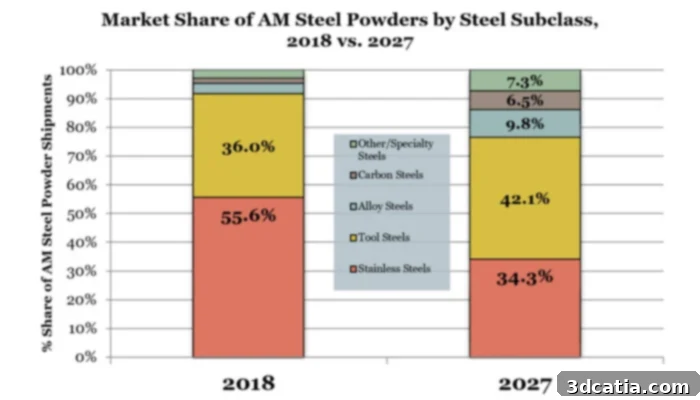
The detailed analysis presented in SmarTech’s latest report meticulously dissects the market share across various steel subcategories within the additive manufacturing ecosystem. The findings are particularly illuminating, predicting that tool steel is poised for the most significant expansion in market share. Projecting forward, tool steel is expected to command a substantial 42.1% of the market by 2027, marking a considerable leap from its 36% share in 2018. This anticipated growth highlights the increasing demand for high-performance, custom tooling, molds, and dies that additive manufacturing can produce with unparalleled complexity and efficiency. Tool steels, renowned for their exceptional hardness, abrasion resistance, and ability to maintain structural integrity under high temperatures and stress, are indispensable in applications requiring precision and durability, such as injection molding, metal forming, and cutting tools. The ability to integrate features like conformal cooling channels into molds, optimizing thermal management and accelerating production cycles, is a key driver for tool steel’s increasing prominence in 3D printing. Conversely, the report indicates that stainless steels, while still vital, are expected to see a slight decrease in their overall market share. This shift doesn’t necessarily signify a decline in stainless steel use, but rather an acceleration in the adoption of other specialized steel alloys that offer superior performance characteristics for specific, often more demanding, industrial applications. SmarTech’s research further reveals that despite the vast array of steel compositions available, only about ten primary steel alloys are currently widely printed using additive manufacturing technologies. However, this number is far from static. The study emphasizes that numerous key players in the industry are actively investing in extensive research and development to formulate and qualify new steel materials specifically optimized for additive processes. These innovative material developments are paving the way for expanded capabilities and unlocking novel opportunities across the entire additive manufacturing market, promising even more diverse applications and enhanced performance attributes in the near future.
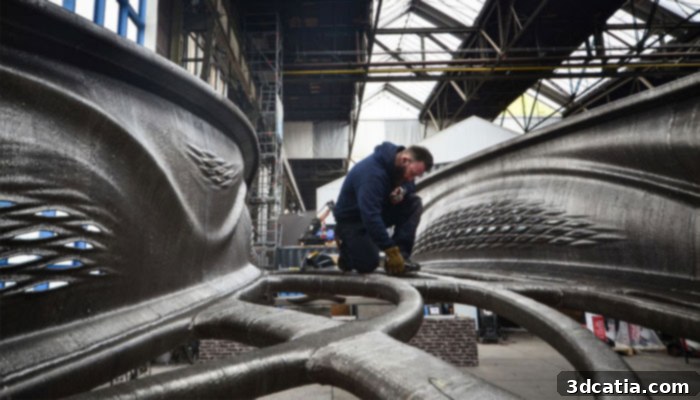
One of the most compelling insights from the SmarTech Analysis report is the shifting landscape of steel’s application in additive manufacturing. Historically, metal additive manufacturing has found its strongest foothold in high-value sectors such as medical and aerospace, primarily due to the criticality of their components and the ability of AM to produce lightweight, complex geometries. While these two markets continue to be significant users of steel for critical components, the report emphatically highlights a burgeoning trend: the increasing use of steel for the manufacture of final parts in sectors that fall outside these traditional strongholds. This expansion signifies a broader industrial acceptance and maturation of metal 3D printing with steel. Industries such as automotive, energy (oil & gas, renewables), marine, industrial machinery, and even consumer goods are progressively leveraging the benefits of steel additive manufacturing. These sectors are discovering that 3D printing with steel enables the creation of highly customized components, rapid prototyping of functional parts, on-demand spare part production, and the design of complex geometries that improve performance or reduce assembly steps. For instance, in the automotive sector, steel AM is being used for specialized engine components, intricate fixtures, and tooling, allowing for faster iterations and performance optimization. The energy sector benefits from the production of durable, complex parts that can withstand harsh operating conditions, while industrial machinery gains from robust, customized components that enhance efficiency and extend lifespan. A prominent example of steel’s capabilities beyond traditional applications was the groundbreaking MX3D bridge, 3D printed from steel in Amsterdam. This ambitious project, reported in April of the previous year, showcased the potential for large-scale, structurally sound, and architecturally innovative steel constructions using additive techniques, signaling a new era for infrastructure and design.
MX3D bridge | Photo credits: Adriaan de Groot
The future for steel in additive manufacturing appears exceptionally bright, driven by continuous innovation in material science and increasing industrial adoption. As new steel alloys are developed specifically for additive processes, offering enhanced printability, mechanical properties, and cost-effectiveness, the range of applications will only broaden. Challenges remain, including the need for further standardization, robust qualification processes for printed parts, and continued efforts to reduce post-processing requirements and increase printing speeds. However, the consistent growth reported by SmarTech Analysis underscores a strong market trajectory and a clear commitment from industries to integrate steel 3D printing into their core manufacturing strategies. This shift represents a significant move towards digital manufacturing, enabling more agile supply chains, greater design freedom, and the production of highly optimized, custom components previously unattainable with conventional methods. The strategic insights provided by reports like SmarTech’s are invaluable for businesses looking to navigate and capitalize on these evolving market dynamics. Understanding these trends allows companies to make informed decisions about technology investments, material selections, and market positioning, ultimately fostering sustainable growth within the additive manufacturing sector. As the capabilities of steel additive manufacturing continue to advance, its role as a cornerstone material for industrial innovation will only solidify, transforming how products are designed, manufactured, and delivered across the globe.
For those interested in delving deeper into the detailed findings and market forecasts, comprehensive information is available on SmarTech’s official website HERE. We invite you to share your thoughts and perspectives on the remarkable growth of steel in additive manufacturing by leaving a comment below or engaging with us on our vibrant Facebook and Twitter pages! Don’t miss out on the latest advancements and news in the world of 3D printing; sign up for our free weekly Newsletter to receive all the essential updates straight to your inbox.