
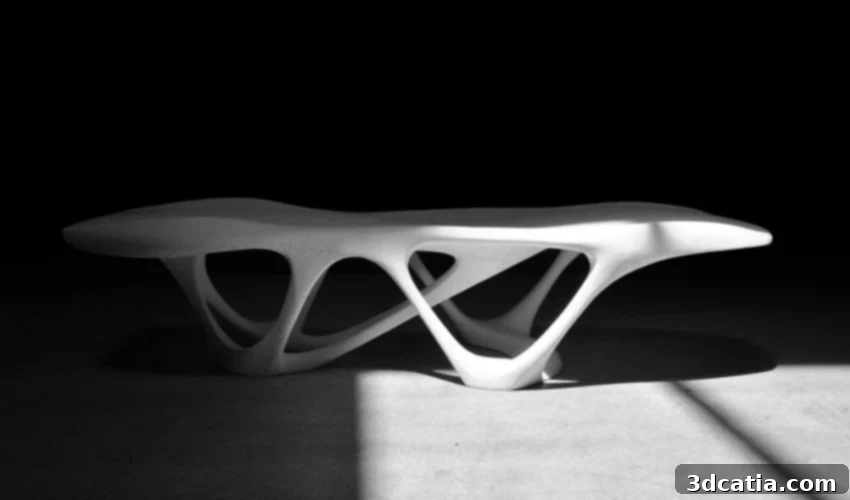
Slicelab Pioneers Concrete Design with Revolutionary 3D Printed Molds
In an era where design boundaries are constantly being pushed, additive manufacturing has emerged as an indispensable force, enabling the creation of original designs and intricate parts with previously unimaginable shapes. This transformative technology has fostered a burgeoning synergy between art and 3D printing, giving rise to numerous innovative initiatives like “Scan the World,” which digitizes cultural artifacts for broader access. Companies worldwide are increasingly recognizing and embracing the profound potential of this fusion, and among the leading pioneers is Slicelab. Established in 2012 and operating from their creative hubs in New York and Detroit, Slicelab is a renowned multidisciplinary design studio dedicated to exploring avant-garde design methodologies. Their expertise lies in digital fabrication, offering comprehensive services in architecture, product design, and furniture design. Furthermore, Slicelab extends its specialized knowledge to other enterprises through manufacturing consulting, cementing its reputation as a leader in innovative production techniques. Recently, the studio captivated the design world by unveiling a groundbreaking concrete table, meticulously crafted using a 3D printed mold, showcasing a remarkable blend of traditional material with cutting-edge technology.
This exceptional piece of furniture, aptly named the “Delicate Density Table,” is a testament to Slicelab’s commitment to pushing material and fabrication limits. Measuring an impressive 5 feet in length, 17 inches in width, and 15 inches in height (approximately 152.5 cm x 45.5 cm x 38 cm), the table commands attention with its substantial presence, weighing around 86 kilograms (90 lbs). Constructed from robust concrete, the creation of the Delicate Density Table was a complex endeavor, brought to fruition through an sophisticated integration of advanced simulation and optimization technologies. The American design firm eloquently articulates their core objective: “The intent of this project was to research a new fabrication and mold making method for complex concrete forms by using 3D printing. With concrete’s ability to take on any shape, it shares a strong similarity to how rapid prototyping is able to produce nearly any geometry. The potential of combining these two mediums was seen as a great opportunity.” This statement encapsulates the project’s ambition to harmonize concrete’s inherent versatility with the unparalleled geometric freedom offered by rapid prototyping. Essentially, the Delicate Density Table stands as an aesthetically captivating and structurally dense piece of furniture, its existence made possible by the transformative power of modern 3D printing techniques.
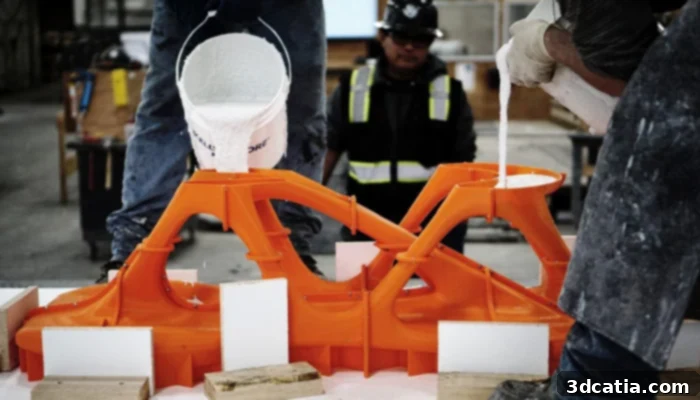
Filling the 3D printed mold with white concrete. (photo credits: Slicelab)
The Ingenious Fabrication Process: Crafting Complex Concrete with 3D Printed Molds
The journey from digital concept to tangible concrete masterpiece involved an intricate and innovative fabrication process. One of the primary challenges was the sheer scale of the Delicate Density Table. Given its substantial dimensions, directly printing a single, monolithic mold would have been impractical due to the limitations of typical 3D printer build volumes and the structural integrity requirements for such a large casting. To overcome this, Slicelab ingeniously segmented the digital model of the mold into 23 discrete parts. This strategic division was crucial for several reasons: it allowed for meticulous optimization of each component, facilitated easier printing on standard large-format FDM machines, and significantly limited the necessity for extensive support structures during the printing phase, which in turn reduced material waste and post-processing time. PLA (Polylactic Acid) was chosen as the material for the mold, favored for its ease of printing, cost-effectiveness, and sufficient rigidity for concrete casting.
Following the successful 3D printing of all 23 segments, a painstaking assembly process ensued. Each part was carefully joined and secured to form a complete, robust PLA mold, which collectively weighed approximately 30 kg. The integrity of this assembled mold was paramount, as it needed to withstand the immense pressure and weight of the wet concrete. Once the expansive mold was fully formed and meticulously sealed, it was prepared for the casting phase. Slicelab employed a reverse-filling method, pouring the specialized white concrete into the mold from the underside. This technique is particularly effective in achieving a flawless, air-bubble-free, and aesthetically superior surface finish on the final concrete piece, as gravity aids in settling the concrete evenly against the mold’s interior. The precision of the 3D printed mold allowed for the realization of the table’s intricate, flowing lines and delicate yet dense form, which would be virtually impossible to achieve with traditional mold-making techniques.
A PLA Mold Divided into 23 Parts: Engineering for Unprecedented Detail
The decision to segment the PLA mold into 23 parts was a critical engineering choice that underpinned the success of the Delicate Density Table. Beyond merely accommodating build volume constraints, this modular approach provided invaluable flexibility throughout the production cycle. It allowed Slicelab’s designers and engineers to individually refine each section, ensuring optimal structural performance and surface quality. This granular control over the mold’s geometry also played a significant role in minimizing the need for support material, a common challenge in large-scale additive manufacturing projects. Reducing supports not only saves material and cost but also drastically cuts down on post-processing labor, as complex geometries often require extensive manual removal and finishing of support structures. After the meticulous printing and assembly, the combined weight of 30 kg for the PLA mold underscored its substantial nature, necessary to contain the heavy concrete mixture.
The subsequent step involved the careful filling of this elaborate mold with white concrete. The selection of white concrete was deliberate, chosen for its clean, modern aesthetic that highlights the table’s intricate form and provides a striking contrast to traditional gray concrete. The reverse-filling method, where concrete is introduced from the bottom up, is a sophisticated casting technique. It prevents air pockets from forming against the mold surface, ensuring a smooth, immaculate finish on the visible parts of the table. This attention to detail in the casting process is what gives the Delicate Density Table its refined and “delicate” appearance, despite its inherent density and robust material. Finally, after the concrete had cured to the required strength, the painstaking process of demolding began. Unlike simpler molds that can be easily opened or removed, the complex, undulating geometry of the Delicate Density Table necessitated that the PLA mold be carefully broken down piece by piece. This destructive demolding process, while labor-intensive, was essential to preserve the integrity of the final concrete form, allowing Slicelab to reveal the stunning, perfectly formed concrete table beneath.
The Convergence of Craftsmanship and Digital Manufacturing
The successful realization of the Delicate Density Table stands as a powerful testament to the potent synergy between time-honored construction methods and advanced 3D printing technology. Slicelab expresses immense satisfaction with this hybrid approach, emphasizing the pivotal role that 3D printing played throughout the entire manufacturing process. They assert, “This is unparalleled in the traditional mold making techniques regularly seen throughout the field of concrete casting.” This statement highlights the revolutionary nature of their methodology. Traditional concrete casting, while versatile, often struggles with the intricate and free-form geometries that Slicelab effortlessly achieved. Conventional mold making typically involves labor-intensive carving, fabrication of complex wooden or foam forms, or the use of flexible rubber molds, all of which have inherent limitations in detail, cost, and lead time, especially for unique, one-off designs. Additive manufacturing, by contrast, allowed Slicelab to bypass these constraints, producing a mold with extraordinary precision and complexity directly from a digital design file.
This project is yet another compelling illustration of how additive manufacturing and the broader field of design are not merely complementary but are rapidly becoming inseparable. The ability to rapidly prototype and iterate on mold designs digitally, then physically produce them with unparalleled accuracy, opens up vast new possibilities for architects, product designers, and artists. It allows for the exploration of organic forms, intricate textures, and structural optimizations that would be economically or physically prohibitive using conventional methods. Slicelab’s Delicate Density Table is more than just a piece of furniture; it is a proof-of-concept that signifies a paradigm shift in material fabrication. It demonstrates how digital tools can empower designers to transcend material limitations, pushing the boundaries of what is aesthetically and structurally feasible in concrete. This innovative approach promises not only greater design freedom but also potential efficiencies in prototyping and production for custom pieces, paving the way for a new era of bespoke and high-performance concrete elements in both art and industry.
The Future of Custom Fabrication: Slicelab’s Enduring Legacy
Slicelab’s work on the Delicate Density Table is not an isolated incident but rather a significant marker in the ongoing evolution of design and manufacturing. It underscores a broader trend where multidisciplinary studios are leveraging advanced digital fabrication techniques to solve complex design challenges and create unique, high-value products. Their approach to integrating 3D printed molds into concrete casting offers a scalable model for producing custom architectural elements, public art installations, and bespoke furniture pieces with intricate geometries and superior finishes. This methodology reduces the reliance on extensive manual labor for complex mold creation, potentially leading to more cost-effective and time-efficient production cycles for highly customized designs. Furthermore, the precise control offered by 3D printing allows for material optimization, potentially leading to lighter yet stronger concrete structures, addressing sustainability concerns through efficient material usage.
The impact of such innovation extends beyond the immediate product. It inspires further research into new material combinations, hybrid manufacturing workflows, and sustainable design practices. As additive manufacturing technologies continue to advance, becoming faster, more precise, and capable of handling a wider range of materials, we can anticipate an even greater convergence with traditional crafts. Slicelab exemplifies how a creative vision, combined with technical prowess, can unlock new aesthetic and functional possibilities. Their Delicate Density Table stands as a beacon for what is achievable when designers are empowered by cutting-edge tools to reimagine the creation process itself. This pioneering spirit contributes not only to the specific fields of furniture and architectural design but also to the broader discourse on how technology can enhance human creativity and reshape our built environment.
What are your thoughts on Slicelab’s innovative approach and the remarkable Delicate Density Table? We’d love to hear your perspective on this fusion of 3D printing and concrete design. Also, what do you think about other pioneering projects, such as the first ever Dutch 3D printed concrete home? Share your insights in a comment below or connect with us on ourFacebook,Twitter andLinkedIn pages! Don’t miss out on the latest advancements in additive manufacturing—sign up for our free weeklyNewsletter here, and get the most current 3D printing news delivered straight to your inbox!