
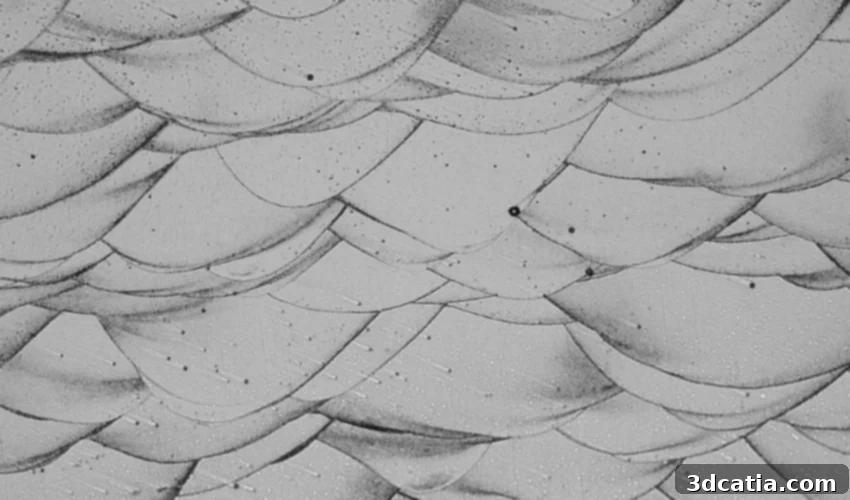
Revolutionary 3D Printed Aluminum Alloys Redefine High-Temperature Performance
Aluminum, celebrated for its lightweight nature and impressive strength, is a cornerstone material across numerous industries. However, its susceptibility to diminished mechanical performance at elevated temperatures poses a significant challenge, particularly in sectors like aerospace and automotive where components such as turbines and engines demand exceptional thermal resistance. This limitation has spurred intense research efforts to enhance the high-temperature capabilities of aluminum alloys, unlocking their full potential in demanding applications.
In a groundbreaking development, researchers at Nagoya University in Japan have pioneered a new series of aluminum alloys specifically engineered for enhanced mechanical strength and heat tolerance, leveraging the power of metal 3D printing. These innovative alloys utilize readily available, low-cost elements and are fully recyclable, aligning with sustainability principles. Notably, one of the alloy variants exhibits remarkable strength and flexibility, even at temperatures reaching 300°C. The findings of this study have been published in the prestigious journal Nature Communications, marking a significant advancement in materials science and engineering.
Pushing the Boundaries of Alloy Design: A Quest for the “Perfect Alloy”
The research team adopted a systematic approach to identify elements that could effectively strengthen the aluminum matrix and promote the formation of protective micro- or nanostructures. Their methodology involved a combination of predictive modeling and experimental validation. Initially, they formulated predictions regarding the behavior of various elements within the aluminum matrix. Subsequently, they created novel alloys incorporating copper, manganese, and titanium to empirically verify their predictions. Electron microscopy was then employed to meticulously analyze the resulting microstructures and confirm the validity of their initial hypotheses.
Among the newly developed alloys, one stood out for its exceptional performance. This alloy, composed of aluminum, iron, manganese, and titanium, surpassed all other 3D-printed aluminum materials in terms of high-temperature strength and room-temperature flexibility. This remarkable combination of properties makes it particularly attractive for applications requiring both robustness at high temperatures and ease of processing at ambient conditions.
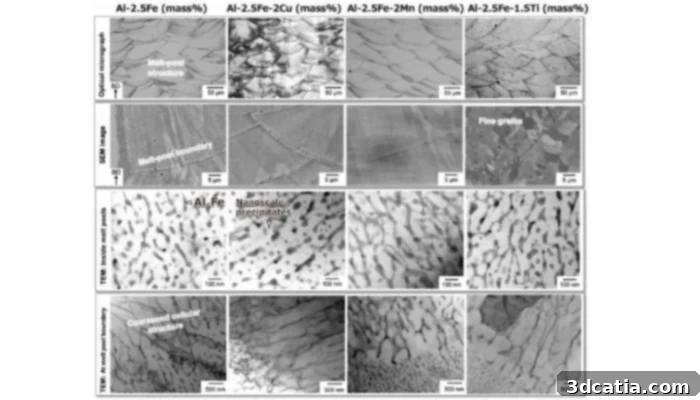
Microscopic views of aluminum alloys after 3D printing. (Photo credits: Takata et al., 2025)
Naoki Takata, the lead author of the study and a professor at Nagoya University’s Graduate School of Engineering, emphasized the unconventional nature of their alloy design. “The design centers on iron, which metallurgists usually don’t add to aluminum because it makes the metal brittle and vulnerable to corrosion,” he explained. This highlights the researchers’ willingness to challenge conventional wisdom and explore novel approaches to alloy development.
The microscopic images provide valuable insights into the structural transformations induced by 3D printing in aluminum alloys. The images illustrate the layer-by-layer melting and solidification process inherent in additive manufacturing, revealing the intricate grain organization that dictates the material’s mechanical strength. Furthermore, they showcase the distribution of microscopic particles within and at the grain boundaries, which are critical determinants of the alloy’s behavior under stress and at high temperatures. Understanding these microstructural features is essential for optimizing the properties of 3D-printed aluminum alloys.
Reimagining Aluminum’s Internal Structure with 3D Printing Technology
The key to this breakthrough lies in the utilization of laser powder bed fusion, a powerful 3D printing technique. According to Professor Naoki Takata, this technology enables the “trapping” of iron and other elements in metastable forms, a feat unattainable through traditional manufacturing methods. This unique capability allows for the creation of novel microstructures that enhance the alloy’s performance characteristics. The research team’s systematic design approach was instrumental in identifying elements capable of reinforcing the aluminum matrix and generating protective micro- and nanostructures. This meticulous approach ensured that the resulting alloys exhibited improved strength and heat tolerance without compromising their printability, a crucial factor for practical applications.
Laser powder bed fusion offers several advantages over conventional manufacturing processes. The rapid heating and cooling rates inherent in this technique promote the formation of non-equilibrium phases and microstructures, leading to enhanced material properties. Furthermore, the precise control over the deposition process allows for the creation of complex geometries and intricate designs, opening up new possibilities for component optimization.
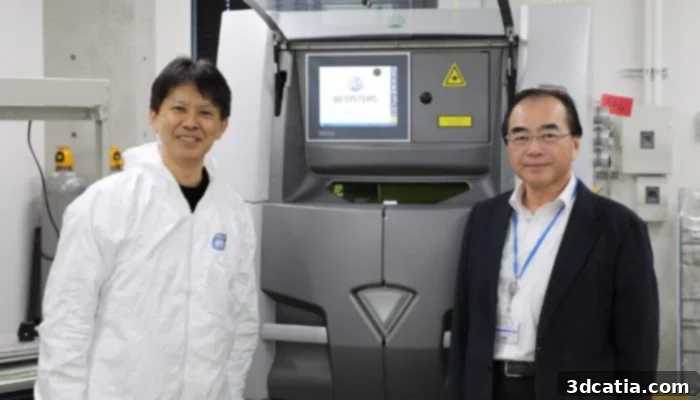
Naoki Takata of Nagoya University, principal investigator of the project (left), and Masaki Kato, senior author and division manager at the Aichi Center for Industry and Science Technology (right), with the center’s laser 3D printer that creates stronger and more heat-resistant aluminum alloys.
The newly developed alloys, based on aluminum and iron and enriched with copper, manganese, and titanium, represent a significant advancement in materials engineering. These alloys combine the desirable attributes of lightness, high mechanical strength, and stability at elevated temperatures. The carefully engineered design enables the added elements to fortify the internal structure of the metal and enhance its ductility, leading to the production of higher-performance and more durable components. Moreover, the use of low-cost, recyclable materials underscores the environmental sustainability of this innovative solution, aligning with the growing emphasis on eco-friendly manufacturing practices.
Professor Takata further emphasized the broader applicability of their method: “Our method relies on established scientific principles about how elements behave during rapid solidification in 3D printing and is applicable to other metals. The alloys also proved easier to 3D print than conventional high-strength aluminum, which frequently cracks or warps during fabrication.” This suggests that the principles underlying their alloy design can be extended to other metal systems, paving the way for the development of a wide range of high-performance 3D-printed materials.
The fact that these alloys exhibit improved printability compared to conventional high-strength aluminum alloys is a significant advantage. Cracking and warping are common challenges in the 3D printing of aluminum alloys, often requiring complex process optimization and support structures. The enhanced printability of the new alloys simplifies the manufacturing process and reduces the likelihood of defects, making them more attractive for industrial applications.
The Promise of Lighter Vehicles and Reduced Emissions
The success of these new aluminum alloys hinges on the precise control of the microstructure. The presence of certain metastable phases contributes to the strengthening of the metal, while titanium promotes the formation of finer grains and enhances ductility. This carefully orchestrated interplay of microstructural features results in a material with exceptional performance characteristics. According to the researchers, this innovation holds immense potential for revolutionizing the design and manufacturing of automotive and aerospace components, enabling the creation of lightweight structures that offer both high performance and environmental sustainability.
The potential applications of these materials are vast and far-reaching. They could facilitate the manufacture of lightweight aluminum components for parts that operate at high temperatures, such as compressor rotors and turbine components, leading to improved engine efficiency and reduced fuel consumption. In the automotive industry, the use of lightweight aluminum alloys can contribute to significant weight reductions in vehicles, resulting in improved fuel economy and lower emissions.
The aerospace industry stands to benefit greatly from this innovation. Aircraft engines demand materials that combine lightness and heat resistance, and the new aluminum alloys perfectly meet these requirements. The use of these alloys in aircraft engine components can lead to improved fuel efficiency, reduced emissions, and enhanced aircraft performance. Moreover, the research provides a valuable framework for designing new classes of metals specifically tailored for 3D printing, accelerating development across diverse industrial sectors.
The ability to design metals specifically for 3D printing opens up a whole new realm of possibilities in materials engineering. Traditional alloy design often focuses on optimizing properties for conventional manufacturing processes, such as casting or forging. By tailoring alloys to the unique characteristics of 3D printing, it is possible to achieve unprecedented levels of performance and functionality.

Fine metal powder used to 3D print new aluminum alloys. Each particle has a diameter of less than 20 micrometers. A laser melts these particles layer by layer to build the final metal part.
What are your thoughts on these innovative aluminum alloys developed by researchers at Nagoya University? Share your opinions in the comments below or on our LinkedIn or Facebook pages! Don’t forget to subscribe to our free weekly Newsletter for the latest 3D printing news delivered directly to your inbox. You can also find all our videos on our YouTube channel.
*All Photo Credits: Nagoya University