
Revolutionizing Industries: The Latest Innovations in 3D Printing Across Aerospace, Construction, Food, and Sustainable Materials
Welcome to our weekly deep dive into the world of additive manufacturing, where groundbreaking innovations are constantly reshaping industries. This edition takes us on an exhilarating journey through diverse sectors, highlighting how 3D printing is pushing boundaries and offering unprecedented solutions. We kick off with a look behind the scenes of the prestigious Formula SAE student competition, where engineering brilliance meets motor racing passion, and discover how a student team leveraged metal 3D printing to achieve superior performance in their electric vehicle. Next, we ascend into the aerospace realm, exploring a significant collaboration between the ADDMAN Group and Continuous Composites that promises to accelerate advanced manufacturing for critical applications. Our exploration continues into the construction sector, where a consortium of partners is embarking on an ambitious project to design a substantial 7.8-ton bridge using cutting-edge 3D concrete printing techniques. Finally, we’ll tantalize your taste buds with an exciting development in the food 3D printing market, particularly focusing on sustainable seafood alternatives, before concluding with a revolutionary new material designed to combat plastic pollution. Prepare to be inspired by the transformative power of 3D printing. Have a fantastic weekend and happy reading!
Precision Engineering for Speed: 3D Printing Fuels Student Success in Motor Racing
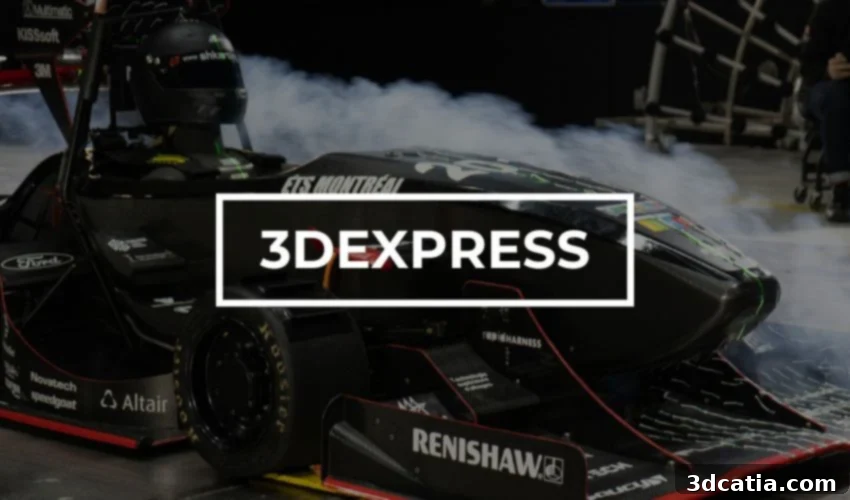
The Formula SAE university competition, an annual spectacle held in Montreal, challenges over 600 students to design, build, and race small-scale F1-style vehicles. This fiercely competitive event demands innovative engineering solutions to achieve peak performance. This year, one exceptional team from Montreal’s École de technologie supérieure (ETS) distinguished itself by embracing metal additive manufacturing to craft critical components for their electric vehicle. The pursuit of speed and efficiency in motor racing hinges significantly on lightweighting – every gram saved contributes to faster acceleration, improved handling, and enhanced overall performance.
The ETS team focused on optimizing crucial structural elements, specifically the pillars – the vertical supports located between the front and rear doors of the car. Traditionally, these components would be CNC machined from aluminum, a method that, while precise, limits design complexity and material efficiency. Recognizing the potential of additive manufacturing, the students partnered with Renishaw, a global leader in metal 3D printing technology. Their goal was to reimagine these pillars with an organic, lattice-like internal structure, a design impossible to achieve with conventional machining.
By utilizing Renishaw’s expertise and AlSi10Mg aluminum powder, a material known for its excellent strength-to-weight ratio and printability, the team successfully printed parts that delivered substantial weight reductions. The front pillars were an impressive 30% lighter than their traditionally manufactured counterparts, while the rear pillars achieved a 28% weight reduction. These figures are not just marginal improvements; in the high-stakes world of motor racing, such significant weight savings translate directly into a competitive edge on the track, showcasing the profound impact of advanced manufacturing techniques on automotive engineering and design. This project serves as a compelling example of how educational competitions foster innovation and prepare future engineers for real-world challenges, pushing the boundaries of what’s possible with additive manufacturing.
Shooting for the Stars: ADDMAN and Continuous Composites Partner for Aerospace Innovation
The aerospace and defense sectors are continually seeking materials and manufacturing processes that offer superior performance, reduced weight, and design flexibility. In this high-stakes environment, additive manufacturing is increasingly proving its indispensable value. The latest significant development comes from a strategic partnership between the ADDMAN Group, a leading provider of advanced manufacturing solutions, and Continuous Composites, pioneers of Continuous Fiber 3D Printing (CF3D®) technology. This collaboration aims to dramatically scale the application of CF3D® for critical aerospace and defense components, propelling the industry into a new era of innovation.
Continuous Fiber 3D Printing is a revolutionary process that integrates continuous carbon, glass, or aramid fibers into thermoplastic or thermoset matrices during the printing process. This results in parts with exceptional strength, stiffness, and fatigue resistance, rivalling or even surpassing traditional composites, while offering the geometric complexity and design freedom inherent to 3D printing. The partnership empowers ADDMAN to leverage this cutting-edge technology for producing high-performance test parts and prototypes, specifically targeting demanding applications such as Hypersonics and Unmanned Aerial Vehicles (UAVs).
Hypersonic applications, which involve flight at speeds exceeding Mach 5, present immense material challenges due to extreme temperatures and pressures. CF3D® composites, especially when paired with advanced materials, offer the potential to create components that can withstand these harsh environments while significantly reducing weight. Similarly, for UAVs, which require maximum flight endurance and payload capacity, lightweight yet incredibly strong components are paramount. ADDMAN’s commitment to this partnership is underscored by the installation of a CF3D machine at its Fort Myers headquarters. This strategic move establishes ADDMAN as the sole service bureau in the US capable of offering both carbon-carbon composite and refractory alloy 3D printing, providing a unique and comprehensive solution for demanding clients.
Furthermore, the CF3D® technology seamlessly integrates with ADDMAN Group’s existing material expertise. Their Castheon 3D-printed Niobium alloys, for instance, are particularly well-suited for high-temperature and hypersonic applications, offering excellent thermal stability and strength. This synergy between advanced printing technology and specialized materials is expected to unlock new design possibilities and performance thresholds for aerospace and defense systems. For those eager to delve deeper into this groundbreaking collaboration and its implications, 3Dnatives will host an insightful webinar featuring both companies on Tuesday, December 3rd, at 10 AM EST / 4 PM CET. Registration for this free event is available HERE.
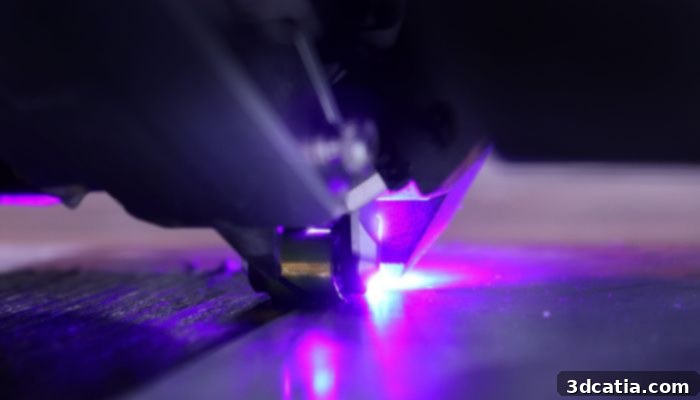
Photo Credits: Continuous Composites
Building the Future: A Concrete 3D Printing Collaboration Unveils a 7.8-ton Bridge
The construction industry, often perceived as traditional, is undergoing a profound transformation thanks to additive manufacturing. 3D concrete printing, in particular, is proving its capacity to enable faster, more cost-effective, and sustainably advanced construction methods. Swiss materials giant Sika has recently announced a significant collaboration with several partners to further the ambitious Diamanti project. This initiative centers around the creation of a monumental 9-meter long by 2-meter wide polyhedral structure – a bridge – meticulously designed and built using advanced 3D concrete printing techniques.
The consortium behind this venture includes industry leaders such as Carsey 3D, Cerib, and AEvia, each bringing specialized expertise to the table. A primary objective of the Diamanti project is to drastically minimize the amount of material required for construction, a critical factor for both environmental sustainability and economic efficiency. By leveraging the geometric freedom offered by 3D printing, designers can create optimized structures that use material only where absolutely necessary, reducing waste and embodied carbon.
Sika’s role in this groundbreaking project is multifaceted. They are providing a specially formulated, fiber-reinforced concrete designed for precise extrusion, ensuring optimal flow, adhesion, and structural integrity during the printing process. Beyond material supply, Sika contributes its extensive knowledge in additive manufacturing processes, material science, and advanced modeling techniques. This holistic approach ensures that the project not only builds a physical structure but also advances the fundamental understanding and application of 3D printing in large-scale construction.
Ultimately, the Diamanti project represents a bold step towards a future where 3D technologies are routinely employed to design and construct all types of structures, from intricate architectural elements to critical infrastructure like bridges. This collaborative effort aims to refine current construction methodologies, offering unprecedented design freedom, rapid prototyping capabilities, and significant reductions in construction time and labor. The initial tangible results of this pioneering work will be publicly displayed from May 10 to November 23, 2025, at the “Time – Space – Existence” exhibition hosted by the European Cultural Centre in Italy, providing a glimpse into the future of sustainable architecture and engineering.
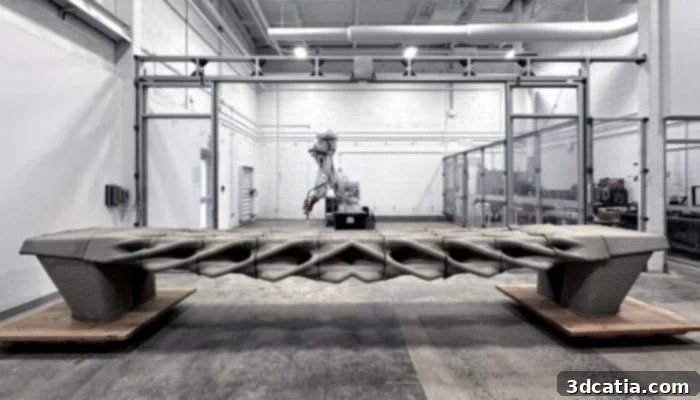
Part of the 3D-printed bridge (photo credits: Polyhedral Structural Laboratory, University of Pennsylvania)
Savoring the Future: A Partnership to Advance Sustainable Food 3D Printing
As global populations grow and environmental concerns mount, the demand for sustainable and ethically produced food alternatives is skyrocketing. In response, innovative companies are turning to advanced technologies like 3D printing to revolutionize food production. If you keep pace with the latest developments in additive manufacturing, you’re likely familiar with Steakholder Foods, an Israeli pioneer in using 3D printing to create plant-based alternatives to traditional meat, fish, and seafood products. Their mission is to provide delicious, nutritious, and sustainable options that appeal to a broad consumer base.
Steakholder Foods has recently forged a significant R&D partnership with UMAMI Bioworks, a move designed to accelerate their groundbreaking work and bring their innovations closer to commercial reality. The core objective of this collaboration is to scale up the production of 3D-printed fish fillets. This is a crucial step towards achieving international commercialization, addressing pressing environmental issues such as overfishing, marine ecosystem degradation, and the carbon footprint associated with conventional seafood farming and capture.
The synergy between Steakholder Foods’ expertise in plant-based food formulations and UMAMI Bioworks’ technological prowess promises to yield highly realistic and palatable fish fillets. 3D printing allows for the precise layering of different plant-based ingredients, mimicking the intricate fibrous texture and flake of natural fish, while also enabling the infusion of authentic flavors and nutritional profiles. This level of customization and control is impossible with traditional food manufacturing methods. The ability to produce sustainable alternatives that taste and feel like conventional fish can play a pivotal role in shifting consumer habits towards more environmentally friendly choices.
We will certainly keep you updated on the progress of this exciting venture. Imagine a near future where you walk into your local supermarket and find perfectly sculpted, delicious, and sustainable salmon fillets, produced entirely through 3D printing, available right alongside traditional options. This partnership is not just about creating new food products; it’s about contributing to a more sustainable global food system, offering solutions to complex ecological challenges, and redefining how we consume seafood for generations to come.

Photo Credits: Shlomi Arbiv/Steakholder/SWNS
Tackling Environmental Challenges: Beeswax as a Sustainable 3D Printing Material
Plastic pollution represents one of the most formidable environmental crises of our era. Millions of tons of plastic waste inundate landfills and oceans annually, persisting for centuries and causing devastating harm to ecosystems and wildlife. In light of this urgent challenge, the quest for truly sustainable, biodegradable, and renewable material alternatives has become paramount. Within this context, 3D printing emerges as a vital tool, enabling the rapid prototyping and production of innovative components from these new, environmentally conscious materials.
A remarkable example of this sustainable innovation is seen in the “The Wax Project” initiative, which explores the architectural applications of beeswax. This project creatively leverages 3D printing to develop prototypes of intricate lattice structures, utilizing beeswax as a primary building material. Beeswax is a natural, abundant, and completely biodegradable resource, making it an ideal candidate to replace conventional plastics in various construction and design applications. Its inherent properties also offer unique aesthetic and functional advantages.
The process involves 3D printing the initial beeswax prototypes, often featuring complex internal geometries that optimize material use and provide structural integrity. These prototypes then serve as masters for creating silicone molds, which are subsequently used to cast the final beeswax panels. The resulting translucent panels not only provide appealing visual qualities, allowing for diffused light and a warm ambiance, but also possess inherent functional properties. Crucially, these beeswax panels are designed for easy reuse and recycling, significantly extending their lifecycle and dramatically reducing their carbon footprint compared to synthetic materials. This project not only showcases the versatility of beeswax as a construction material but also highlights 3D printing’s role in facilitating sustainable practices, offering a hopeful vision for reducing plastic dependency and fostering a more circular economy in architecture and beyond.
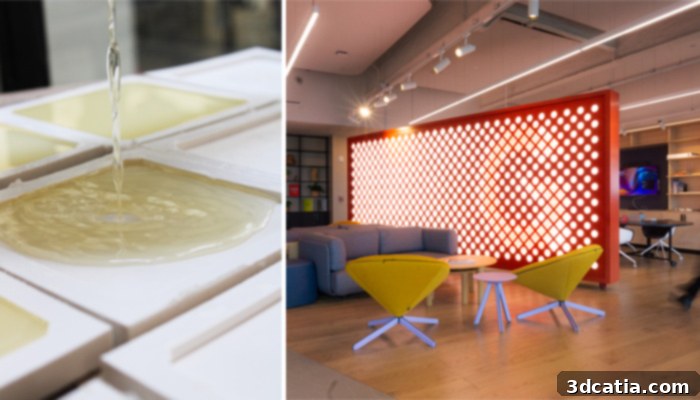
Photo Credits: Manufactura Mexico
The scope and impact of 3D printing continue to expand at an incredible pace, transforming industries from motor racing and aerospace to construction and food production, while also offering critical solutions for environmental sustainability. What are your thoughts on the innovative use of 3D printing in student motor racing competitions? How do you envision the new collaboration between Continuous Composites and the ADDMAN Group shaping the future of aerospace additive manufacturing? We invite you to share your insights and opinions in a comment below or join the conversation on our LinkedIn, Facebook, and Twitter pages! Don’t miss out on the latest advancements – be sure to sign up for our free weekly Newsletter here to get all the cutting-edge 3D printing news delivered straight to your inbox! You can also explore our extensive library of videos on our YouTube channel for more in-depth content and demonstrations.