
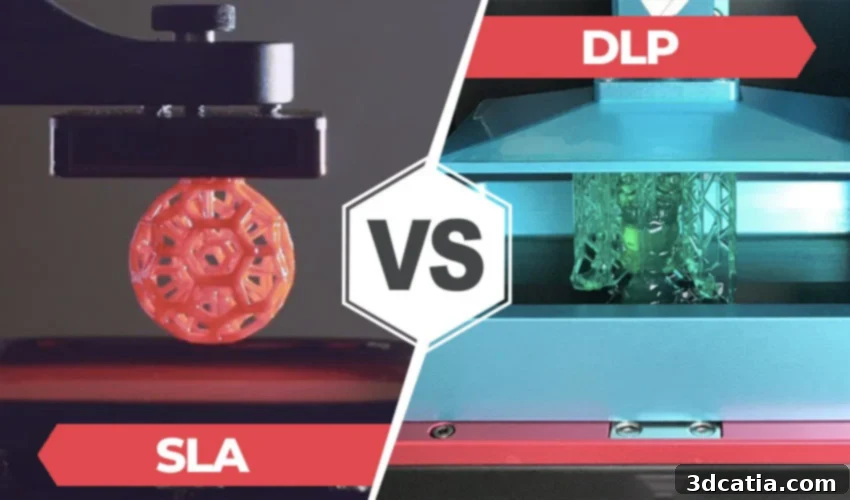
SLA vs. DLP: A Comprehensive Comparison of Resin 3D Printing Technologies
Since the groundbreaking invention of stereolithography (SLA) in 1984 by Charles Hull, the landscape of additive manufacturing has rapidly evolved. This pioneering technology, which marked the dawn of 3D printing, has since been joined by a multitude of innovative processes, including Fused Deposition Modeling (FDM), Selective Laser Sintering (SLS), and Multi Jet Fusion (MJF). Many of these, like Digital Light Processing (DLP), are direct descendants or close relatives of the original SLA concept, leveraging similar principles with distinct implementations.
Each of these 3D printing technologies caters to specific industry needs and applications, offering unique advantages and disadvantages. Today, our focus will be narrowed down to two of the most prominent resin-based technologies: SLA and DLP. We will delve into their fundamental characteristics, operational mechanisms, material compatibilities, and practical applications to establish a clear and detailed comparison between these two fascinating processes. While SLA and DLP share many commonalities, they also exhibit notable differences that can significantly influence the choice for a particular project. This article will explore how these technologies work, the types of materials they utilize, who the key manufacturers are, and what users can expect in terms of print quality, speed, and cost.
Understanding SLA and DLP Technologies: Core Principles and Similarities
At their core, both Stereolithography (SLA) and Digital Light Processing (DLP) are forms of resin 3D printing that rely on the principle of photopolymerization. This process involves exposing liquid photopolymer resins to a light source, causing them to solidify layer by layer. Both technologies typically utilize a resin tank where the liquid material is held, and a build platform that submerges into or rises from this resin as each layer is cured. This shared foundation makes them particularly well-suited for producing small to medium-sized models with exceptionally fine details and smooth surface finishes, qualities often unattainable with extrusion-based methods like FDM.
The versatility of materials is another shared advantage. Both SLA and DLP printers are compatible with a wide range of photopolymer resins, enabling the production of parts with varying mechanical properties, from flexible to hard. They can also process composite materials, often filled with glass or ceramic particles, to enhance specific properties like strength or heat resistance. However, it’s crucial to acknowledge a common characteristic of resin-printed parts: their relative fragility. Parts produced via SLA or DLP are generally more susceptible to deterioration if exposed to direct sunlight for prolonged periods and may be prone to warping or brittleness if not post-cured correctly or if exposed to certain environmental conditions. Proper post-processing and storage are essential for maximizing the longevity and performance of these printed objects.
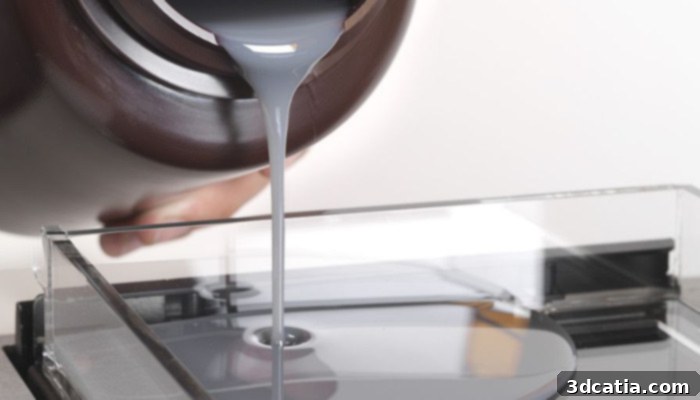
Liquid resin is used for both SLA and DLP.
Stereolithography (SLA): Precision Through Laser Technology
Stereolithography holds the distinction of being the first commercially available 3D printing technology, pioneered by Charles Hull in 1984. Today, it remains one of the most accurate and precise additive manufacturing processes available on the market. Unlike DLP technology, SLA utilizes a highly focused ultraviolet (UV) laser as its light source. This laser beam meticulously traces the cross-section of each layer onto the surface of the liquid resin, polymerizing the material point by point along the horizontal (X-Y) axis. As each layer is completed, the build platform moves slightly (typically by a layer thickness, usually in the Z-axis), and the process repeats until the entire object is formed.
SLA machines broadly come in two main configurations: top-down and bottom-up. In top-down systems, the laser projects onto the top surface of a resin tank, and the build platform descends further into the resin with each successive layer. This configuration allows for larger print volumes and often simpler resin handling. Conversely, bottom-up systems, which are more common in desktop SLA printers, project the laser from beneath a transparent resin tank, curing the resin directly onto a rising build platform. This method often requires less resin and allows for easier part removal but can introduce complexities with a non-stick layer between the resin and the transparent window. Regardless of the configuration, SLA excels at achieving exceptionally smooth surfaces and can produce objects with incredibly thin layers, typically ranging from 0.05 mm down to 0.01 mm, enabling the capture of intricate details and tight tolerances that are critical for applications demanding high fidelity.
Digital Light Processing (DLP): Speed Through Image Projection
Digital Light Processing, a technology with roots in image projection dating back to the 1980s, adapts this concept for 3D printing by using a digital projector as its light source. Unlike the point-by-point laser scanning of SLA, DLP cures an entire layer of resin simultaneously by projecting a complete image of that layer onto the resin surface. This method drastically reduces print times, especially when printing multiple parts or larger objects, as the time required to cure a layer is constant regardless of the complexity or quantity of features within that layer.
At the heart of a DLP printer is a Digital Micromirror Device (DMD). This sophisticated component, situated between the projector and the resin tank, consists of millions of microscopic mirrors. Each mirror can be individually tilted to either reflect the projector’s light towards the resin, thereby curing it, or deflect it away. In essence, the DMD acts as a dynamic mask, selectively hardening the resin precisely according to the desired layer’s geometry. While the original DLP technology uses a DMD, some modern 3D printers have adopted high-resolution LCD screens instead of DMDs. These ‘Masked Stereolithography’ (MSLA) or ‘LCD-based resin printers’ achieve a similar effect by using the LCD screen to block or pass UV light, offering a significantly lower machine price point. However, for the scope of this in-depth comparison, our primary focus remains on traditional DLP systems utilizing DMDs.
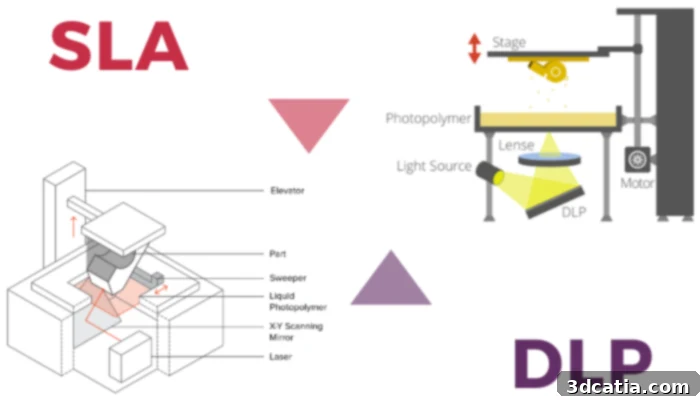
SLA and DLP printing process diagrams (photo credits: 3D Hubs / bitfab)
Key Operational Differences: Speed, Size, and Maintenance
When directly comparing the operational aspects of SLA and DLP, several distinctions emerge. As highlighted, the DLP process is generally considered faster than stereolithography. This speed advantage stems from its ability to cure an entire layer in one flash of light, whereas SLA’s laser must meticulously trace each point and line. For batch production of small, detailed parts, DLP often outperforms SLA in terms of throughput.
In terms of physical footprint, DLP printers, particularly those with powerful projectors, can sometimes be larger than comparable desktop SLA machines. This is primarily due to the integrated projector system, which requires space for optics and cooling. The resin tanks on DLP machines also tend to be shallower compared to those found in some industrial SLA systems, which can impact the available Z-axis build height or necessitate more frequent resin refills for taller prints. Furthermore, a significant difference lies in maintenance requirements. DLP printers often demand less complex maintenance and are generally easier to repair. This ease of service is largely attributed to the robust nature of projector systems compared to the intricate and delicate laser assemblies typically found in SLA machines, which can require specialized calibration and repair procedures.
Print Quality: Precision and Surface Finish
Print quality is often the paramount deciding factor when choosing between additive manufacturing technologies, especially when 3D printing is intended for the production of finished, end-use parts. In such cases, the level of detail, structural integrity, and surface finish play an exceptionally critical role. Fundamentally, both SLA and DLP technologies are renowned for their capability to produce highly precise, high-resolution models with exceptionally fine details. However, the ultimate quality of the print is not solely determined by the process itself but is also heavily influenced by the specific photopolymer resin used. Material choice often depends on the manufacturer, as many machines operate within closed ecosystems, limiting compatibility to proprietary resins designed for optimal performance with their specific hardware.
SLA’s Unrivaled Smoothness and Consistent Quality
When printing with the SLA process, the resin is polymerized point by point on the build platform. This precise, controlled laser tracing allows for exceptional accuracy. A key characteristic of SLA is that the printing time scales with the physical length or area traced by the laser in each layer. Thus, printing very long parts will naturally take longer, as the laser must traverse the entire bed for each layer. However, this methodical approach ensures that SLA is highly suitable for printing objects of varying lengths, from a few millimeters up to 1.50 meters or even more in industrial systems, without any inherent loss of quality due to increased part dimensions. SLA can achieve an impressive Z-axis resolution, with layer thicknesses as low as 25 microns (0.025 mm) or even finer on advanced machines. This resolution is largely independent of the model’s overall size, ensuring consistent quality across the entire build platform and resulting in parts with incredibly smooth surfaces that often require minimal post-processing for aesthetic purposes.
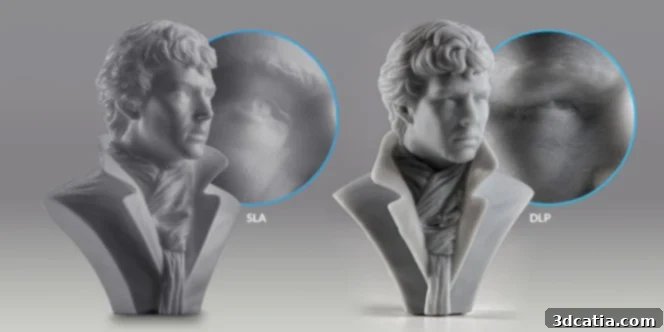
Photo credits: Formlabs
DLP’s Efficiency with Pixel-Based Considerations
DLP technology, while offering significant speed advantages, comes with its own considerations regarding print quality. DLP printers can achieve remarkably thin layers, with layer thicknesses often reaching as low as 5 microns (0.005 mm). However, a distinguishing factor of DLP is the pixel-based projection inherent to its operation. This can occasionally lead to a phenomenon known as “voxelation” or “stair-stepping” on the final product, particularly visible on angled surfaces or curves. This effect arises because the light is projected as a grid of pixels, meaning that curves are approximated by these square pixels, affecting the ultimate smoothness of the printed parts’ surfaces. When printing very long or wide components, further quality variations may occur across the print bed. The center of the build plate typically receives the most concentrated and uniform energy from the projector, with light intensity gradually diffusing towards the edges. This can result in slight differences in curing consistency and dimensional accuracy, especially for parts spanning the entire build area. Despite this, advancements in projector technology and anti-aliasing techniques have significantly improved DLP’s surface finish in recent years.
Technical Characteristics: Speed, Volume, and Post-Processing
Printing Speed: Time is Money
In the realm of print speed, DLP technology generally takes a substantial lead. This is its primary advantage over SLA. Because DLP cures an entire layer of resin in a single projection, the printing process is often much faster, especially when producing multiple small parts or parts with extensive cross-sectional areas. The time it takes for a DLP printer to complete a layer is largely constant, regardless of the complexity or number of features within that layer. Therefore, in the DLP process, only the height of the component (the number of layers) significantly affects the overall printing speed. In contrast, the SLA process, which polymerizes resin point by point, means that print speed is directly proportional to the total path the laser must trace for each layer, making it slower for dense or complex cross-sections.
Print Volume: Scaling for Different Needs
Stereolithography is not typically the first choice for producing exceptionally large components, primarily due to the high cost of photopolymer resins compared to materials used in processes like FDM. Additionally, the build volume for SLA printers is inherently limited by the physical dimensions of the resin tank. However, industrial SLA systems can still achieve impressive build volumes. For example, the Formlabs Form 3L SLA printer offers a build volume of 335 x 200 x 300 mm, while high-end industrial machines like the 3D Systems ProX 950 boast massive capacities of 1500 x 750 x 550 mm. For DLP printers, build volumes can also vary significantly. The EnvisionTEC Xtrem 8K machine, for instance, provides a substantial build volume of 450 x 371 x 399 mm, and the Carima model DM400A offers 400 x 330 x 500 mm. While desktop DLP printers often have smaller build envelopes than their SLA counterparts, industrial DLP systems are catching up, offering competitive volumes with their speed advantages.
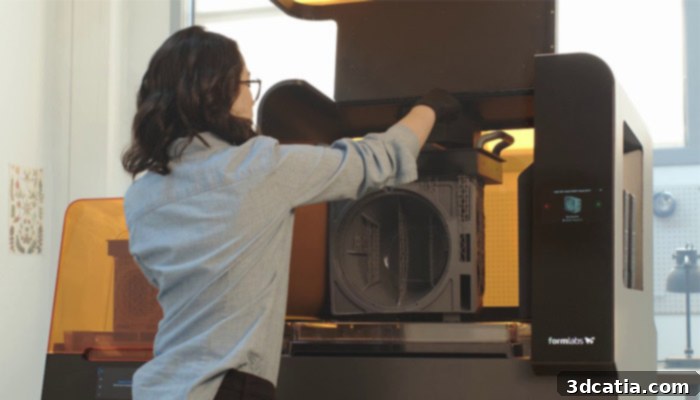
The Form 3L has a larger build volume (photo credits: Formlabs)
Post-Treatment: An Essential and Demanding Step
Regardless of whether one uses SLA or DLP, post-treatment of parts is an absolutely mandatory step in all resin 3D printing processes. This is primarily because, to successfully print very thin or delicate models, supporting structures are invariably required to prevent part deformation during the printing process. These supports must then be carefully removed after the primary curing is complete. This post-processing stage can be remarkably time-consuming and is frequently cited as one of the main disadvantages of resin 3D printing compared to other methods. The specific post-processing steps and their complexity are largely dictated by the type of resin material used, although the general sequence applies to both SLA and DLP prints.
A typical post-processing workflow includes several critical stages. First, the printed parts must be thoroughly cleaned to remove any residual uncured liquid resin from their surfaces. This is commonly done using solvents such as isopropyl alcohol (IPA) or tripropylene glycol monomethyl ether (TPM). After cleaning, the parts require drying, often with compressed air or simply by allowing them to air dry. Next, the support structures must be carefully removed, a process that can range from simple snapping off to precise cutting with specialized tools, depending on the support design and part geometry. Following support removal, a crucial step known as post-curing is almost always required. This involves exposing the cleaned parts to a secondary source of UV light, often within a dedicated curing chamber, to fully polymerize the resin and achieve the material’s optimal mechanical properties. Finally, depending on the desired finish and application, parts may undergo additional steps such as sanding, polishing, or painting. In principle, post-processing for both SLA and DLP not only demands significant time but also often requires a certain degree of skill and expertise from the user to achieve the best results, or it may be outsourced to specialists. Recognizing this challenge, many companies are now dedicating resources to optimizing or even automating these post-processing steps to streamline the additive manufacturing workflow.
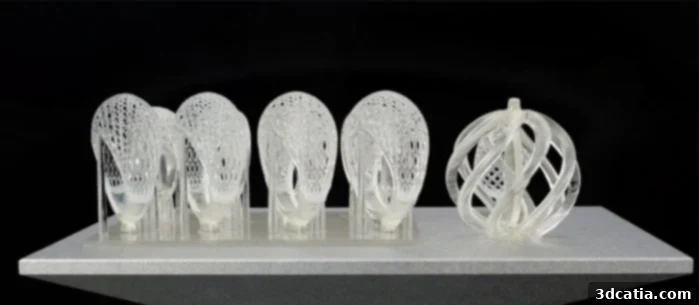
Removing print media is a post-processing step that can take time.
Application Cases: Where SLA and DLP Shine
When examining application cases, SLA and DLP technologies predominantly serve similar industries and fulfill comparable roles, largely owing to their shared advantages in producing high-resolution, detailed parts. The jewelry sector, for instance, heavily relies on resin 3D printing for creating intricate patterns for investment casting, where the high precision and smooth surfaces of resin prints are indispensable for flawless metal castings. Similarly, the dental industry has embraced resin 3D printing, utilizing it extensively for applications such as creating highly accurate dental models, surgical guides, aligner molds, and custom prosthetics. Manufacturers like Formlabs offer specialized biocompatible resins tailored for medical professionals, enabling the creation of various medical devices, including precise surgical guides that aid in complex operations.
Beyond these core sectors, the broad variety of photopolymer resins available has expanded the utility of resin 3D printing into many other industries. For rapid prototyping, both SLA and DLP offer the speed and fidelity needed to iterate designs quickly and cost-effectively, allowing engineers and designers to validate concepts with highly accurate physical models. In the manufacturing sector, they are used to produce master patterns for injection molds or vacuum casting, where the smooth surface finish ensures minimal post-processing for the mold itself. Furthermore, in general engineering, resin 3D printing is employed for producing functional prototypes, jigs, fixtures, and even end-use parts where specific material properties like flexibility, toughness, or heat resistance are required. The continuous development of new resins with enhanced mechanical and chemical properties further broadens the scope of applications, making SLA and DLP integral tools across a diverse range of professional fields, from consumer products to aerospace components.
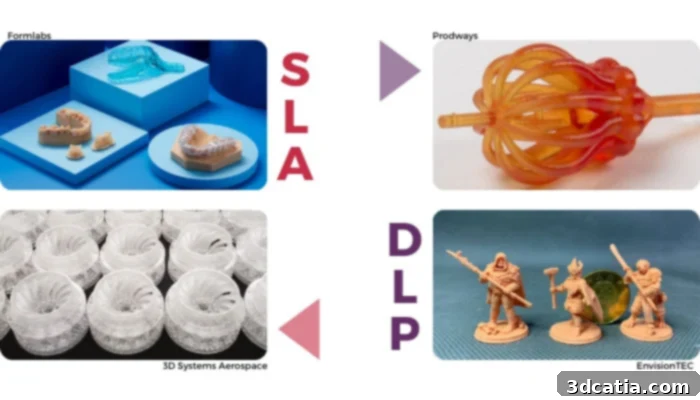
Regardless of whether its SLA or DLP the accuracy is remarkable.
Main Manufacturers and Market Innovators
The market for resin 3D printers, particularly in SLA and DLP, is populated by a mix of pioneering companies and innovative newcomers. For Stereolithography (SLA), 3D Systems, the company founded by the inventor Charles Hull, naturally remains one of the primary and most influential manufacturers. They offer a range of industrial SLA solutions known for their large build volumes and robust performance. Over the years, other key players have emerged, with Formlabs establishing itself as a dominant leader in the desktop and professional SLA segment. Formlabs is not only recognized for its accessible yet high-quality SLA machines, such as the Form 3 and Form 3L, but also for its extensive ecosystem of proprietary resins tailored for various applications, including specialized materials like Castable Wax 40 Resin for dental and jewelry industries. Other notable manufacturers, such as DWS, also contribute to the SLA market with their XFAB range of printers, catering to different professional needs.
In the realm of Digital Light Processing (DLP) 3D printers, EnvisionTEC, founded in 2002, is widely regarded as a pioneer and a leader in the development and commercialization of this technology. Many other companies have since capitalized on the advantages of the DLP process to develop their own lines of printers, including well-known names like B9 Creator and Asiga, which offer high-precision solutions for demanding applications in jewelry and dental fields. Furthermore, some manufacturers have innovated beyond traditional DLP to offer even faster or more specialized photopolymerization technologies. Carbon 3D, for example, introduced Digital Light Synthesis (DLS), a process that precisely controls the flow of oxygen to create a continuous liquid interface, enabling significantly faster print speeds. Similarly, Photocentric developed Daylight Polymer Printing (DPP), utilizing an LCD screen and daylight-curable resins for more cost-effective and larger format resin printing. The French company Prodways has also patented a distinct process akin to DLP, known as MOVINGLight technology, further showcasing the continuous evolution and diversification within this segment of additive manufacturing.
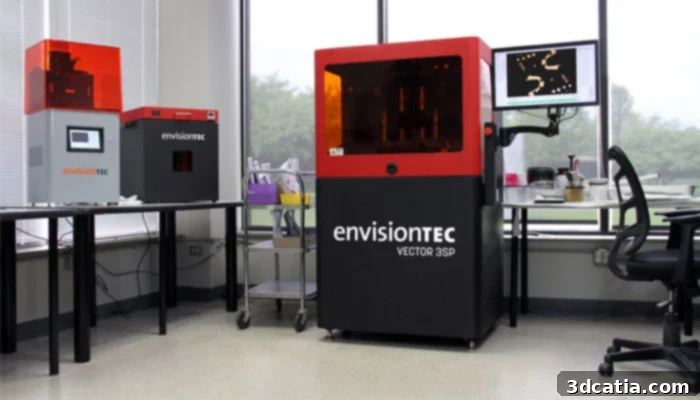
EnvisionTEC is considered the pioneer of the DLP process in 3D printing (photo credits: EnvisionTEC)
Cost Analysis: Accessibility and Investment
When considering the investment required, DLP printers are, in the majority of cases, generally less expensive than SLA machines, particularly at the entry-level and desktop segments. However, similar to all ranges of 3D printers, it’s crucial to differentiate between desktop-grade machines designed for hobbyists or small professional studios and large-scale industrial-grade printers built for high-volume production and demanding manufacturing environments.
For entry-level SLA printers, models like the now-legacy Form 2 from Formlabs (though superseded by the Form 3 and 3L) represented a significant step in making SLA technology accessible. Launched in 2015 with a print volume of 145 x 145 x 175 cm and a point accuracy of around 145 microns, it was available starting from approximately $2,400. Currently, the average price for a professional desktop SLA 3D printer typically ranges between $3,000 and $4,000, offering a balance of precision, reliability, and ease of use for various applications. However, if industrial-scale machinery is required, the prices escalate dramatically. For example, 3D Systems’ industrial SLA solutions can command prices as high as $500,000 or more, reflecting their advanced capabilities, large build volumes, and specialized features. It’s also worth noting that SLA machines employing a top-down laser configuration generally tend to be more expensive due to the engineering complexity and larger resin requirements.
Conversely, DLP 3D printers are often much more accessible, making them appealing to a broader spectrum of additive manufacturing enthusiasts and small businesses. Brands like Anycubic offer several entry-level DLP machines with prices starting as low as $200, exemplified by their Photon Zero printer, which offers a surprisingly good performance for its price point. For professionals in industries such as dental or jewelry, machines offered by pioneers like EnvisionTEC are typically available around the $15,000 mark, providing industrial-grade reliability and precision. Yet, price variations are significant across manufacturers; for instance, Asiga, another reputable manufacturer, offers professional DLP 3D printers starting at around $1,000, demonstrating a wide range of options to suit different budgets and operational demands. When evaluating costs, it’s important to consider not just the initial purchase price of the printer, but also the ongoing costs of proprietary resins, replacement parts (like FEP films or projector bulbs), and post-processing consumables, which can significantly impact the total cost of ownership over time.
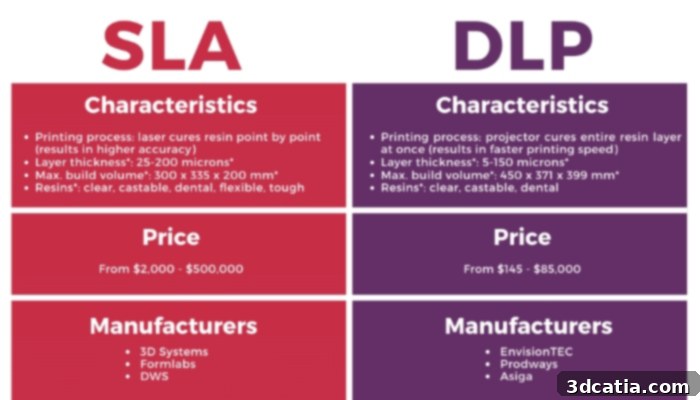
Comparison of SLA and DLP technologies (specifications refer to a desktop 3D printer)
Choosing the Right Technology: SLA vs. DLP
The choice between SLA and DLP ultimately depends on specific application requirements, budget constraints, and desired outcomes. If absolute precision, exceptionally smooth surface finishes, and the ability to print very large single parts without quality degradation are paramount, even at the expense of print speed for complex geometries, then Stereolithography (SLA) is likely the superior choice. Its laser-based approach offers unmatched fidelity and consistency across the build platform, making it ideal for highly detailed prototypes, master patterns, and aesthetic models where visual quality is critical.
Conversely, if high throughput, faster print times (especially for multiple small parts or batch production), and a more cost-effective entry point are key priorities, Digital Light Processing (DLP) offers a compelling alternative. Its full-layer curing mechanism provides significant speed advantages, making it excellent for rapid prototyping, functional parts where slight voxelation is acceptable, and applications like dental and jewelry where speed and detail for smaller objects are crucial. While DLP might exhibit some pixelation on angled surfaces, advancements in projector technology and anti-aliasing techniques continue to close this gap. Both technologies offer immense potential for innovation and customized production, continuing to push the boundaries of what’s possible with additive manufacturing.
Do you currently utilize SLA or DLP 3D printing in your projects? We’d love to hear about your experiences, challenges, and successes with these fascinating technologies! Share your insights in a comment below or connect with us on our Facebook, Twitter, and LinkedIn pages. For the latest updates, breakthroughs, and comparative analyses in the world of 3D printing, remember to sign up for our free weekly Newsletter here, delivering the freshest news straight to your inbox!