
Pioneering Sustainable Construction: Northumbria University’s 3D Printing Initiative to Address the UK Housing Crisis
Construction 3D printing stands as a revolutionary technology, promising a paradigm shift from traditional building methods. It is frequently lauded for its potential to deliver projects with unprecedented speed, cost efficiency, and environmental sustainability. However, despite these significant advancements, the sector still grapples with considerable challenges, particularly concerning its environmental footprint. Concrete, the ubiquitous material dominating construction 3D printing applications, is a notorious contributor to global carbon emissions. This inherent flaw has spurred intensive research efforts aimed at developing more eco-friendly alternatives. Earlier this year, a dedicated team at the University of Virginia successfully engineered a concrete formulation that significantly reduced carbon emissions from construction 3D printing by an impressive 31 percent. Such breakthroughs highlight the ongoing commitment to making additive manufacturing in construction truly sustainable. Building on this momentum, the United Kingdom’s Northumbria University recently announced a pivotal development: the installation of a state-of-the-art construction 3D printer on its campus. This strategic move marks the beginning of an ambitious mission to rigorously test and validate innovative concrete elements, with the ultimate goal of fostering their adoption by the wider industry. The overarching vision is to leverage this advanced technology to sustainably alleviate the pressing regional housing shortage, demonstrating the practical application of cutting-edge research.
The implementation of this transformative 3D printing construction technology within Northumbria’s Structures Laboratory, an integral part of its Mechanical and Construction Engineering Department, was made possible through a strategic partnership. This collaborative effort brought together Luyten 3D, a globally recognized leader in the manufacturing of advanced 3D construction printers, and ChangeMaker 3D, an innovative UK-based company specializing in sustainable construction technologies. Financial backing for this pioneering initiative was secured through a prestigious Royal Society Research grant, underscoring the project’s scientific merit and potential impact. This synergistic alliance combines cutting-edge hardware with expert knowledge in sustainable practices, positioning Northumbria University at the forefront of additive manufacturing research for the built environment. The partnership aims to not only advance technological capabilities but also to develop practical, scalable solutions that can address real-world challenges like housing shortages and environmental sustainability.
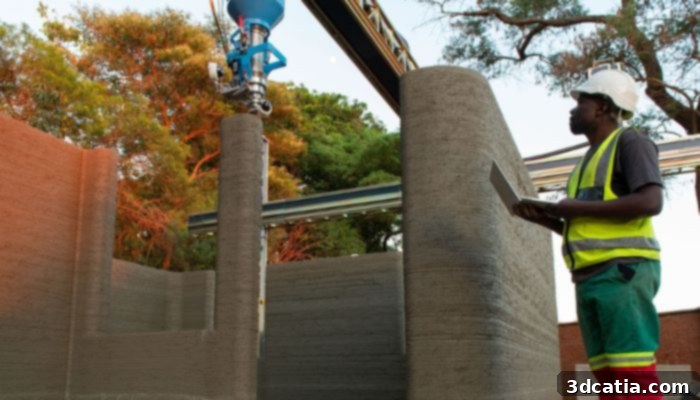
Construction 3D printing done by ChangeMaker 3D (Photo credits: ChangeMaker 3D)
The research conducted by Northumbria University holds immense potential to significantly impact the housing industry across North East England, a region currently grappling with a severe deficit in both social and non-social housing provisions. The statistics paint a stark picture: social housing waiting lists in North East England have reached their highest levels since 2012, soaring to over 75,000 applicants in 2023. This represents an alarming 51 percent increase from 2022, highlighting a rapidly escalating crisis. Rental costs and general housing prices show no signs of improvement, placing further strain on residents. A 2022 report revealed that an overwhelming 82 percent of landlords in the region reported a surge in demand for rented accommodation, yet a mere five percent indicated plans to expand their rental property portfolios in the subsequent year. This critical imbalance between supply and demand underscores the urgent need for innovative, efficient, and scalable construction methods. By deploying advanced 3D printing construction, Northumbria University aims to develop solutions that can rapidly increase housing supply, thereby addressing a pressing societal need and offering tangible relief to thousands of individuals and families struggling to secure affordable and stable housing.
Ahmed Mahil, President and CEO of Luyten 3D, has articulated his company’s readiness to rise to this challenge. He stated, “Luyten3D is ready to contribute to increasing housing supply in the United Kingdom through their technology and are open to any discussions with those in the industry to help tackle the crisis at hand.” This commitment highlights the transformative potential of Luyten 3D’s advanced construction printers, which boast remarkable efficiency. The company claims that its cutting-edge machines can construct the primary structure of a three-bedroom house in mere weeks, a stark contrast to the months typically required by conventional building methods. This accelerated construction timeline is a critical factor in addressing the urgent housing deficit, offering a tangible pathway to rapidly scale up housing production. The partnership with Northumbria University will provide a vital platform for Luyten 3D to validate these claims under rigorous academic conditions, demonstrating the scalability, durability, and cost-effectiveness of their technology within a research-driven environment. This collaborative approach promises to accelerate the adoption of 3D printing in construction, paving the way for more efficient and sustainable housing solutions across the UK.
Construction 3D Printing for a Sustainable Future: Addressing the Carbon Footprint
The imperative for sustainable construction has never been more urgent. According to a compelling report by the UN Environment Programme in 2024, the global construction sector is a significant contributor to climate change, accounting for approximately 21 percent of worldwide greenhouse gas emissions. Within this staggering figure, concrete alone is responsible for an estimated eight percent of global carbon emissions, primarily due to the energy-intensive production of cement, its key component. Recognizing this environmental challenge, Northumbria University’s initiative is firmly rooted in a commitment to developing sustainable infrastructure. Dr. Mohammadali Rezazadeh, Assistant Professor of Structural Engineering and the Principal Investigator for this groundbreaking project, elaborated on the core objectives. He explained, “We are developing eco-friendly concrete mixes, reinforcing them with corrosion-resistant composite materials, and optimizing their designs to reduce material usage, shaping a more sustainable future in construction.” This holistic approach goes beyond simply substituting traditional concrete; it encompasses a comprehensive strategy to minimize environmental impact at every stage, from material selection to structural design. By integrating innovative materials and intelligent design principles with the efficiency of construction 3D printing, the research aims to significantly reduce the carbon footprint of future buildings, making sustainability a cornerstone of modern construction practices.
One of the most visually distinctive characteristics of 3D-printed buildings is their often-curved exterior walls, a striking departure from the sharp, linear corners prevalent in traditional construction. This architectural freedom is a direct benefit of 3D printing technology, where the nozzle’s precise and fluid movement allows for the creation of intricate, organic structures. Such complex geometries, which would typically be prohibitively expensive and labor-intensive to achieve using conventional building techniques, can be realized with additive manufacturing without incurring additional costs. Intriguingly, these fluid architectural designs offer more than just aesthetic appeal; they can significantly enhance a building’s energy efficiency. Curved walls, for instance, can improve thermal performance by minimizing cold bridges and optimizing natural light penetration. They can also facilitate innovative insulation strategies and reduce the overall material volume required while maintaining structural integrity. With their newly installed 3D printers, Northumbria University is poised to thoroughly investigate these advantages. Researchers will delve into how these unique geometries can be optimized to improve thermal regulation, reduce energy consumption for heating and cooling, and ultimately contribute to creating truly high-performance, sustainable buildings. This exploration promises to unlock new frontiers in architectural design, seamlessly merging aesthetic innovation with environmental responsibility.
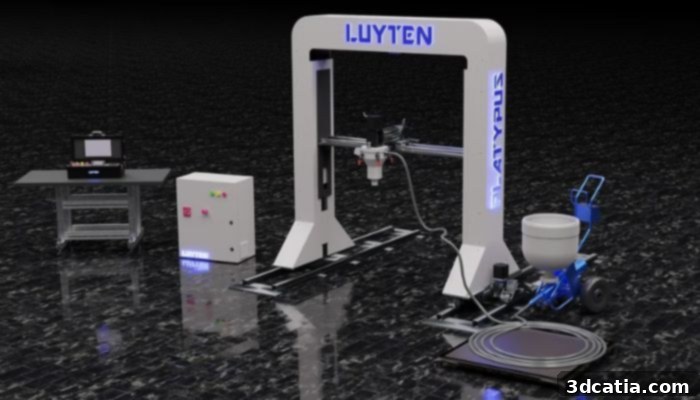
Luyten 3D’s Platypus construction 3D printer (Image Credits: Luyten 3D)
The pivotal role of selecting and installing the Luyten 3D Platypus printer in Northumbria’s Structures Laboratory was expertly handled by ChangeMaker 3D. Natalie Wadley, the company’s co-founder and CEO, expressed an ambitious vision for the future, articulating her strong hopes for the comprehensive integration of 3D concrete printing across all facets of the UK construction sector. This aspiration extends beyond mere technological adoption; it encompasses a societal impact. A crucial aspect of this initiative is its direct benefit to students, who will gain invaluable hands-on experience with this cutting-edge technology. Wadley emphasized the broader educational mission, stating, “We’re supporting our mission to deliver social value through skill development and preparing our future designers and engineers.” This commitment ensures that the next generation of construction professionals will be equipped with the knowledge and practical expertise necessary to lead the industry towards a more sustainable and technologically advanced future. By fostering a learning environment centered around additive manufacturing, Northumbria University, in collaboration with ChangeMaker 3D, is cultivating a skilled workforce capable of addressing the complex challenges of modern construction and driving innovation across the built environment.
Leveraging Local Partnerships for Broader Impact and Innovation
The Luyten 3D Platypus concrete printer represents a perfect fit for Northumbria’s Structures Lab due to its remarkable capability to rapidly achieve complex geometrical structures. This advanced machine utilizes principles of biomimicry, drawing inspiration from nature’s designs to create components with superior weight-to-strength ratios while significantly reducing concrete consumption. The Platypus, designed with a height and width of 1000 mm each, is notably compact for a construction 3D printer, yet its dynamic mobile gantry system allows for a customizable length, providing unparalleled flexibility for various project scales. This adaptability makes the machine ideal for pilot-testing small-scale versions of building elements, a crucial step in the research and development process. This capability presents a tremendous opportunity for external companies to collaborate with Northumbria University, enabling them to rigorously test the long-term performance and durability of their components in a controlled, academic environment before committing to full-scale projects. Such preliminary validation is critical for de-risking innovative construction solutions and accelerating their market readiness. The ability to perform extensive testing on complex structural elements with reduced material usage and rapid prototyping cycles positions Northumbria University as a leading hub for construction innovation and material science research, fostering vital industry-academia linkages.
Building on the momentum of this cutting-edge infrastructure, the Northumbria University team is actively engaging with a diverse range of external partners, ensuring the wider community and various industries can benefit from their advanced 3D printing construction technology. According to the university’s recent press release, researchers have already initiated discussions and collaborations with leading organizations in critical sectors such as health, water management, and civil engineering. These strategic partnerships aim to explore and support the development of sustainable solutions for a broad spectrum of applications. This includes, but is not limited to, the creation of innovative hospital buildings designed for efficiency and environmental responsibility, the construction of durable and eco-friendly water tanks crucial for infrastructure, and the development of green infrastructure projects that integrate seamlessly with natural environments. By extending the reach of their additive manufacturing capabilities, Northumbria University is demonstrating its commitment to solving real-world problems and contributing significantly to regional and national development goals. This collaborative ecosystem fosters interdisciplinary innovation, paving the way for sustainable practices that transcend traditional construction boundaries and create lasting positive impacts across multiple essential services. To delve deeper into these exciting initiatives and partnerships, interested parties can read the full press release here.
What are your thoughts on Northumbria University’s groundbreaking construction 3D printing initiative and its potential to revolutionize sustainable building practices? We encourage you to share your insights and opinions in a comment below, or engage with us on ourLinkedIn,Facebook, andTwitter pages! Don’t miss out on the latest advancements and news in the additive manufacturing world – be sure to sign up for our free weeklyNewsletter here, delivered directly to your inbox with all the crucial 3D printing updates. Additionally, you can explore a wealth of informative videos and content on our dedicatedYouTube channel. Your engagement helps foster a vibrant community dedicated to the future of 3D printing.
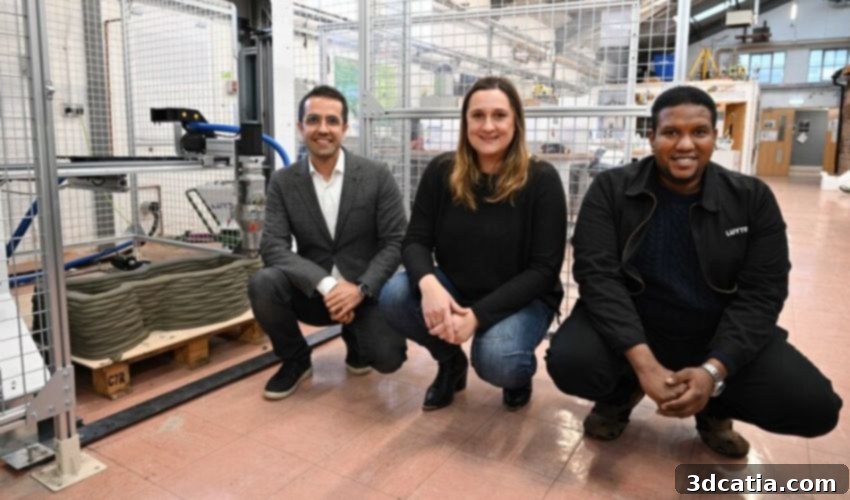
*Cover Photo: From left to right: Northumbria Assistant Professor Mohammadali Rezazadeh, ChangeMaker3D Chief Executive Officer Natalie Wadley and Luyten3D President Ahmed Mahil