
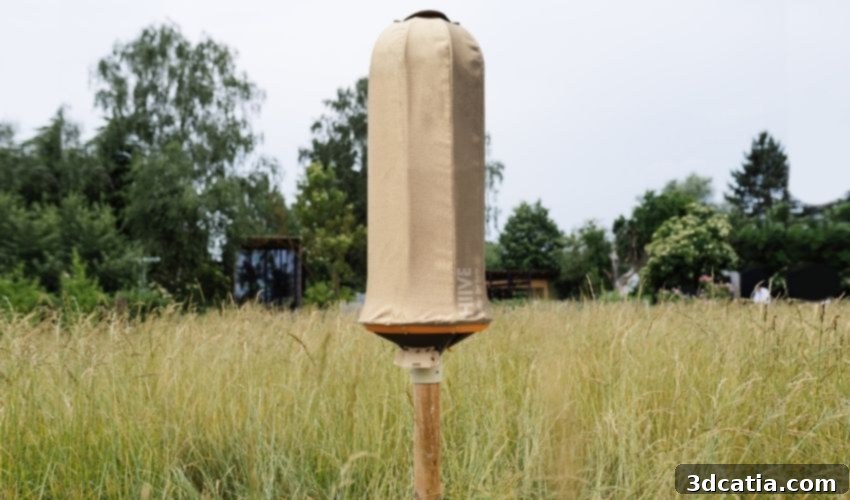
Revolutionizing Bee Conservation: HIIVE’s 3D Printed Sustainable Beehives for a Healthier Planet
3D printing stands at the forefront of innovation, empowering designers and engineers to bring complex and challenging projects to life with unparalleled cost-effectiveness and sustainability. For sectors spanning architecture, industrial design, and even environmental conservation, this transformative technology unlocks a realm of previously unimaginable possibilities, allowing creativity to flourish without conventional constraints. Its influence extends far beyond mainstream applications like fashion or construction, reaching into unexpected areas, including the preservation of vital ecosystems. A prime example of this innovative application is HIIVE, a pioneering German startup that harnesses the power of advanced 3D printing to craft superior, environmentally respectful homes for bees, directly addressing their critical needs.
The initiative by HIIVE is particularly crucial given the escalating crisis of Colony Collapse Disorder (CCD), a phenomenon that has led to a alarming global decline in bee populations. Bees, as indispensable pollinators, play a pivotal role in maintaining the health and stability of our own ecosystems and ensuring food security worldwide. Their diminishing numbers pose a severe threat to biodiversity and agricultural productivity. It is within this context that the dedication of companies like HIIVE to creating more suitable and natural habitats for these essential insects becomes not just commendable, but vitally important. We recently had the opportunity to speak with Philip Potthast, one of the visionary co-founders of HIIVE, to delve deeper into the company’s ambitious mission, its innovative use of additive manufacturing, and the intricate details behind their groundbreaking 3D printed beehives.
3DN: Could you briefly introduce yourself and your connection to 3D printing?
My name is Philip Potthast, and I am a co-founder of HIIVE. My professional background is rooted deeply in industrial design, a field where my primary focus revolves around the thoughtful integration of sustainable materials and recycled raw resources into product development. For me, 3D printing represents a fascinating, albeit complex, relationship – a true love-hate dynamic as an industrial designer. On one hand, the technology offers an incredible spectrum of possibilities, dramatically accelerating product development cycles. It allows for rapid prototyping, enabling us to test and refine designs iteratively, quickly moving from concept to tangible physical models. This iterative process is invaluable, as it significantly reduces time-to-market and fosters innovation by making experimentation more accessible.
However, on the other hand, 3D printing can be notoriously time-consuming and, at times, incredibly nerve-wracking if one doesn’t meticulously attend to every minute detail from the very outset. Factors such as material calibration, printer settings, environmental conditions, and post-processing requirements can all contribute to challenges. A slight oversight in slicing parameters or material flow can lead to failed prints, wasted resources, and considerable frustration. Despite these occasional hurdles, the transformative potential of 3D printing, especially in creating complex, optimized structures that would be impossible or prohibitively expensive with traditional manufacturing methods, far outweighs its complexities, making it an indispensable tool in our journey to innovate sustainable solutions.
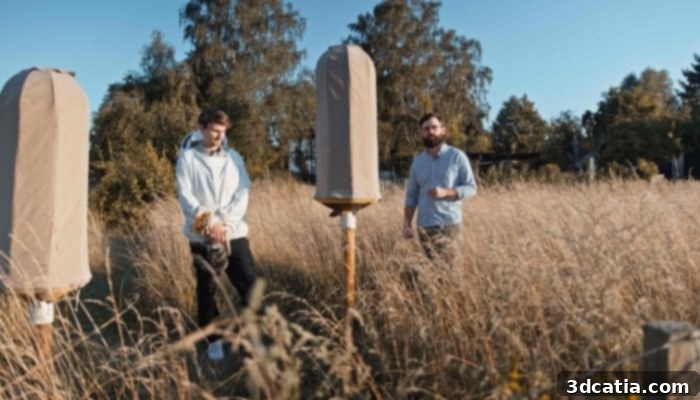
Left: Philip Potthast (photo credits: HIIVE)
3DN: What about HIIVE, what is it and how did it come about?
HIIVE is fundamentally dedicated to providing a superior, more natural, and species-appropriate home for honey bees. Our innovative approach allows beekeepers to nurture their colonies in a manner that closely respects and supports the innate behaviors and biological needs of *Apis mellifera*, the Western honey bee. Unlike conventional rectangular hives, which often impose unnatural living conditions, our bee houses are meticulously designed to mimic the natural tree cavities that bees historically inhabit. Every HIIVE unit is crafted exclusively from recycled and natural materials, underscoring our unwavering commitment to environmental sustainability and minimizing ecological footprint throughout the product lifecycle.
Throughout the entire development process, our team has maintained an acute focus on what we term “Human-Animal-Centered design.” This philosophy ensures that our products are not only optimized for the well-being and natural instincts of the honeybees but also offer practical usability and ergonomic benefits for beekeepers. The result is a harmonious interplay between the stringent demands that honeybees place on their ideal habitat – such as optimal thermal insulation, specific internal dimensions, and entrance configurations – and the practical considerations of beekeepers, including ease of inspection, maintenance, and honey harvesting without unduly disturbing the colony. Our overarching mission is to redefine beekeeping by creating habitats that are as close to nature as possible, fostering healthier, happier bee colonies, and contributing significantly to global bee conservation efforts.
3DN: Can you tell us a little more about the 3D technology(ies) you use?
Our reliance on 3D printing technology is a cornerstone of HIIVE’s innovative manufacturing process. To ensure the highest quality and sustainability, we collaborate closely with the reputable filament manufacturer 3dk.berlin. At present, our production strategy involves the use of several FDM (Fused Deposition Modeling) printers. FDM is an additive manufacturing technology where a thermoplastic filament is heated and extruded layer by layer to build a three-dimensional object. This method is particularly well-suited for producing the complex components that form the basic framework of our HIIVES.
The choice of material is absolutely critical for the durability and efficacy of our bee houses. We specifically utilize 3dk.berlin’s engineering PLA (Polylactic Acid), a specialized variant of this widely used thermoplastic. What sets this engineering PLA apart is its exceptional dimensional stability, capable of withstanding temperatures up to 130 degrees Celsius. This particular characteristic is paramount because our products are designed to endure a wide array of extreme outdoor weather conditions. Standard PLA, while biodegradable, would simply not possess the necessary resilience to withstand the intense heat of direct summer sun, the freezing temperatures of winter, or the fluctuations in humidity and UV exposure that our bee houses are subjected to year-round. The enhanced thermal resistance of our chosen material ensures that the HIIVE maintains its structural integrity and protective qualities, providing a consistently safe and stable environment for the bees regardless of external environmental stressors.
3DN: What inspired the design for the HIIVE bee hives? What is the advantage of using 3D printing in their production?
The fundamental inspiration for the design of the HIIVE bee houses stems directly from the natural habitat of honey bees. *Apis mellifera* historically thrives in tree cavities – these are their original, species-appropriate homes. These natural hollows within trees provide a unique and stable microclimate that is perfectly adapted to the bees’ needs, offering excellent insulation against temperature extremes, optimal humidity levels, and protection from predators. Furthermore, these cavities often host a beneficial community of symbionts, such as specific fungi and microorganisms, which contribute positively to the overall health and resilience of the bee colony. Unfortunately, due to a myriad of factors including habitat destruction, deforestation, and human intervention, there are now tragically few wild bee colonies left thriving in our forests.
The HIIVE project aims to reverse this trend by being the very first industrially manufacturable solution that authentically replicates the intricate conditions of a natural tree cavity. This is where the profound advantage of 3D printing becomes evident. Traditional manufacturing methods would make it incredibly challenging, if not impossible, to produce the complex internal geometries and specific material properties required to mimic a tree cavity effectively. With the unparalleled design freedom offered by 3D printing, we were able to embark on an extensive iterative development process. This involved numerous trials and prototypes, allowing us to precisely refine and optimize the internal structure, wall thickness, thermal properties, and ventilation systems of the HIIVE. Each iteration brought us closer to the optimal design, ensuring that every aspect, from insulation to internal surface texture, contributes to creating an environment that is biologically ideal for honey bees.
Beyond rapid prototyping, 3D printing offers significant benefits in terms of manufacturing efficiency and customization. It allows for the production of highly complex, organic shapes that are essential for replicating natural conditions, without the need for expensive molds or extensive tooling. This not only keeps production costs manageable for such intricate designs but also enables precision that would be unattainable with conventional techniques. The ability to precisely control material deposition ensures efficient resource use and contributes to the overall sustainability of our product. Ultimately, 3D printing was not just a convenience; it was a fundamental enabler that allowed us to translate the biological requirements of bees into a tangible, scalable, and highly effective habitat solution.
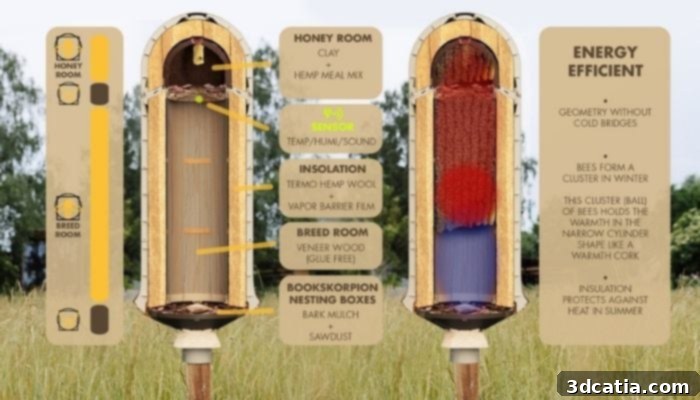
Photo Credits: HIIVE
3DN: How do you see the future development of this project? What are the next milestones?
Looking ahead, we envision HIIVE as more than just a physical habitat; we aim to integrate smart technology to further enhance bee welfare and support beekeepers. We are currently in the advanced stages of developing an innovative sensor kit, which, when coupled with a complementary mobile application, will serve as an optional yet powerful extension to our HIIVE system. This technological integration unlocks completely new possibilities for proactive and non-intrusive beekeeping.
With the help of our precisely engineered, low-energy sensors, beekeepers will be able to discreetly track vital parameters within the hive without causing any disturbance to the bees. These parameters can include internal temperature, humidity levels, acoustic patterns, and even subtle weight fluctuations, which can indicate honey production rates or the overall health and vigor of the colony. This rich data provides invaluable insights into colony dynamics, allowing beekeepers to monitor conditions, anticipate potential issues like diseases or pests, and intervene only when necessary, minimizing stress on the bees. Furthermore, we are actively developing a sophisticated swarm alarm system. This intelligent feature will notify HIIVE owners in advance when their colony is preparing to swarm, an important natural reproductive process that, if unmanaged, can lead to the loss of a significant portion of the colony. The swarm alarm empowers beekeepers to take timely action, such as adding more space or splitting the hive, thereby retaining the colony and preventing unwanted swarms.
Our next significant milestone, targeted for 2022, is the ambitious transition of HIIVE from small-scale production into full mass production. This step is crucial for making our sustainable and bee-friendly habitats accessible to a broader audience of beekeepers and conservation enthusiasts around the globe. Scaling up involves optimizing our 3D printing processes, streamlining material sourcing, and establishing robust quality control measures to ensure that every HIIVE meets our rigorous standards for durability and biological efficacy. This expansion will enable us to significantly amplify our impact on bee conservation, offering a viable and natural solution to counter the global decline in bee populations. We are committed to continuous innovation, ensuring that HIIVE remains at the cutting edge of sustainable beekeeping technology.
3DN: Do you have any final words for our readers?
As we approach the end of February, we are thrilled to announce the launch of our crowdfunding campaign. This campaign is a pivotal step towards producing HIIVE serially and making our innovative bee habitats widely available. We extend a heartfelt invitation to anyone who shares our passion for protecting honey bees, wishes to provide them with a truly natural and species-appropriate home, or is simply interested in embarking on their own journey into sustainable beekeeping, to support us. Your contributions are not just an investment in a product; they are an investment in the health of our planet and the future of these essential pollinators.
By backing our campaign, you will be directly enabling the mass production of HIIVE, helping us expand our reach and make a tangible difference in bee conservation efforts globally. Every supporter brings us closer to a world where honey bees thrive in natural, respectful environments, contributing to robust ecosystems and sustainable agriculture. For more comprehensive information about our mission, the technology behind HIIVE, and details on how you can contribute to our crowdfunding initiative, please visit our website. You can find all the necessary information and support links HERE. Join us in making a profound difference for honey bees and our shared future.
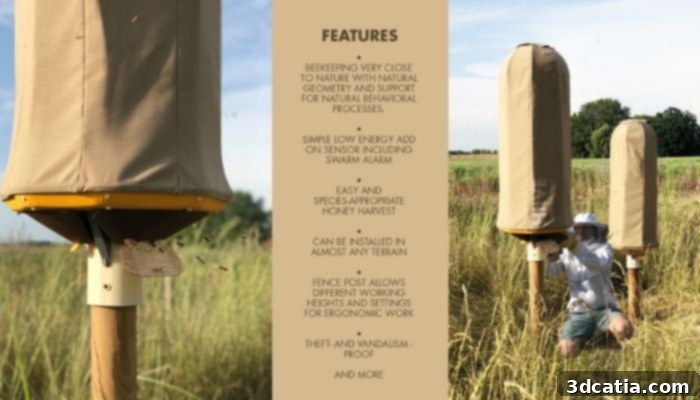
(Bild: HIIVE)
What are your thoughts on these innovative 3D printed beehives from HIIVE and their potential impact on bee conservation? We encourage you to share your insights in a comment below or engage with us on our social media platforms: Linkedin, Facebook, and Twitter. Don’t miss out on the latest advancements in additive manufacturing; remember to sign up for our free weekly Newsletter here to get the freshest 3D printing news delivered straight to your inbox! You can also find all our compelling videos and interviews on our YouTube channel, showcasing the diverse applications of 3D technology.
*Cover Photo Credits: HIIVE