
Revolutionizing Ostomy Care: How 3D Printing Delivers Custom, Leak-Proof Solutions with Odapt
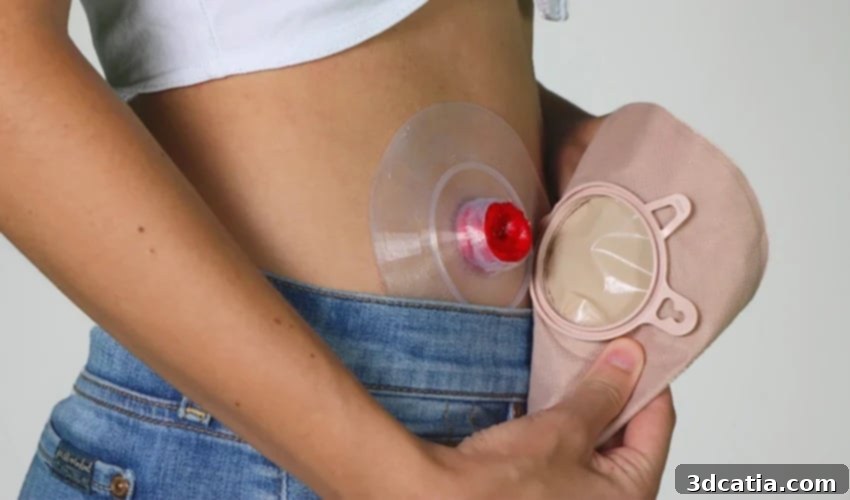
Millions worldwide suffer from debilitating intestinal infections and complex urinary system problems, including serious conditions such as bladder cancer, colon cancer, and Crohn’s disease. For many patients grappling with these challenging diagnoses, an ostomy becomes a life-saving necessity. An ostomy involves a surgical procedure that creates an opening, known as a stoma, in the abdomen, allowing bodily waste or urine to be expelled into an external collection system, typically consisting of a disc and an ostomy bag. The United Ostomy Associations of America (UOAA) estimates that between 725,000 and 1 million people in the U.S. currently live with an ostomy, a number that continues to grow annually. Despite its critical role, traditional ostomy care is often fraught with complications, most notably leakage from the ostomy bag. This prevalent issue significantly impacts patients’ quality of life, leading to skin irritation, discomfort, and emotional distress. However, a groundbreaking innovation led by three Spanish students is set to transform ostomy management. They have leveraged the power of 3D printing technology to create Odapt, a revolutionary, customized 3D printed disc designed to eliminate leaks and provide unparalleled comfort and security for ostomy wearers.
For those unfamiliar, understanding what an ostomy entails is crucial to appreciating the significance of Odapt. As mentioned, an ostomy is a surgical procedure performed to reroute waste from the digestive or urinary system when a part of the intestine or bladder is diseased or damaged and needs to be removed or bypassed. This involves bringing a section of the intestine (in cases of colostomy or ileostomy) or urinary tract (for urostomy) through the abdominal wall, forming a stoma. The stoma itself is a red, moist, and typically round or oval opening. While ostomies are life-saving, patients often face numerous challenges, including maintaining proper hygiene, managing skin irritation around the stoma, and dealing with the psychological impact of living with an external bag. The lack of personalized fit in existing ostomy devices exacerbates many of these issues, making daily life unnecessarily difficult for countless individuals. Recognizing this critical gap, Ivana Llobet, Jessica Nissen, and Patricia López, three visionary students from the Master in Industrial Design Engineering program at Elisava Barcelona School of Design and Engineering, embarked on a mission to redefine ostomy care. Their collaborative effort culminated in the creation of Odapt, a customized 3D printed disc for an ostomy bag meticulously engineered to adapt seamlessly to any unique stoma shape and abdominal contour, offering a truly personalized solution.
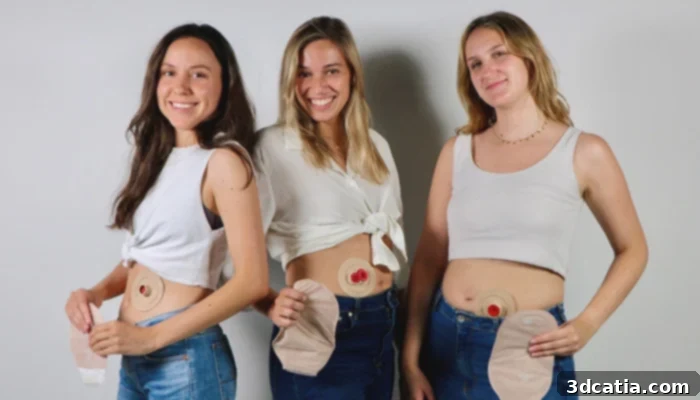
From left to right, Jessica, Ivana and Patricia, Odapt project managers
The genesis of the Odapt project stemmed from a profound observation: the fundamental design of ostomy bags had remained largely unchanged since their invention in the 1950s. This static approach meant that despite advancements in medical science, the core problem of ill-fitting, generic discs persisted. The students quickly identified that the commercially available discs were fundamentally incapable of adapting effectively to the highly individual anatomical variations of each patient’s stoma and surrounding abdominal area. To gain a deeper understanding of these challenges, the team embarked on extensive research, conducting in-depth interviews with ostomy patients, consulting with medical professionals, and even undertaking empathy-building exercises to truly comprehend the daily struggles faced by individuals living with ostomy bags. This immersive approach led to a stark realization: the most pervasive and debilitating issue was chronic leakage, almost universally attributed to the poor adhesion and inadequate fit of standard discs to the stoma. According to a university press release, a staggering 90% of patients using conventional ostomy bags experience leaks. These leaks are not just a minor inconvenience; they lead to painful skin irritation, potential infections, frequent changes, increased costs, and profound psychological distress, including anxiety, social isolation, and a significant reduction in overall quality of life. Motivated by these compelling insights and a desire to make a tangible difference, the students committed themselves to developing a robust and reliable solution through Odapt.
What Is the Role of 3D Printing in Odapt’s Innovative Design?
The critical innovation behind Odapt lies in its strategic adoption of 3D printing technology, which enables the creation of truly customized and highly effective medical devices. The resulting Odapt disc is meticulously fabricated from biocompatible silicone, a material chosen for its exceptional properties. Silicone is not only highly flexible and comfortable against the skin, but it is also hypoallergenic and durable, making it ideal for prolonged contact with sensitive peristomal skin. Crucially, a specialized layer of silicone adhesive is precisely applied to the disc, designed to ensure superior adhesion to the skin while remaining gentle and safe. This combination of customized shape and advanced adhesive is paramount to Odapt’s effectiveness, as it allows the disc to perfectly conform to the unique topography of each patient’s stoma and surrounding abdominal wall. This personalized fit is the core mechanism that virtually eliminates leaks, offering unparalleled security and peace of mind. Furthermore, Odapt’s design ensures versatility; it is compatible with a wide range of commercially available ostomy pouches, meaning patients do not have to overhaul their entire ostomy system to benefit from the leak-proof disc. The success of this ambitious project is also a testament to the diverse and complementary expertise of the three young women at its helm. Patricia Lopez brought invaluable experience in 3D modeling, industrial design, and advanced 3D printing techniques, forming the technical backbone of the product’s creation. Ivana Llobet dedicated herself to understanding the human element, delving deep into patient experiences, engaging with healthcare professionals, and facilitating user experience workshops to ensure the design was truly patient-centric. Jessica Nissen orchestrated the overall product development, from conceptualization and detailed product design to the crucial aspects of graphic design and brand communication. This synergy of technical prowess, empathetic user research, and comprehensive design management was instrumental in bringing Odapt from concept to a tangible, life-changing product, poised to significantly improve the lives of countless individuals with ostomies by offering a level of comfort, security, and dignity previously unattainable with standard devices.
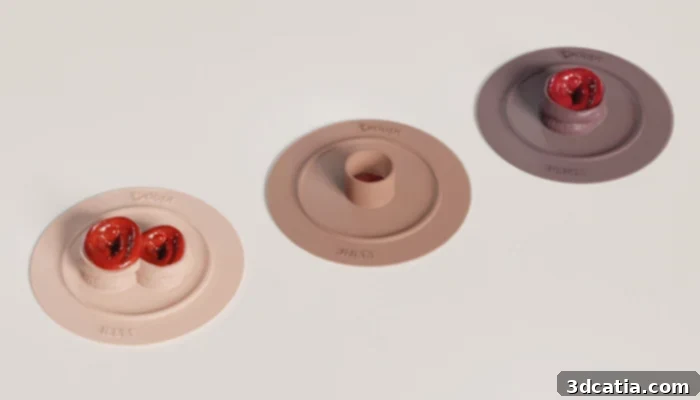
Odapt, the ostomy disc that was 3D printed in silicone
The profound impact of Odapt extends beyond its innovative technology; it represents a paradigm shift towards personalized medical devices, made possible through additive manufacturing. The meticulous design process for each Odapt disc begins with an accurate 3D scan of the patient’s stoma and peristomal area. This digital model is then used to custom-design a disc that perfectly matches the unique contours of their body, ensuring an optimal, pressure-free fit. This level of customization is impossible with traditional manufacturing methods, which rely on mass production of standardized sizes. The use of 3D printing also allows for rapid prototyping and iteration, meaning the design can be quickly refined based on patient feedback and clinical testing, accelerating the development cycle and ensuring the final product meets the highest standards of efficacy and comfort. The students’ commitment to a patient-centered approach, involving users at every stage of development, underscores the ethical and practical advantages of this design philosophy. By addressing the primary concern of leakage, Odapt not only prevents physical discomfort and potential health issues but also empowers patients to regain confidence and participate more fully in their daily lives without constant worry. This innovative solution has garnered significant attention and accolades, signaling its potential to become a cornerstone in modern ostomy care. The team has already initiated the process of registering the Odapt brand and product, a crucial step towards making this life-changing device widely available. Their ingenuity and dedication were recognized when they became finalists and subsequently won the prestigious People’s Choice Award in the highly competitive Forward AM Innovation Award, securing an impressive €25,000 in capital to further their development and commercialization efforts. This initial funding is vital for bringing Odapt to market and ensuring that more patients can benefit from this personalized approach to ostomy management. This project not only showcases the incredible potential of 3D printing in healthcare but also highlights how student-led innovation can address long-standing medical challenges with creativity and cutting-edge technology. You can learn more about this transformative project by visiting the official Elisava project page HERE.
Odapt represents a significant leap forward in patient-centered healthcare, demonstrating how advanced manufacturing techniques can be harnessed to create solutions that dramatically improve quality of life. The challenges faced by individuals with ostomies are complex, extending far beyond the physical aspects to encompass significant emotional and social hurdles. By effectively mitigating the issue of leakage through customized, comfortable, and secure devices, Odapt offers not just a medical product, but a pathway to renewed confidence and normalcy. This project serves as an inspiring example of how interdisciplinary collaboration, combining design engineering with a deep understanding of user needs, can lead to truly impactful innovations. As 3D printing technology continues to evolve, its application in personalized medicine, from prosthetics to internal implants and external medical devices like Odapt, is set to expand exponentially, promising a future where medical care is increasingly tailored to the individual. The success story of Odapt underscores a crucial message: innovation driven by empathy and enabled by technology has the power to address even the most persistent and overlooked medical challenges, bringing tangible relief and dignity to those who need it most. We believe this pioneering spirit will pave the way for numerous future advancements in medical device technology. What are your thoughts on Odapt and the future of 3D printed medical devices? We invite you to share your insights in a comment below or join the conversation on our social media channels: Linkedin, Facebook, and Twitter. Don’t miss out on the latest advancements in additive manufacturing—sign up for our free weekly Newsletter here to get the freshest 3D printing news delivered straight to your inbox! You can also explore all our compelling videos and interviews on our YouTube channel, where we continually highlight groundbreaking innovations like Odapt.
*All Image Credits: Elisava, Odapt