
Revolutionizing Industries: This Week’s Top 5 Groundbreaking 3D Printing Innovations
This week, we’ve dived deep into the most compelling advancements within the realm of additive manufacturing, showcasing how this transformative technology is fundamentally changing production across various sectors. From rapid prototyping to end-use parts, 3D printing is no longer a niche tool but a pivotal force reshaping industries worldwide. Its versatility has allowed it to infiltrate a multitude of applications, ranging from medical advancements to automotive innovations, and even redefining construction. This curated selection of videos highlights some of the most exciting developments, offering a glimpse into a future where customisation, efficiency, and complex geometries are the new standard. Join us as we explore these remarkable breakthroughs, keeping you updated with the cutting-edge innovations that are driving the 3D printing revolution. For an even broader perspective on the latest in additive manufacturing, be sure to visit our dedicated Youtube channel, where you can find an extensive collection of 3D printing videos. We hope you find these insights inspiring and have a fantastic week ahead!
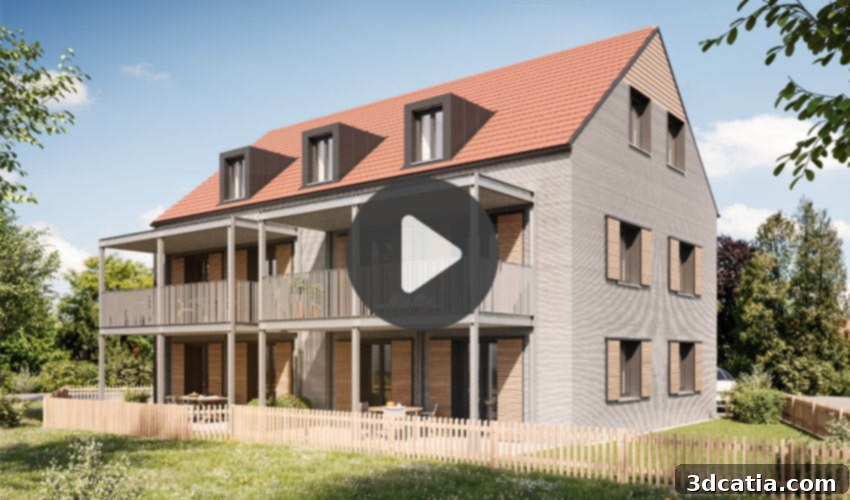
Top 1: COBOD’s BOD2 Printer Constructs the World’s First Commercial Apartment Building
The construction industry is experiencing a monumental shift with the advent of large-scale 3D printing, and Danish manufacturer COBOD is at the forefront of this revolution. This week, we highlight their groundbreaking project: a three-story residential building with 3D printed walls in Wallhausen, Germany. This ambitious project spans an impressive surface area of 380 square meters and marks a significant milestone as it represents the world’s first commercial apartment building constructed using 3D printing technology. Unlike previous projects, which were often for research or demonstration, this initiative is driven by commercial intent, signifying a mature stage in construction 3D printing.
The building is being erected using COBOD’s state-of-the-art BOD2 printer, a machine renowned for its remarkable speed and efficiency. The BOD2 can print at a maximum speed of 100 cm per second, capable of depositing the equivalent of 10 tons of concrete per hour. This incredible pace dramatically reduces construction timelines, addressing critical challenges within the traditional construction sector such as labor shortages and material waste. The flexibility of 3D printing also allows for more complex and innovative architectural designs that might be cost-prohibitive or physically impossible with conventional methods.
While the exact completion date for this pioneering structure remains unconfirmed, its impact is already profound. The building will be owned by Michael Rupp Bauunternehmung GmbH and will feature five distinct apartments designed for rental purposes. This commercial application underscores the growing viability and economic benefits of concrete 3D printing, paving the way for more sustainable, faster, and potentially more affordable housing solutions globally. This project serves as a powerful testament to how additive manufacturing is not just prototyping but actively shaping the built environment of tomorrow. You can delve deeper into this incredible feat of engineering in the video provided below!
Top 2: Cobra Golf Achieves Mass Production with 3D Printed Putter
In a remarkable demonstration of how 3D printing is transforming consumer products, Cobra Golf has teamed up with Parmatech and HP Metal Jet to produce the first mass-produced 3D printed putter: the KING Supersport-35. This collaboration highlights the incredible potential of additive manufacturing to move beyond prototyping and directly into large-scale production, offering unprecedented design freedom and performance enhancements in sports equipment. The structure of the putter head, meticulously crafted using HP’s advanced Metal Jet technology, features an intricate design that would be impossible to achieve with traditional manufacturing techniques.
HP Metal Jet, a form of binder jetting for metals, enables the rapid and cost-effective production of complex metal parts. This technology is particularly advantageous because it allows for the creation of internal lattice structures and precise weight distribution within the putter head, significantly improving its moment of inertia (MOI) and overall playability. Such internal geometries are crucial for optimizing performance, providing golfers with enhanced stability, feel, and accuracy. This capability represents a paradigm shift for product design, where engineers are no longer constrained by the limitations of conventional molding or machining processes.
The transition from initial prototype to mass production is often a challenging hurdle for new manufacturing technologies. While 3D printing excels at rapid iteration and customization, scaling it for high-volume output can be more complex compared to established methods like injection molding. Cobra Golf’s success with the KING Supersport-35 putter demonstrates that these challenges are being effectively overcome, proving that metal additive manufacturing can indeed be a viable and scalable solution for commercial products. This achievement not only elevates the standard for golf equipment but also signals a broader trend where 3D printing will increasingly be used to manufacture high-performance, personalized consumer goods. Discover more about this innovative putter and its manufacturing process in the video below!
Top 3: A New 3D Printed Bionic Arm Inspired by a Video Game Character
The world of prosthetics is being revolutionized by 3D printing, offering unprecedented levels of customization, functionality, and even aesthetic appeal. In an exciting collaboration that bridges technology and pop culture, Japanese video game developer Konami has partnered with the acclaimed prosthetic limb designer Open Bionics. Their joint venture has led to the creation of a stunning 3D printed bionic arm, directly inspired by the iconic character Venom Snake from the beloved Metal Gear Solid (MGS) video game series. This innovative appendage is specifically designed for individuals with below-elbow amputations, offering not just practical assistance but also a powerful sense of identity and empowerment.
This cutting-edge bionic arm integrates many advanced features found in Open Bionics’ existing range of ‘Hero Arms,’ known for their user-friendly design and impressive capabilities. What sets this particular arm apart is its unique blend of advanced robotics and artistic flair, drawing on the intricate details and rugged aesthetic of Venom Snake’s prosthetic. The use of 3D printing allows for precise customization, ensuring a perfect fit for each user, which is crucial for comfort and optimal functionality. Furthermore, it significantly reduces the manufacturing time and cost associated with traditional prosthetic production, making sophisticated bionic limbs more accessible.
Functionality is at the heart of this design; Open Bionics’ recreation boasts an impressive dexterity, capable of rotating up to 180 degrees. This wide range of motion, combined with its ability to behave like a life-like muscle, grants users a high degree of control and natural movement. For young people living with amputations, such a technologically advanced and visually appealing prosthetic can be truly life-changing. It transforms a medical device into a statement of strength and individuality, fostering confidence and integration. This project beautifully illustrates how additive manufacturing can not only restore function but also inspire and uplift individuals globally, setting new standards for personalized medical devices. Witness this incredible fusion of technology and design in the video below!
Top 4: Tailor-Made Eyewear Through 3D Printing Technology
The impact of additive manufacturing technologies continues to expand, reaching even the most personal aspects of our daily lives, including the optical industry. The following video from EOS, a global leader in high-end additive manufacturing solutions, perfectly illustrates this by showcasing how Chinese company Nanjing BRAGi Optical Technology is leveraging 3D printing to create revolutionary tailor-made glass frames. This application exemplifies the power of 3D printing in enabling mass customization and responding to individual consumer needs with unprecedented speed and precision.
Nanjing BRAGi Optical Technology has rapidly established an innovative business model centered around a complete scan-to-print solution. This process typically involves scanning a customer’s face to capture precise anatomical data, which is then used to design a perfectly fitting and uniquely styled pair of glasses frames. The design is then sent to an industrial 3D printer, which can produce the frames using durable and lightweight materials like nylon (polyamide). This method eliminates the limitations of standard sizing and mass-produced designs, offering unparalleled comfort and aesthetic customization. Customers can choose from an extensive range of styles, colors, and even intricate patterns that would be impossible to achieve with traditional frame manufacturing techniques.
The benefits of 3D printed eyewear extend beyond just customization. For businesses, this approach significantly reduces inventory costs and waste, as frames can be produced on-demand rather than relying on large stock volumes. It also enables rapid prototyping and iteration of new designs, allowing companies to quickly respond to market trends and offer cutting-edge styles. For consumers, the advantage is clear: a pair of glasses that not only reflects their personal style but also fits flawlessly, enhancing comfort during prolonged wear. This video offers a compelling look at how 3D printing is not just a manufacturing tool but a catalyst for personalized products and innovative business strategies in the fashion and optical sectors. Discover the future of eyewear in the video provided!
Top 5: TISSIUM’s Biomorphic Polymers Transform Tissue Repair
Since its inception in 2013, TISSIUM has been dedicated to confronting one of the most enduring medical challenges: the effective reconstruction of damaged tissue within the human body. This medtech company has made extraordinary strides by developing a proprietary technology centered on what they call biomorphic programmable polymers. These innovative materials are designed to fundamentally transform the way tissues are repaired and regenerated, with the ultimate goal of restoring their natural function and integrity. This represents a significant leap forward in surgical and regenerative medicine, promising better patient outcomes and more efficient recovery processes.
The foundational research for this groundbreaking technology was initially conducted at some of the world’s most prestigious institutions: MIT, Brigham and Women’s Hospital, and Harvard Medical School. This academic pedigree underscores the scientific rigor and advanced understanding that underpins TISSIUM’s developments. Biomorphic programmable polymers are essentially “smart” materials engineered to interact seamlessly with biological environments. They can be applied to damaged tissue, where they adapt to the specific site, providing structural support, promoting healing, and eventually biodegrading once their function is complete, leaving behind regenerated natural tissue.
The potential applications of TISSIUM’s technology are vast, ranging from cardiovascular repair to neurological reconstruction and general surgical sealing. A recent and significant milestone for the company was receiving approval from the U.S. Food and Drug Administration (FDA) for its Investigational Device Exemption (IDE) application for its vascular sealant. This approval is a crucial step, allowing TISSIUM to proceed with clinical trials for their product, bringing it closer to widespread medical use. Such advancements highlight the critical role of material science and biomedical engineering, often enabled by sophisticated manufacturing techniques like advanced 3D printing, in addressing complex health challenges and ultimately improving human lives. Explore the future of tissue repair in the video below!
What were your thoughts on this week’s captivating selection of top 5 videos? Each one offers a unique perspective on the power and versatility of 3D printing, from building entire homes to repairing human tissue. Which of these groundbreaking innovations resonated most with you, or perhaps sparked new ideas about the future of additive manufacturing? We would love to hear your insights and favorite picks! Share your comments below, or engage with us on our vibrant social media channels via Facebook and Twitter pages. To ensure you never miss out on the latest advancements, exclusive news, and in-depth analyses from the rapidly evolving 3D printing industry, don’t forget to sign up for our free weekly Newsletter. Get all the essential updates delivered straight to your inbox and stay ahead in the world of additive manufacturing!