
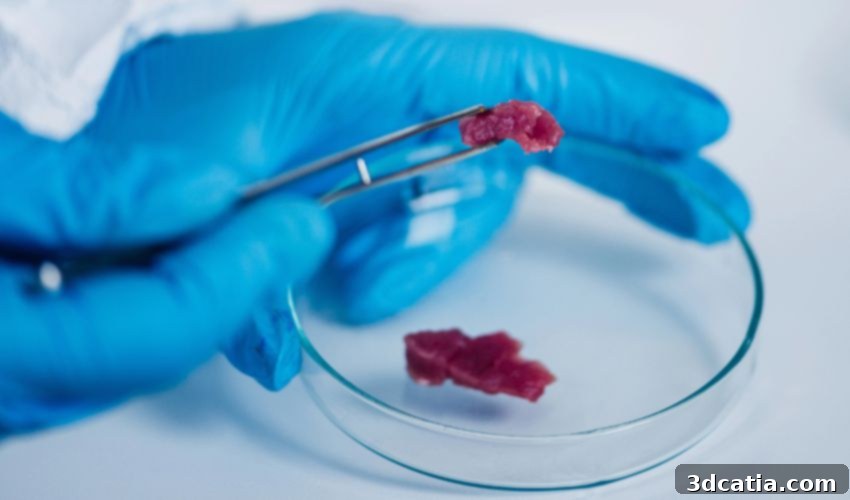
Revolutionizing Food Safety: How 3D Printed Microfluidic Chips Detect Pathogens Faster
The unsettling public health announcements from organizations like the USDA, detailing “food recalled due to pathogens,” are unfortunately common occurrences. Whether it’s the notorious E.coli, Salmonella, Listeria, Norovirus, or any of the more than 31 identified pathogens responsible for foodborne illnesses, the critical task of tracking and preventing these harmful microorganisms from contaminating the public’s food supply is a paramount responsibility for governmental agencies and food producers worldwide. However, as history has repeatedly shown, even the most rigorous systems are not infallible. The persistent challenge of ensuring food safety on a global scale demands innovative solutions. Now, groundbreaking research introduces a new hope: a sophisticated 3D printed microfluidic chip designed to make a substantial difference in this ongoing battle.
While food recalls might occasionally grab headlines, the true scope of foodborne illnesses is far more pervasive than many realize. These diseases represent a significant public health burden with staggering statistics. In the United States, for instance, the CDC estimates that approximately 48 million people fall ill each year from foodborne pathogens, leading to 128,000 hospitalizations and a tragic 3,000 deaths annually. This alarming reality is amplified when considering the global impact. The World Health Organization (WHO) reports that ‘unsafe’ food causes a staggering 600 million cases of illness and 420,000 deaths worldwide every year. A particularly vulnerable demographic, children under the age of five, account for at least one-third of these fatalities, underscoring the critical need for advanced detection and prevention strategies. Pregnant women, older adults, and individuals with compromised immune systems are also extremely susceptible to severe complications and life-threatening consequences from contaminated food.
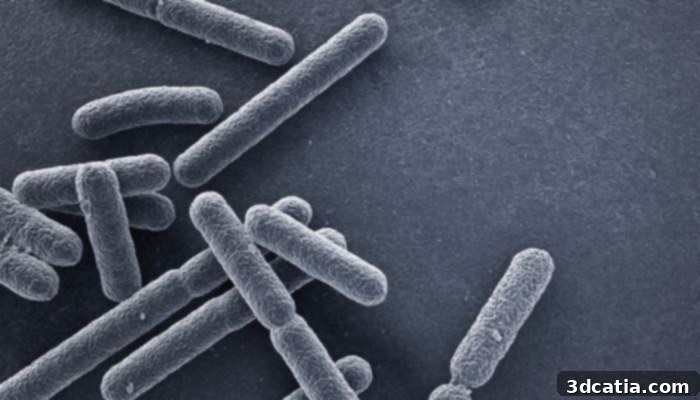
Foodborne pathogens like E.coli (pictured) can have devastating effects on public health. Innovative detection solutions are crucial.
This dire situation is precisely what researchers from Guangdong University of Technology and Pudong New District People’s Hospital are dedicated to addressing with their pioneering new solution. Their primary objective is to develop a method for food screening that is not only significantly faster and more cost-effective but also demonstrably more accurate and effective than current techniques. By achieving this, they aspire to revolutionize the way food safety is managed, ultimately keeping contaminated products out of the hands of unsuspecting consumers. Crucially, additive manufacturing, specifically 3D printing, plays an indispensable and transformative role in making this advanced detection system a reality.
A 3D Printed Microfluidic Chip for Enhanced Food Screening and Pathogen Detection
As highlighted, the paramount objective for the research team was to engineer a novel method that would significantly enhance the detection of various foodborne pathogens. Author Silu Feng articulates the multifaceted challenges inherent in this task: “Detecting these pathogens is challenging, due to their diverse nature and the various environments in which they can thrive. Additionally, low concentrations of pathogens in large food samples, the presence of similar non-pathogenic organisms, and the complex nature of different food types make accurate and rapid detection difficult.” This statement underscores the limitations of traditional methods which often struggle with sensitivity, specificity, and throughput when dealing with complex food matrices and diverse microbial populations.
Feng further elaborates on the shortcomings of conventional pathogen detection techniques, such as labor-intensive cell culture and expensive, time-consuming DNA sequencing. While effective in controlled laboratory environments, these methods often prove challenging to employ at the large scale required for comprehensive food safety screening across vast supply chains. This means that, in many scenarios, not every batch or even a representative sample of food can be thoroughly tested, leaving potential gaps in detection. Current methodologies, Feng notes, are plagued by a number of significant obstacles. These include lengthy result times, which can delay product release and increase spoilage; the considerable need for specialized and expensive laboratory equipment; and the requirement for highly trained personnel to operate these complex systems. Furthermore, a critical limitation is their frequent inability to detect multiple pathogens simultaneously from a single sample, often requiring separate tests for different contaminants. These collective challenges represent a bottleneck in modern food safety, all of which the innovative 3D printed microfluidic chip is specifically designed to overcome, promising a more efficient, accessible, and comprehensive approach to pathogen detection.
The manufacturing of this revolutionary microfluidic chip leverages the power and versatility of Fused Deposition Modeling (FDM), a widely accessible and cost-effective 3D printing technology. Specifically, the team utilized a Sermoon V2 3D printer in conjunction with the Creality Slicer software, demonstrating that advanced scientific instruments can be produced using readily available consumer-grade equipment. This choice of manufacturing method significantly lowers the barrier to entry for developing and replicating such devices. However, the production process didn’t stop at printing. Extensive post-processing was deemed critical to achieving the desired functional performance of the chip. This included meticulous sanding, which was essential for improving the surface quality of the 3D printed microfluidic channels. Smooth surfaces are paramount in microfluidics to ensure unimpeded liquid flow and prevent non-specific binding or accumulation of samples, which could compromise detection accuracy. Furthermore, the chosen ABS material, while robust and suitable for FDM, presented an inherent challenge due to its hydrophobic nature. For the detection platform to function effectively, it needed to be hydrophilic, meaning it would readily interact with water-based biological samples. To overcome this, a precise mixture of the surface hydrophilic agent HYDRO 3000 and isopropyl alcohol (in a 3:7 ratio) was applied. This crucial surface modification successfully transformed the inherently hydrophobic ABS platform into a hydrophilic 3D environment, enabling efficient sample loading, fluidic control, and effective interaction with target pathogens.
In terms of the functional design of the 3D printed microfluidic chip itself, the researchers meticulously engineered it to be highly specialized and efficient. According to their detailed explanation, the chip is ingeniously split into four distinct sections, with each segment precisely tailored and functionalized to detect a specific pathogen. This multi-channel design is a significant leap forward, allowing for simultaneous screening of multiple threats from a single sample, dramatically accelerating the detection process. The core mechanism relies on specific binding: when a sample containing a target pathogen is introduced into its corresponding section, the pathogen will selectively bind to a specially prepared detection surface within that channel. This binding event triggers a measurable change in the optical properties of the detection area. This optical signal change serves as a clear and rapid indicator of the pathogen’s presence. Through rigorous testing, this innovative approach proved remarkably effective in quickly detecting common and dangerous foodborne pathogens, including E.coli, Salmonella, Listeria, and S.aureus. Critically, the system demonstrated high sensitivity, capable of identifying these contaminants even when present in very low quantities, which is often a major hurdle for traditional detection methods. This ability to detect trace amounts quickly and accurately represents a major advancement for proactive food safety management.
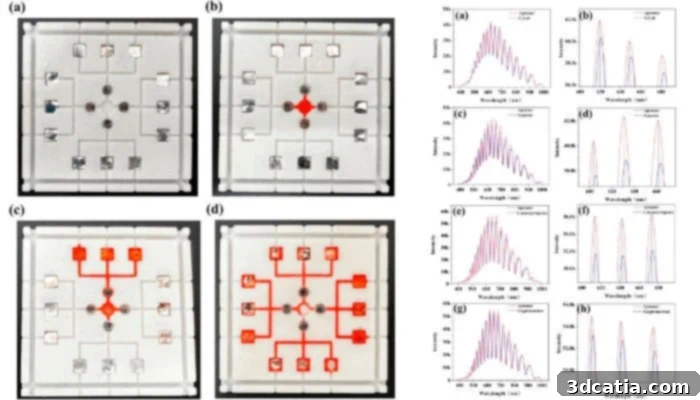
A demonstration of the liquid flow function in the 3D printed testing platform (left), illustrating efficient sample movement through microchannels; Representative optical signals for different pathogens (right), showcasing the clear indicators of contamination (photo credits: Feng et al.).
Looking ahead, the research team harbors ambitious hopes for the continued development and refinement of this groundbreaking device. The immediate goal is to further enhance the chip’s capabilities, making it even more robust, user-friendly, and broadly applicable for widespread food screening across various industry sectors. This could involve increasing the number of pathogens detectable on a single chip, improving automation for high-throughput analysis, or developing more portable versions for on-site testing at farms, processing plants, or even in markets. The implications of this technology for global food safety are profound. By offering a rapid, cost-effective, and highly sensitive method for pathogen detection, this 3D printed microfluidic chip has the potential to dramatically reduce the incidence of foodborne illnesses, prevent costly product recalls, and ultimately save lives. It represents a significant step towards a future where food safety protocols are more proactive, efficient, and accessible, ensuring healthier outcomes for consumers worldwide. The full details of this pioneering work are available for in-depth review in the paper published in AIP Advances, accessible HERE.
What are your thoughts on this innovative 3D printed chip for the rapid detection of foodborne illnesses? Do you believe it has the potential to fundamentally transform food safety practices and make a significant global impact? We encourage you to share your insights and opinions in a comment below or join the discussion on our LinkedIn, Facebook, and Twitter pages! Don’t miss out on the latest advancements and news in the world of additive manufacturing; sign up for our free weekly newsletter here to get essential 3D printing updates delivered straight to your inbox! Additionally, you can explore all our engaging video content and interviews on our YouTube channel.