
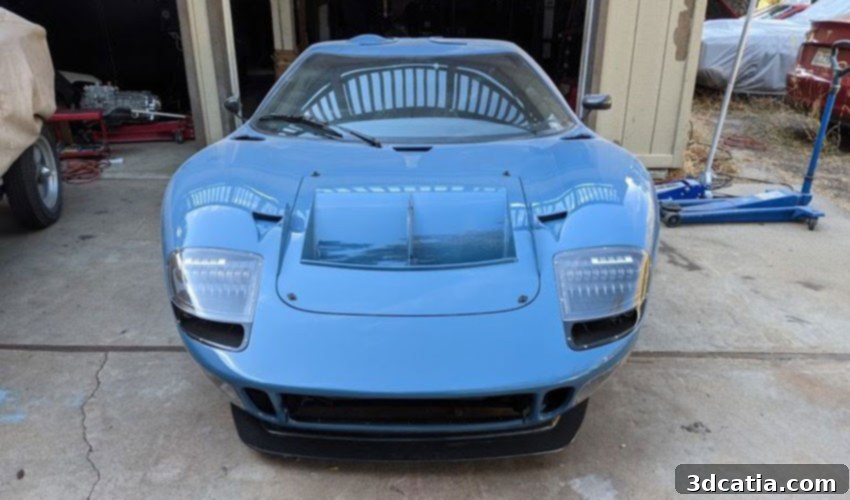
Revolutionizing Classic Car Customization: The Ford GT40 and the Precision of 3D Scanning Technology
The Ford GT40 is more than just a sports car; it’s a legendary icon born in the intensely competitive crucible of 1960s motorsport. With only 126 examples ever produced, its scarcity only amplifies its mystique. The enthralling saga of its creation, fueled by the fierce rivalry between Henry Ford II and Enzo Ferrari, has captivated automotive enthusiasts and even inspired cinematic masterpieces. This storied history makes every GT40 a priceless artifact, and any modification or restoration project demands the utmost precision and respect for its heritage. Today, we delve into a remarkable project where vintage car enthusiast Chris Ashton, proprietor of Ruffian Cars, harnessed the cutting-edge capabilities of 3D technology to meticulously modify and customize his cherished Ford GT40.
Utilizing advanced Artec Space Spider and Artec Eva 3D scanners, Ashton embarked on a mission to transform his GT40. This innovative approach allowed him to accurately reproduce complex shapes and design entirely new components with unprecedented speed and fidelity, mirroring the original’s essence while introducing bespoke enhancements. The ambition? To return this automotive marvel to the road, not just preserved, but reimagined with modern precision, pushing the boundaries of classic car customization.
3D scanners have become indispensable tools across various industries, particularly for digitizing historical objects and intricate components. In the realm of classic cars, this technology offers a revolutionary solution to a long-standing problem: the scarcity of original parts. Most spare parts for vintage vehicles are no longer manufactured, making maintenance, repair, and restoration tasks incredibly challenging and prohibitively expensive. This often forces owners to scour the globe for rare parts or resort to costly, time-consuming manual fabrication methods that frequently lack precision. However, with a professional 3D scanner, an owner can easily digitize an existing part – or even an entire vehicle – to create a highly accurate digital twin. This digital model can then be modified, customized, and ultimately brought back into the physical world through additive manufacturing, commonly known as 3D printing. This process not only preserves the integrity of the original design but also opens up a world of possibilities for creating enhanced, perfectly fitting, and even performance-optimized components.
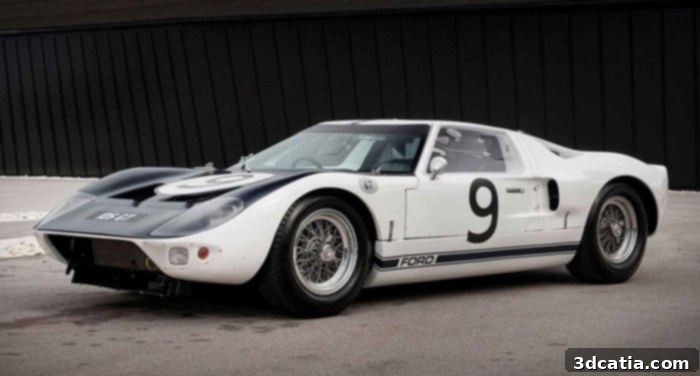
Photo Credits: Ford
Artec’s Advanced Solutions Empowering Ford GT40 Customization
Chris Ashton’s journey with Ruffian Cars, a California-based company specializing in building and modifying high-performance sports cars, perfectly encapsulates the synergy between passion and pioneering technology. His deep-seated love for automobiles seamlessly integrates with his business, where additive manufacturing has been a core component of their part reproduction strategy for several years. However, their earlier processes often involved numerous physical iterations and extensive manual adjustments to achieve a model that closely resembled the original. This iterative, labor-intensive approach highlighted a significant bottleneck in efficiency and precision.
Recognizing the need for a more streamlined and accurate workflow, Ruffian Cars strategically invested in Artec Space Spider and Artec Eva 3D scanners. Their primary objective was to meticulously reproduce and enhance critical components, such as the car’s wideners, which demand both aesthetic appeal and structural integrity. These advanced scanners promised to drastically reduce development cycles and deliver unparalleled accuracy, transforming the way they approached custom fabrication. The combination of Artec’s powerful hardware and intuitive software enabled Chris and his team to capture incredibly detailed geometric data of the GT40, forming the foundation for all subsequent digital design and physical production.
Chris Ashton eloquently describes the transformative impact of this technology on his workflow: “Previously I would have needed to sculpt the flares out of foam or clay, right on top of the car, and take the whole car to a shop for them to pull the molds (or do it myself, which is messy and involves a lot of chemicals.) And I would have had to do the job twice because you can’t mirror a part in the real world. The big advantage here is that the fender flares were built digitally on a scale scan of the actual car so we know they’ll fit properly, and the left and right sides will be exact mirrors of each other.” This statement highlights a crucial benefit: the ability to create perfectly symmetrical parts digitally, eliminating the inaccuracies and extensive labor associated with traditional manual sculpting and duplication. The digital environment ensures that every curve and contour is flawlessly replicated and mirrored, guaranteeing a perfect fit and aesthetic balance across the vehicle.
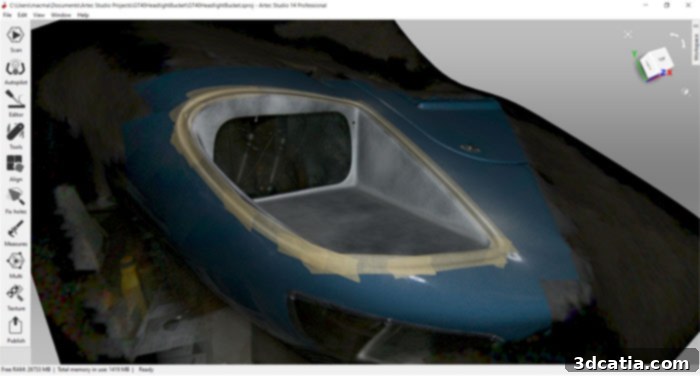
The internal angles and curves of the headlight housing were 3D scanned (photo credits: Artec 3D)
The strategic deployment of two distinct Artec scanners was key to the project’s success. Chris explains that the Artec Eva scanner was employed for capturing the entire vehicle’s geometry, thanks to its ability to quickly scan large objects with impressive accuracy. The Eva excels at creating comprehensive digital models of complex surfaces, providing the broad structural context for the customization. Complementing this, the Artec Space Spider was utilized for detailed scanning of smaller components and for “zooming in” on specific areas and intricate features destined for integration or modification. The Space Spider is renowned for its exceptional resolution and precision, making it perfectly suited for applications demanding fine detail and accuracy – ideal for faithfully capturing the subtle nuances of small objects like headlight housings or complex internal angles. This dual-scanner approach ensured that both the macroscopic and microscopic details of the GT40 were captured with unparalleled fidelity, establishing a robust foundation for all subsequent digital design work.
Once the physical vehicle was meticulously digitized, the data was imported into 3D software. This digital environment allowed Chris and his team to visualize the vehicle in real-time, enabling them to design new parts directly around the scanned model with absolute confidence in their fit and integration. Chris emphasizes the game-changing aspect of this digital workflow: “Since the scans come into the computer at real-world scale, I can model my new parts around them and print them without any scale issues, which is a huge improvement over what I was doing before, which was taking measurements, building on those, and hoping they were correct.” This seamless transition from physical scanning to digital modeling and ultimately to physical 3D printing eradicates the guesswork, drastically reducing design iterations and guaranteeing that every custom-fabricated part will fit perfectly the first time. The entire additive manufacturing process becomes significantly more efficient and incredibly accurate, empowering a new level of bespoke automotive design.
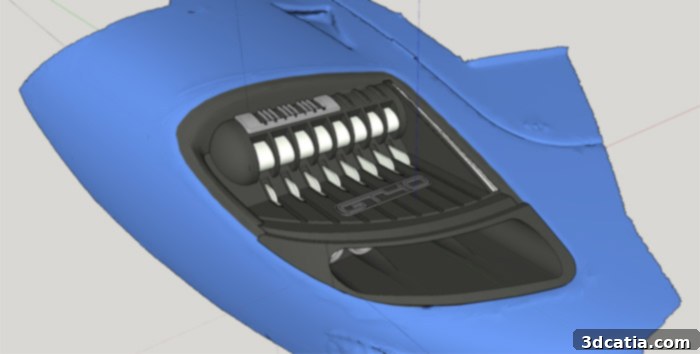
The assembled headlight model (photo credits: Artec 3D)
Chris Ashton’s ambitious work on the Ford GT40 extends far beyond merely reproducing fender wideners. His comprehensive customization effort touches nearly every aspect of the vehicle, from the subtle intricacies of the seatbelt buckles to the more prominent features like the fenders and side skirts. This holistic approach ensures that every custom component not only fits flawlessly but also contributes to a cohesive, enhanced design. By digitally designing and 3D printing these parts, Ashton is able to achieve a level of personalization and precision that would be virtually impossible through traditional manufacturing methods. This entire project serves as a compelling testament to how 3D scanning and additive manufacturing are democratizing bespoke automotive design, allowing enthusiasts and professionals alike to reimagine and restore classic vehicles with unprecedented accuracy and creativity.
The culmination of this groundbreaking project was showcased at SEMA 2021, a premier trade show where automotive manufacturers and customizers unveil their latest innovations and products. Chris Ashton’s Ford GT40, a masterpiece of modern engineering fused with classic design, stood as a shining example of what is possible when passion meets cutting-edge technology. For those interested in exploring the capabilities of the scanners used in this remarkable endeavor, more detailed information on Artec 3D scanners can be found HERE.
*Thumbnail Photo Credits: Artec 3D
The integration of 3D scanning and additive manufacturing represents a paradigm shift in classic car restoration and customization. It offers a sustainable path forward for preserving automotive heritage while simultaneously allowing for modern enhancements and personalized touches. This technology not only solves the immediate problem of obsolete parts but also fosters a new era of creativity and precision in the automotive aftermarket. What are your thoughts on utilizing advanced scanning solutions for repairing and customizing classic cars? We invite you to share your insights in a comment below or join the discussion on our Facebook and Twitter pages. Don’t forget to sign up for our free weekly newsletter, delivering all the latest news in 3D printing directly to your inbox!