
The Rapid Ascent of Metal 3D Printing: Market Insights, Innovations, and Future Growth
The landscape of advanced manufacturing is undergoing a profound transformation, with metal 3D printing emerging as a pivotal technology driving this evolution. A recently published report by VoxelMatters Research highlights the significant acceleration within this sector, revealing that global revenues for metal additive manufacturing reached an impressive $2.85 billion in 2022. This figure represents a robust year-on-year growth of 26%, underscoring the increasing industrial adoption and technological maturity of metal AM processes. The report’s findings provide a compelling narrative of a market in full expansion, far exceeding previous conservative estimates, such as the one made last year by IDTechEx.
A crucial insight from the VoxelMatters study is the primary drivers behind this revenue growth. It unequivocally states that the development and deployment of additive manufacturing machines are responsible for more than half of the total market revenue. This emphasizes the critical role of equipment innovation and increasing accessibility to sophisticated metal 3D printers. Following equipment, specialized services and advanced materials contribute significantly to the market’s financial vitality. Among the various business sectors leveraging this technology, aerospace stands out as the undisputed leader, demonstrating unparalleled enthusiasm and investment in metal additive solutions. Should the current growth trajectory persist, expert projections indicate that the metal 3D printing market could swell to an extraordinary $40 billion by 2032, painting a remarkably optimistic picture for the coming decade.
Comprehensive Market Analysis and Technological Deep Dive
To compile its comprehensive findings, VoxelMatters Research undertook an extensive survey involving over 400 companies actively engaged in the metal additive manufacturing ecosystem. This broad scope included not only 3D equipment manufacturers but also material developers and service providers, ensuring a holistic view of the industry. The resulting report is a rich repository of data and analysis, featuring over 170 tables and graphs that meticulously dissect market dynamics across various vertical sectors. Key industries scrutinized include the automotive, medical, aerospace, energy, and consumer goods sectors, providing detailed insights into how each is integrating and benefiting from metal AM.
Beyond mainstream applications, the study offers an exhaustive overview of the diverse array of metal 3D printing technologies available today. While powder-based processes such as Powder Bed Fusion (PBF) have long dominated the conversation, the report deliberately sheds light on lesser-known, yet equally transformative, manufacturing techniques. Among these, cold spraying is highlighted as a promising additive process, valued for its ability to deposit metallic materials without melting, thus avoiding thermal distortions. The report also touches upon advanced processes like friction stir welding, illustrating that the future of metal additive manufacturing lies in exploring a broader spectrum of possibilities beyond conventional methods to address specific industrial challenges and unlock new application areas.
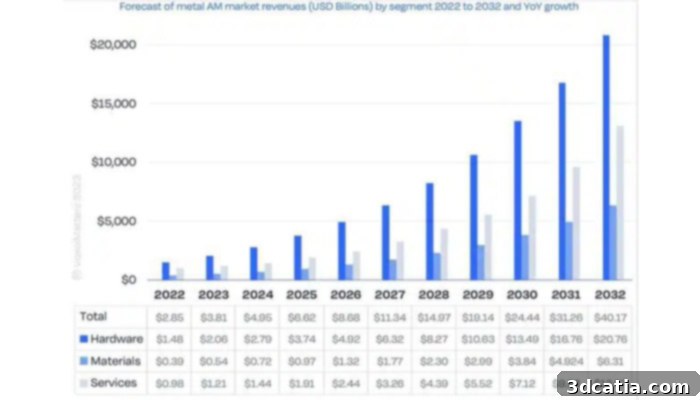
Predicted growth in the metal 3D printing market (Image credits: VoxelMatters Research)
Aerospace: A Catalyst for Metal AM Innovation
Although the full report’s granular details are still emerging, it clearly reinforces the pivotal role of specific vertical markets in adopting metal 3D printing. As anticipated, aerospace remains at the forefront of this industrial revolution. This comes as no surprise, given the sector’s stringent demands for lightweight yet robust components, complex geometries, and superior performance, all of which additive manufacturing excels at delivering. The rapid adoption of metal AM in aerospace extends across various applications, from producing highly intricate tooling and functional prototypes to manufacturing certified end-use parts.
Industry behemoths such as Airbus and Boeing have made substantial investments, establishing dedicated additive manufacturing centers and integrating various metal 3D printing solutions into their production workflows. This strategic commitment is driven by the potential for significant benefits, including part consolidation, supply chain optimization, and the ability to manufacture components with designs impossible to achieve with traditional methods. These advancements enable the creation of lighter aircraft, reducing fuel consumption and operational costs, while simultaneously enhancing structural integrity and overall performance. Despite this rapid progress, certain obstacles persist, particularly concerning the rigorous certification of new processes and materials for flight-critical applications. However, the industry is making rapid strides in addressing these challenges, fostering a more mature and robust market environment than ever before.
Global Leadership in Metal Additive Manufacturing
The report also offers a fascinating geographical breakdown of market leadership and technological specialization. Germany continues to be recognized as a pioneer in metal additive manufacturing, particularly in the realm of laser-melting powder bed processes. Historic manufacturers like EOS, Trumpf, and SLM Solutions have played a foundational role in developing and commercializing these technologies, establishing a strong ecosystem of research, innovation, and industrial application within the country. Their expertise has shaped many of the industry standards and best practices.
In Asia, the landscape is diverse and dynamic. Chinese companies are demonstrating significant growth, primarily focusing on advancing various powder-based processes and expanding their domestic market reach with competitive solutions. Meanwhile, Japan appears to be carving out a niche in Directed Energy Deposition (DED) technologies, leveraging its renowned precision engineering capabilities to develop high-performance systems for repair, cladding, and large-format part manufacturing. This regional specialization reflects strategic investments and indigenous technological strengths.
Across the Atlantic, the American market is currently topping the charts, boasting the highest number of national players and generating the largest revenues globally. The U.S. metal AM sector is exceptionally active and dynamic, driven by a combination of robust R&D, venture capital investment, and significant adoption across defense, aerospace, and medical industries. Key players such as Desktop Metal, GE Additive, 3D Systems, and Velo3D are at the forefront of innovation, continually pushing the boundaries of what’s possible with metal 3D printing. Their contributions range from developing new printer architectures and materials to expanding application possibilities across diverse industries.
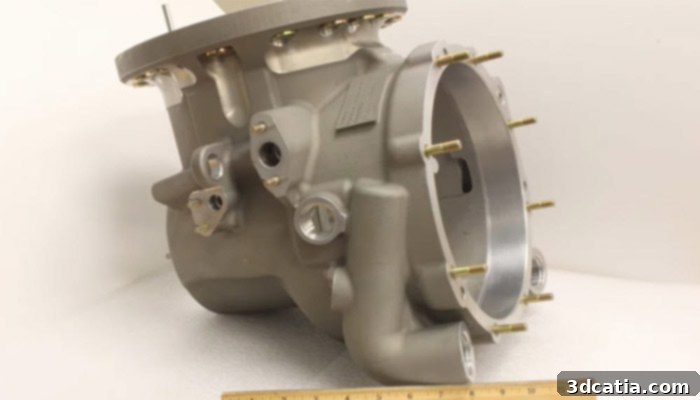
A 3D printed gearbox for a Boeing Chinook helicopter (Image credits: Boeing)
Future Outlook and Concluding Thoughts
The future trajectory for metal additive manufacturing appears exceptionally bright. While it still trails the more established polymer 3D printing market in terms of overall volume, its rapid growth rate and increasing industrial penetration suggest a powerful long-term impact. The continuous advancements in material science, machine capabilities, software optimization, and post-processing techniques are steadily broadening the scope of applications, making metal 3D printing a viable solution for an ever-increasing range of complex and high-performance components.
The market’s ambitious projected growth to $40 billion by 2032 is not merely a statistical forecast; it reflects a fundamental shift in how industries approach design, production, and supply chain management. Metal AM offers unparalleled advantages in terms of part consolidation, lightweighting, mass customization, and the ability to produce on-demand parts, minimizing waste and lead times. As challenges related to cost, standardization, and workforce expertise are systematically addressed, metal 3D printing is poised to reshape traditional manufacturing paradigms and become an indispensable tool for innovation across global industries. Those seeking to delve deeper into these transformative insights can access the full VoxelMatters Research study, which is available for order HERE.
Do you currently utilize metal 3D printing in your operations, or are you considering its potential applications? We invite you to share your experiences and insights in the comment section below. Connect with us and join the conversation on our LinkedIn, Facebook, and Twitter pages! For the very latest updates, news, and analyses from the world of 3D printing, remember to sign up for our free weekly Newsletter here, delivered directly to your inbox. Additionally, explore our comprehensive video content on our YouTube channel for visual insights into this dynamic industry.