
3D Printing Regolith on the ISS: Paving the Way for Sustainable Lunar and Martian Habitats with 3D Printing
On August 10th, Northrop Grumman launched its 16th commercial resupply service mission, a critical endeavor to support and expand the research capabilities of the International Space Station (ISS). This vital mission saw the Cygnus spacecraft deliver a substantial cargo of essential crew supplies, cutting-edge scientific research equipment, and crucial hardware to the orbiting laboratory. Such resupply missions are the lifeblood of continuous human presence in low Earth orbit, enabling astronauts to conduct groundbreaking experiments that push the boundaries of scientific understanding and technological innovation. Among the myriad scientific investigations included in this particular delivery, one experiment garnered significant attention for its potential to revolutionize future space exploration: the Redwire Regolith Print (RRP) study. This ambitious project aims to explore the viability of 3D printing loose rock and soil, known as regolith, directly on the International Space Station (ISS). The core objective is to determine whether regolith can serve as a primary raw material for the on-demand construction of habitats and other vital structures on the Moon and Mars, offering a sustainable alternative to transporting all building materials from Earth.
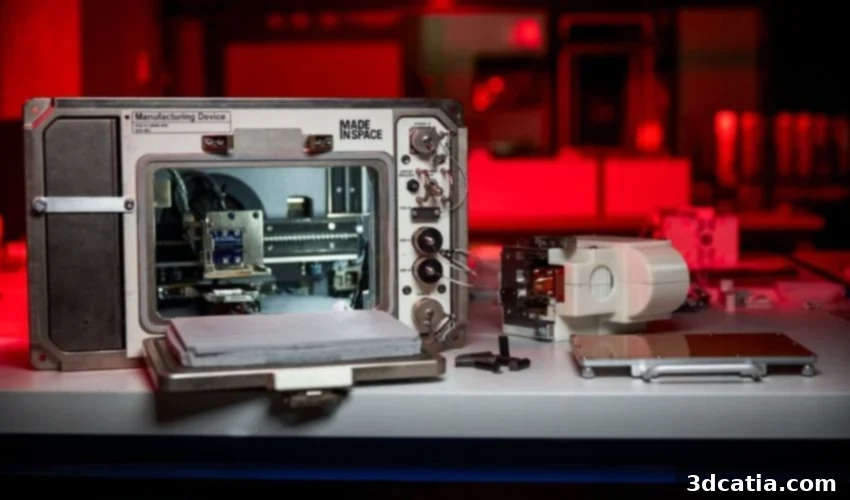
The Redwire Regolith Print (RRP) study marks a pivotal moment for additive manufacturing in space. Michael Snyder, chief technology officer at Redwire, emphasized the unique nature of this experiment, stating that it represents the first instance where the Additive Manufacturing Facility (AMF) on the ISS will be utilized not merely to produce a specific part, but to test a fundamental *manufacturing technique* itself. This distinction is paramount, as it signifies a shift from component fabrication to a comprehensive investigation of extraterrestrial construction processes. The AMF, a sophisticated 3D printer developed by Made In Space (now part of Redwire) and installed on the ISS in 2016, has previously demonstrated the ability to print tools and spare parts from various polymers. Its use for the RRP study involves a specialized upgrade: a new build plate and a custom-designed extrusion system will be integrated into the facility. Researchers will then initiate the printing of various specimens, primarily flat plates, using a carefully formulated regolith simulant. These printed samples are not for immediate application in space; rather, they will be meticulously secured and eventually returned to Earth for extensive post-printing analysis. The primary goal of this meticulous examination is to quantify any differences in material properties, structural integrity, and overall print quality between specimens produced in the microgravity environment (0g) of the ISS and those produced under normal Earth gravity (1g). Understanding these variations is critical for engineers to incorporate appropriate design tolerances and adjustments, ensuring the safety, stability, and longevity of future lunar and Martian habitats built using extraterrestrial resources.
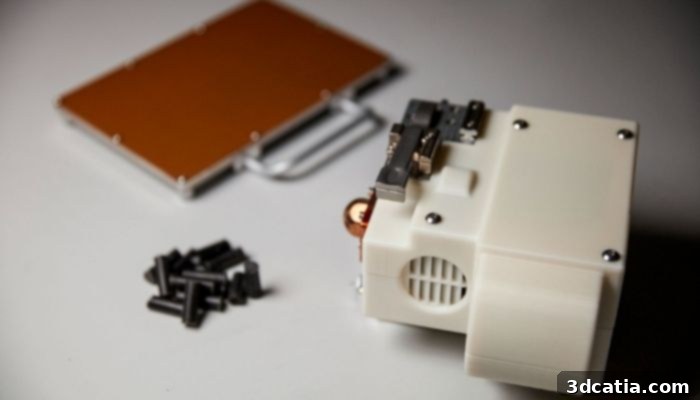
The Redwire Regolith Print (RRP) facility suite including the RRP print heads, plates, and lunar regolith simulant feedstock. (Photo Credits: Redwire Space)
The journey toward the RRP study on the ISS is the culmination of years of dedicated research, innovation, and international collaboration focused on solving one of the most formidable challenges in deep space exploration: establishing self-sustaining human outposts beyond Earth. This extensive work includes landmark initiatives like the Centennial 3D Printed Habitat Challenge, a multi-phase competition organized by NASA, which galvanized engineers and designers to conceptualize and develop innovative solutions for constructing habitats on the Moon and Mars using additive manufacturing. A central theme across all these efforts has been the crucial concept of In-Situ Resource Utilization (ISRU), which advocates for the strategic use of local, extraterrestrial resources. Regolith, defined as the layer of loose, unconsolidated rock and dust that covers solid rock, is abundant on celestial bodies like the Moon and Mars and has emerged as a prime candidate for ISRU in construction. Its appeal is multifaceted: by leveraging materials already present on these planetary bodies, future space missions can drastically reduce the immense volume and mass of supplies and structural components that would otherwise need to be launched from Earth. This reduction in launch mass translates directly into substantial cost savings, minimizes logistical complexities, and significantly decreases the waste generated on extraterrestrial missions – all critical factors for making long-duration space exploration and colonization economically viable and environmentally sustainable. The success of experiments like RRP could unlock the potential for scientists and engineers to confidently use these on-site resources as the primary raw materials for constructing housing, laboratories, landing pads, radiation shielding, and other essential infrastructure, heralding a new era of self-sufficient off-world settlements.
The concept of In-Situ Resource Utilization (ISRU), which the RRP study actively advances, is considered indispensable for the ambitious goals of future human spaceflight. Transporting every kilogram of building material from Earth to the Moon or Mars incurs exorbitant costs and presents immense logistical hurdles, making fully Earth-reliant construction impractical for permanent settlements. ISRU directly addresses this by transforming the seemingly barren extraterrestrial landscape into a readily available construction supply depot. Beyond habitats, regolith holds potential for diverse applications, including extracting oxygen and water (if ice is present), or even fusing it into hard surfaces for landing pads, thereby mitigating the pervasive and hazardous issue of lunar or Martian dust. However, utilizing regolith is not without its challenges; it is highly abrasive, its fine dust is electrostatic and pervasive, posing significant risks to sensitive equipment and human health. Furthermore, the vacuum of space, extreme temperature fluctuations, and unique gravitational environments demand extremely robust and adaptable printing technologies. The RRP study will provide invaluable data on how these environmental factors specifically impact the extrusion-based 3D printing process in microgravity, informing the design of future autonomous construction systems capable of operating reliably in such harsh conditions. This research directly supports NASA’s Artemis program, which aims to establish a sustainable human presence on the Moon, eventually paving the way for crewed missions to Mars. The ability to “live off the land” will be the bedrock of these ambitious endeavors, enabling longer stays and the construction of more complex, self-sufficient facilities without a constant umbilical cord to Earth.
The specific additive manufacturing technology employed for the Redwire Regolith Print experiment on the ISS is an extrusion-based process, a method widely recognized and utilized on Earth for various large-scale construction projects, including the 3D printing of entire houses. This technique involves forcing a semi-liquid or paste-like material through a nozzle, depositing it layer by layer to progressively build up a three-dimensional structure. The concept of using loose rock and soil as a primary building material is also not groundbreaking on Earth, with several terrestrial pioneers demonstrating its efficacy. Earlier this year, the innovative Italian company WASP successfully completed its groundbreaking TECLA project. TECLA, an acronym for Technology and Clay, stands as a prime example of eco-sustainable housing constructed almost entirely from locally sourced raw earth using advanced robotic 3D printing. This project beautifully showcased the potential for circular economy principles in construction, drastically minimizing environmental impact and maximizing resource efficiency. In the context of the RRP study, the material being 3D printed is a meticulously engineered regolith simulant, designed to accurately mimic the physical and mechanical properties of actual lunar or Martian soil. Crucially, this simulant is combined with a binder. The binder plays an essential role in the extrusion process, imparting the necessary rheological properties – such as viscosity and cohesive strength – to the regolith particles, allowing them to be accurately deposited and fused together layer by layer. This mechanism is similar to how clay and straw mixtures are manipulated in WASP’s TECLA project. The inclusion of a binder is particularly vital for achieving cohesive and structurally sound builds in a microgravity environment, where the natural compaction and settling of granular materials behave fundamentally differently than under terrestrial gravity. The successful demonstration of this extrusion and binding process in space will serve as a critical validation for future large-scale, autonomous construction systems on other planetary bodies.
The profound implications of successfully demonstrating regolith 3D printing in space extend far beyond merely constructing basic walls for habitats. This capability opens up vast avenues for fabricating a wide range of essential components and infrastructure “on demand.” This could include specialized tools, critical spare parts, advanced scientific instrument platforms, communication towers, and even durable roadways or landing pads. Such an ability dramatically reduces the reliance on pre-manufactured components launched from Earth, offering unprecedented flexibility, resilience, and adaptability for long-duration missions. Imagine a scenario where a vital piece of equipment breaks down on a Martian outpost; instead of facing years of waiting for a resupply mission, astronauts could potentially print a replacement using readily available local resources. This level of self-sufficiency is not just an operational advantage; it represents a fundamental paradigm shift in how humanity approaches deep space exploration and colonization. It transitions us from an expeditionary model of brief visits to a more permanent, self-sustaining presence, significantly reducing mission risks and accelerating scientific discovery. The data meticulously gathered from the RRP study on the ISS will be instrumental in refining the design of future lunar and Martian 3D printers, optimizing regolith-binder material mixtures, and developing robust protocols for fully autonomous construction. This advancement paves the way for sophisticated robotics to construct entire settlements, including radiation-shielded dwellings and support facilities, before human crews even arrive, ensuring a safe, functional, and productive base awaits them. The synergy between private sector innovation, exemplified by Redwire, and public space agencies like NASA, underscores a powerful collaborative model that is rapidly accelerating humanity’s push into the cosmos.
Andrew Rush, the President and COO of Redwire, succinctly captured the profound significance of this mission: “Redwire Regolith Print demonstrates a key manufacturing capability for building critical infrastructure on the Moon. Technology that enables us to use local, available resources to produce what we need off-Earth is critical for NASA’s Artemis missions and sustainable exploration of the Moon, Mars, and beyond.” His statement powerfully encapsulates the overarching vision shared by a growing global community of space enthusiasts, visionary scientists, and dedicated engineers: to transform humanity from an exclusively Earth-bound species into a thriving multi-planetary civilization. The success of groundbreaking experiments like RRP is not merely about achieving a technical milestone; it signifies a fundamental evolution in our strategic approach to space exploration – moving beyond transient visits to establishing a truly inhabiting and enduring presence. This initiative aligns perfectly with the ambitious broader goals of NASA’s Artemis program, which aims to land the first woman and next man on the Moon, and subsequently to establish a sustainable lunar presence as a proving ground for future human missions to Mars. The invaluable lessons gleaned from printing regolith in the microgravity environment of the ISS will be directly applicable to developing the advanced technologies required for constructing robust landing pads, protective shelters, and other vital structures on the lunar surface, and eventually, on the Martian landscape. This forward-thinking and proactive approach ensures that future generations of explorers will be equipped with the cutting-edge tools and capabilities necessary to not just survive but thrive in environments far removed from our home planet. You can discover more about the diverse array of projects currently underway and those headed to the ISS in the comprehensive video below, which offers a broader overview of the mission’s extensive scientific objectives. Alternatively, for more in-depth specifics, consult the official press release available HERE.
What are your informed thoughts on Redwire’s ambitious plans to leverage 3D printing technology on the International Space Station to rigorously test the feasibility of employing extraterrestrial soil for the construction of lunar and Martian habitation? Do you firmly believe this innovative approach represents the ultimate, sustainable solution for establishing a lasting human presence beyond Earth, or do you foresee significant technical, logistical, or environmental challenges that still require extensive research and development to overcome? We warmly invite you to share your insightful perspectives, probing questions, and educated predictions regarding the unfolding future of space construction in the comment section below. Join the dynamic conversation and connect with us on our vibrant Facebook and engaging Twitter pages, where we consistently discuss the very latest advancements in additive manufacturing and cutting-edge space technology. For those eager to remain at the forefront of all groundbreaking developments, don’t forget the opportunity to sign up for our complimentary weekly newsletter, which meticulously curates and delivers all the essential news, breakthroughs, and trends in the rapidly evolving world of 3D printing directly to your inbox!