
Mastering Stereolithography (SLA) 3D Printing: A Comprehensive Guide
Stereolithography, often abbreviated as SLA and derived from the Greek “stereo” for solid and “lithography” for writing, stands as one of the pioneering and most influential methods in the realm of additive manufacturing. This revolutionary 3D printing technology was first patented in 1984 by Charles “Chuck” Hull, laying the foundational groundwork for what we now understand as modern 3D printing. Just four years later, in 1988, Hull’s company, 3D Systems, brought the first commercial SLA machine to market, forever changing how prototypes and complex parts could be created. This comprehensive guide will delve deep into the mechanics of SLA, explore its diverse applications, and shed light on its significant impact on various industries. For those interested in exploring current market offerings, our Top 10 resin 3D printers list provides excellent insights.
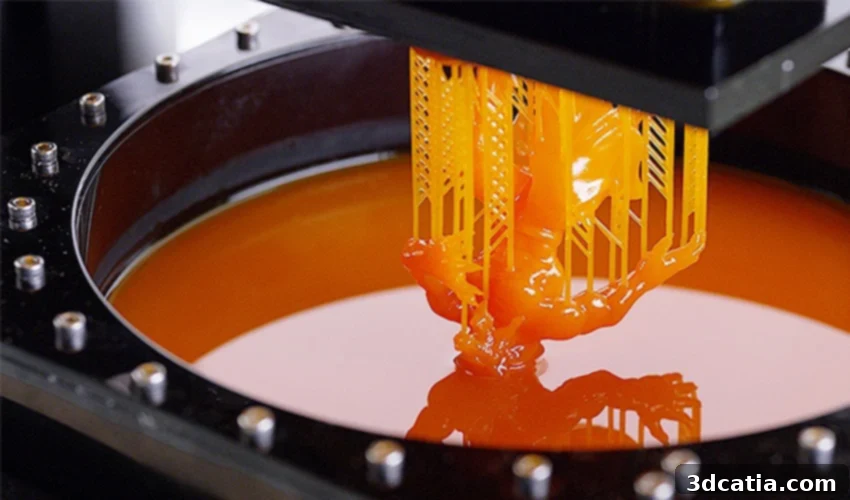
At its core, the Stereolithography (SLA) process employs a technique known as photopolymerization. This involves using a UV-sensitive liquid resin, which solidifies upon exposure to specific wavelengths of ultraviolet (UV) light. In SLA printers, a precise UV laser systematically traces patterns onto the surface of this resin, layer by layer, building a three-dimensional object from the ground up or top-down. This meticulous process is renowned for producing models with exceptionally smooth and detailed surfaces, often surpassing the surface quality achieved by many other 3D printing technologies. This superior finish makes SLA an indispensable tool for applications demanding high aesthetic quality and tight tolerances.
From a historical perspective, Stereolithography is not just a technology; it’s the genesis of industrial 3D printing. Chuck Hull’s groundbreaking patent application in 1984 marked the official beginning of what we now call additive manufacturing. While Hull and 3D Systems successfully commercialized the technology, it’s worth noting that a trio of French researchers—Jean-Claude André, Olivier de Witte, and Alain le Méhauté—filed a similar patent on behalf of the Alcatel group just days before Hull. Although this French patent has since fallen out of use, it underscores the parallel global efforts to harness the power of photopolymerization for solid object creation.
Modern 3D SLA printers typically utilize a liquid photopolymer resin contained within a transparent vat, often protected by a UV-blocking cover, commonly seen in orange, green, red, or yellow hues. While traditional SLA systems were known for offering a relatively smaller production volume compared to some other industrial 3D printing technologies like FDM or SLS, advancements have significantly expanded this capability. Today, specialized machines, such as the Mammoth 3D printer, are capable of producing extraordinarily large parts, exceeding two meters in dimension. This expansion in build volume has opened up SLA to a wider array of industrial applications, from large-scale prototyping to the creation of end-use parts.
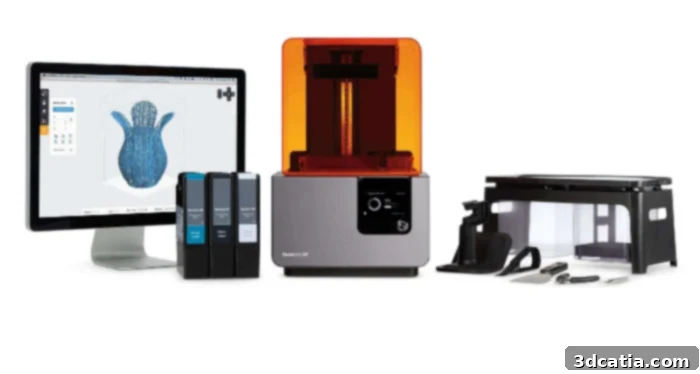
The Formlabs Form 2, a popular desktop SLA 3D printer
How Stereolithography 3D Printing Works: The Technical Deep Dive
The journey from a digital concept to a physical object with SLA 3D printing begins, like any additive manufacturing technique, with a detailed 3D digital file. This file is typically generated using Computer-Aided Design (CAD) software packages such as SolidWorks, Sculptris, or SelfCAD. Once the 3D model is designed, it is exported, most commonly in an STL (STereoLithography) file format. This STL file is then fed into a specialized software known as a slicer. The slicer’s crucial role is to meticulously slice the 3D model into hundreds or even thousands of ultra-thin digital layers. Simultaneously, it generates support structures where necessary to prevent overhangs from collapsing during the printing process. These precise instructions, including layer thickness, exposure settings, and movement paths, are then transmitted to the SLA 3D printer.
Stereolithography machines are intricate systems comprising several key components. At the heart of the system is a resin tray, which holds the photopolymer liquid. A mobile build platform, often referred to as the Z-axis, is submerged into the resin. Depending on the machine configuration (top-down or bottom-up), a scraping system (X-axis) may be present to ensure an even layer of resin is maintained across the surface. The critical element for solidification is a high-precision UV laser, directed by focusing optics and a mirror galvanometric system (controlling X and Y axes). These galvanometers precisely guide the laser beam across the resin surface, tracing the exact cross-section of each layer.
The printing process unfolds layer by meticulous layer. The laser beam sweeps across the surface of the liquid resin, selectively curing and solidifying the photopolymer based on the digital 3D model’s instructions. Once a complete layer has been solidified, the build platform precisely descends by one layer thickness into the resin (in a top-down system), or rises slightly out of the resin (in a bottom-up system). A new layer of liquid resin flows over the previously solidified layer, and the laser process repeats. This cycle continues until all necessary layers have been solidified, and the complete three-dimensional volume of the part is achieved. The precision of this process directly contributes to the exceptional detail and smooth surface finish characteristic of SLA parts.
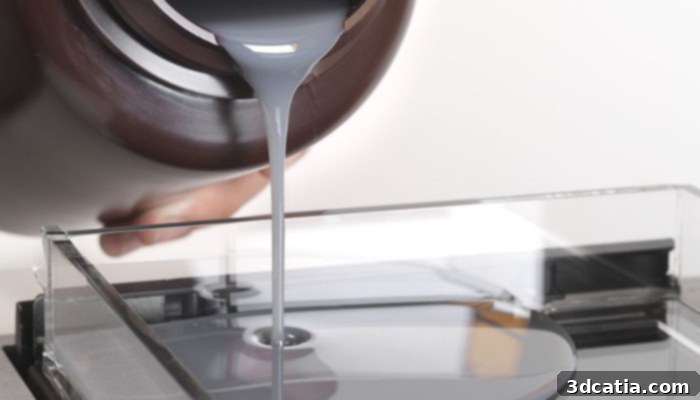
SLA technology fundamentally relies on liquid photopolymer resin
Top-Down vs. Bottom-Up SLA Architectures
It’s important to distinguish between the two primary configurations for SLA machines: top-down and bottom-up. In traditional, large-scale industrial SLA machines, the laser is positioned above the resin vat, and the build platform starts at the top, descending into the resin as layers are cured. A recoater blade often sweeps across the surface to ensure a consistent resin layer. However, many modern desktop SLA machines, such as those by Formlabs, utilize a “bottom-up” approach. Here, the resin tank has a transparent bottom, and the laser or light source projects upwards from beneath. The build platform starts submerged in the resin, lifting slightly after each layer to allow fresh resin to flow underneath, before the next layer is cured from the bottom. This method significantly reduces the amount of resin required and simplifies the mechanical setup, making it ideal for compact, desktop systems.
Post-Printing: Essential Steps for SLA Part Quality
Once the final layer has been cured, the printed object, still attached to the build platform and often covered in uncured liquid resin, requires a crucial set of post-processing steps. The first essential stage is cleaning. The part is carefully removed from the build platform and immersed in a solvent, typically isopropyl alcohol (IPA) or isopropanol, to thoroughly wash away any residual, non-solidified resin from its surface and internal cavities. This step is critical for both the aesthetic quality and the subsequent mechanical properties of the part.
Unlike technologies such as Selective Laser Sintering (SLS) which produces ready-to-use parts from powder, or Fused Deposition Modeling (FDM) which uses thermoplastic filaments, SLA parts almost always require an additional UV post-treatment. This post-curing process involves exposing the cleaned part to intense UV light in a specialized curing chamber. This step is vital to complete the photopolymerization reaction, which may not have fully concluded during the printing phase. Post-curing significantly enhances the material’s mechanical properties, increasing its hardness, strength, and temperature resistance, bringing it closer to its optimal performance specifications.
Furthermore, similar to FDM technology when printing complex geometries, SLA often necessitates the use of support structures. These temporary scaffolds are printed alongside the main part to provide crucial stability for overhanging features, steep angles, and intricate details that would otherwise collapse during the layer-by-layer build process. These supports are typically removed during the post-processing phase, often requiring careful breaking, cutting, or sanding. Designing intelligent support strategies in the slicing software is paramount to minimize post-processing effort and prevent damage to the final part’s surface.
When it comes to surface finish, Stereolithography technology excels. It inherently produces a smooth, often slightly vitreous (glassy) surface finish that is generally superior to parts produced by FDM or SLS processes, especially when comparing similar layer thicknesses. The individual layers of printing are frequently so fine that they are barely visible to the naked eye, leading to highly aesthetic and detailed parts. However, a common limitation of SLA is the relatively restricted availability of colors. Resins are typically offered in a limited palette (e.g., clear, grey, black, white), though some specialized resins and post-processing painting can expand the color options.
3D SLA Printing: Driving Innovation and Spawning New Technologies
Following the expiration of key patents related to Stereolithography, a wave of innovation swept the additive manufacturing industry, leading many companies to develop improved and derivative technologies based on the original SLA principles. One notable advancement is the Digital Light Processing (DLP) method. Instead of a single laser tracing patterns, DLP uses a digital light projector to flash an entire layer’s image simultaneously. This allows for significantly increased print speeds, particularly when printing multiple smaller parts on the same build platform, as the cure time for a single layer remains constant regardless of the part’s complexity or quantity. France’s Prodways further refined this concept with its proprietary MovingLight technology, which moves the video projector itself, further accelerating part production by optimizing light distribution and projection. Another innovative approach comes from British company Photocentric, which utilizes an LCD screen as its UV light source, offering a cost-effective and high-resolution alternative, particularly for desktop-sized machines.
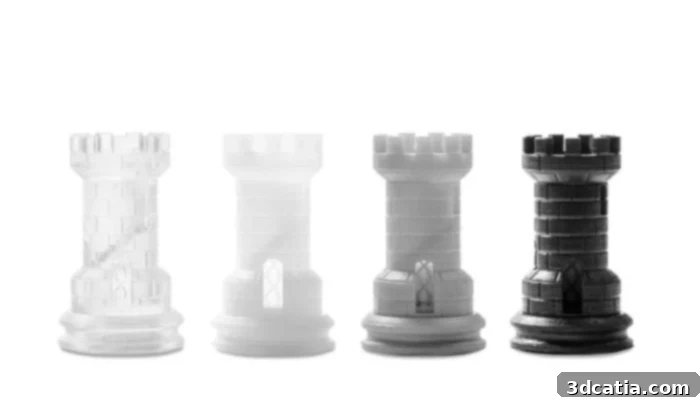
An example of parts produced with an SLA 3D printer, showcasing their characteristic smooth and glassy appearance.
More recently, the manufacturer Carbon3D introduced its groundbreaking CLIP (Continuous Liquid Interface Production) process. This revolutionary technology controls the amount of oxygen present during the photopolymerization reaction, creating an inhibitory “dead zone” at the bottom of the resin tank. This allows for continuous printing without the need for traditional layer-by-layer lifting and re-coating, dramatically increasing print speeds—often 25 to 100 times faster than conventional SLA. Another fascinating initiative, ONO (formerly OLO), successfully raised $2.3 million for a system that leverages the light from a smartphone screen to solidify liquid resin, demonstrating the potential for highly accessible and portable resin 3D printing.
Among the leading manufacturers of 3D SLA printers, 3D Systems, as the original pioneer of the technology, naturally holds a prominent position. However, the market has expanded significantly with the emergence of newer, innovative players such as DWSlab, B9Creator, and particularly Formlabs. Based in Boston, Formlabs revolutionized the desktop 3D printing landscape. In 2011, they launched a highly successful crowdfunding campaign on Kickstarter, raising an impressive sum of $3 million for their Form 1, which became one of the first truly accessible desktop SLA printers, marketed under the $5,000 mark. This democratization of SLA technology brought high-resolution resin printing within reach for a much broader audience, including small businesses, designers, and enthusiasts.
The price range for Stereolithography 3D printers varies widely, reflecting their diverse capabilities and target markets. Entry-level, low-cost desktop versions can start from around €1,000, offering excellent value for hobbyists and educational institutions. On the other end of the spectrum, professional-grade industrial machines, capable of large manufacturing volumes, extreme precision, and high throughput, can command prices reaching several tens of thousands of euros. To explore the extensive selection of resin 3D printers and compare their features and prices, consult our comprehensive 3D Printer Comparator.
Versatile Applications Offered by Stereolithography
SLA 3D printing offers a remarkable range of applications across nearly all sectors of industry, primarily due to its exceptional speed, precision, and ability to produce highly detailed parts. It is most frequently employed for rapid prototyping. Its quick turnaround times allow engineers and designers to iterate on designs swiftly, creating high-fidelity prototypes for fit, form, and aesthetic evaluation before committing to expensive tooling or mass production. Depending on the quality and capabilities of the specific printer and resin used, it’s also possible to obtain parts that are immediately functional, suitable for end-use in certain scenarios. Beyond prototyping, SLA is extensively utilized for the production of highly accurate master patterns for injection molds and specialized tools for foundries, particularly within the demanding worlds of jewelry and dentistry.
One of the most compelling indirect manufacturing processes leveraging stereolithography is lost wax casting (also known as investment casting). This ancient metallurgical technique, which has been practiced for millennia, has been profoundly modernized by 3D printing. With SLA, a highly accurate and intricately detailed replica of the final desired model—often referred to as a “jewelry master” or “castable pattern”—is 3D printed using a special calcinable wax resin. This printed wax pattern is then encased in a refractory material to create a mold. Once the mold is complete and cured, it is heated in a furnace, causing the wax pattern to melt and burn away, leaving behind a perfect cavity. Molten metal (such as gold, silver, bronze, or medical-grade alloys) is then poured into this cavity. After the metal cools and solidifies, the refractory mold is broken away, revealing the finished metal part, which can then be polished and refined. This process is invaluable in jewelry manufacturing for creating intricate pieces and in dentistry for precision dental crowns and bridges.
In the medical field, SLA plays a crucial role in producing highly accurate anatomical models for surgical planning, custom surgical guides, and even biocompatible prosthetics. Its ability to create finely detailed models with smooth surfaces is critical for these sensitive applications. For consumer goods, SLA is used for crafting functional prototypes of consumer electronics, intricate design models, and even custom-fit items. Its versatility and precision continue to drive innovation across diverse industries, making it a cornerstone of modern manufacturing.
We value your insights! Let us know what you think about Stereolithography and its applications in a comment below, or connect with us on our Facebook and Twitter pages! Don’t forget to sign up for our free weekly Newsletter to receive all the latest news and advancements in 3D printing delivered directly to your inbox!