

Revolutionizing Automotive: How 3D Printing Powers Porsche’s Customizable Seats and the Future of Car Manufacturing
The automotive industry is in the midst of a profound transformation, with technological advancements like 3D printing playing a pivotal role in redefining design, manufacturing, and customization. A rapidly increasing number of automotive companies are leveraging the power of additive manufacturing to create a diverse range of parts for their vehicles. From accelerating the rapid prototyping phase and optimizing tooling applications to crafting intricate, custom-made components, the applications of 3D printing are both extensive and continually expanding. This burgeoning market has caught the attention of industry experts, with specialized consulting firms like SmarTech Publishing projecting significant growth. Their comprehensive report predicts that the additive manufacturing market within the automotive sector alone will soar to an impressive $5.3 billion in value by 2023. Beyond its traditional strengths in prototyping and tooling, a substantial portion of this projected revenue is expected to be generated through the production of high-performance, end-use parts, signaling a shift from experimental adoption to mainstream manufacturing integration.
This dynamic sector has witnessed numerous groundbreaking developments, showcasing the versatility and impact of 3D printing. A notable recent example is the collaboration between 3DGBIRE, Ultimaker, and BAC. These three innovative companies partnered to engineer and produce over 40 distinct parts for BAC’s cutting-edge Mono R supercar. This collaboration highlights how additive manufacturing facilitates the creation of lightweight, complex geometries that would be challenging or impossible to achieve with traditional methods, directly contributing to the vehicle’s enhanced performance and unique design. Particularly within the realm of luxury and sports cars, 3D printing presents an unparalleled opportunity to create highly tailor-made components. This level of bespoke craftsmanship is perfectly suited for discerning customers who demand an elevated degree of personalization and exclusivity in their vehicles. Porsche exemplifies this trend with its groundbreaking offering: the 3D printed bodyform full-bucket seats. Designed with the ultimate goal of maximizing driver comfort and performance, these advanced seats are engineered to be completely customizable, offering an unprecedented level of ergonomic precision.
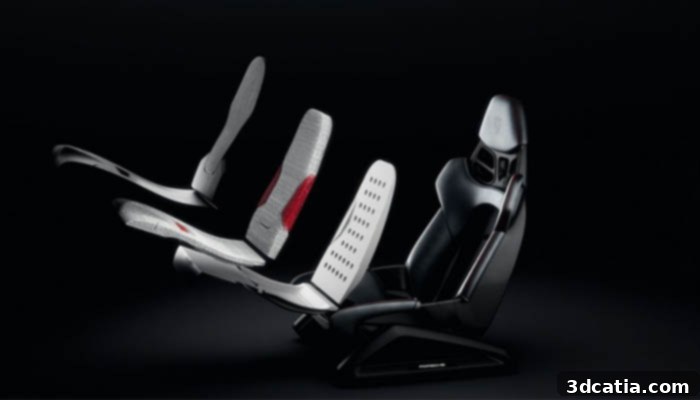
Image via Porsche
The concept of customizable seats is not entirely new, especially within the high-stakes world of professional racing cars, where tailored seating has long been a standard practice to optimize driver performance and safety. The logical next step, therefore, is to extend this highly beneficial concept to high-performance luxury and sports cars, and 3D printing provides the ideal technology to bridge this gap. Michael Stefner, a Member of the Executive Board for Research & Development at Porsche, eloquently explains the philosophy behind this innovation: “The seat is the interface between the human and the vehicle, and is thus important for precise, sporty handling. That’s why personalized seat shells customized for the driver have been standard in race cars for a long time now.” This statement underscores the critical role of the seat in connecting the driver to the vehicle, influencing everything from feedback and control to overall driving dynamics. By bringing advanced personalization to a broader audience, Porsche is not just enhancing comfort but is also aiming to improve the driving experience, making it more intuitive, responsive, and ultimately, safer for its customers.
The Advanced 3D Printing Process Behind Porsche’s Customizable Seats
The engineering marvel of Porsche’s customizable seats lies in their sophisticated construction, which the sports car manufacturer describes as a “sandwich” design. This multi-layered approach combines different materials and manufacturing techniques to achieve optimal performance, comfort, and personalization. The foundation of the seat is a robust base support crafted from expanded polypropylene (EPP). EPP is an excellent choice for this application due to its lightweight properties, exceptional energy absorption capabilities (crucial for safety and impact resistance), and good thermal insulation. Bonded to this EPP base is a highly breathable comfort layer, which forms the core of the seat’s ergonomic innovation. This comfort layer is composed of a specialized mixture of polyurethane-based materials, expertly fabricated using advanced additive manufacturing techniques. The use of 3D printing here is game-changing, as it allows for the precise control over material density and internal structures, enabling a degree of customization previously unachievable.
Porsche has announced that this innovative comfort layer will offer customers an unprecedented choice between three distinct levels of firmness. This flexibility ensures that each driver can select a setting that perfectly matches their personal preference and driving style, enhancing both comfort and the tactile connection with the vehicle. Beyond firmness, the true power of 3D printing shines through in the ability to design this layer to precisely fit the driver’s specific body contour. This personalized fit mitigates pressure points, improves circulation, and provides superior lateral support during dynamic driving, mirroring the benefits previously exclusive to professional racing environments. Completing the sandwich construction is the outer skin, meticulously crafted from Race-Tex. Race-Tex is a premium microfibre material renowned for its high quality, durability, and luxurious feel. Notably, it partially consists of recycled polyester fibers, reflecting a commitment to sustainability without compromising on performance or aesthetics. This outer skin features a specific perforation pattern, ingeniously designed to facilitate climate control, ensuring optimal breathability and temperature regulation even during extended drives. Furthermore, strategically placed window panels offer a tantalizing glimpse of the exposed, colored components beneath, revealing the intricate beauty of the 3D printed lattice structures. These lattice structures are not merely aesthetic; they play a crucial role in providing targeted support, improving ventilation, and further reducing the overall weight of the seat, demonstrating the harmonious blend of form and function enabled by additive manufacturing.
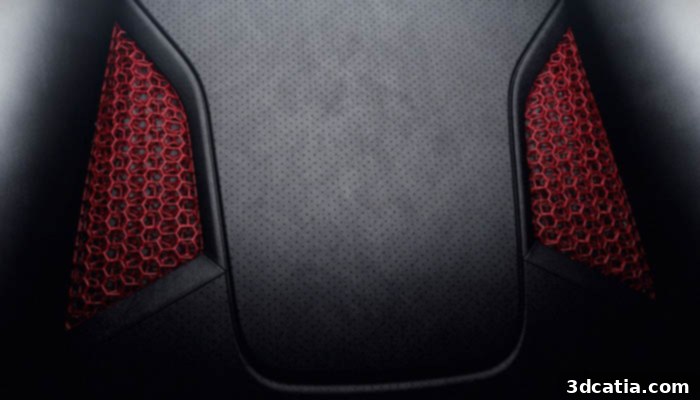
Image via Porsche
The sports car manufacturer has clarified that, for the time being, these innovative seats are still considered a concept design. This strategic approach allows Porsche to meticulously gather crucial feedback from initial users before committing to a larger-scale production. This iterative development process is vital for refining the design, optimizing manufacturing processes, and ensuring the final product meets Porsche’s stringent standards for quality, performance, and driver satisfaction. The 3D printed bodyform full-bucket seat will first become available through Porsche Tequipment, specifically for the iconic 911 and 718 ranges, with an initial rollout slated for as early as May 2020. This initial offering will be purposefully limited to 40 seat prototypes, intended for rigorous use on race tracks across Europe. This controlled environment will provide invaluable real-world data on durability, performance under extreme conditions, and user experience, particularly when used in combination with a six-point seat belt, as is common in high-performance driving. This phased introduction underscores Porsche’s commitment to innovation driven by data and customer experience, ensuring that when the 3D printed seats become more widely available, they will represent the pinnacle of automotive seating technology.
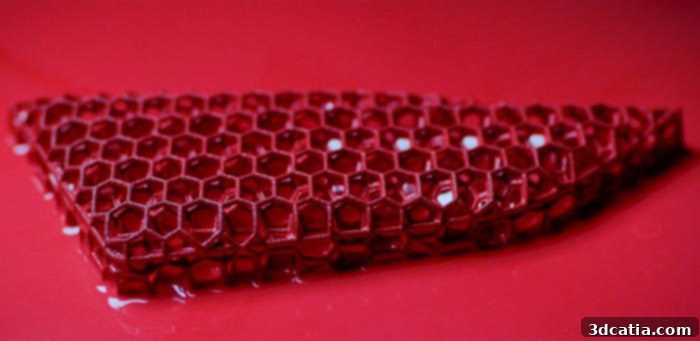
Image via Porsche
*Cover Photo Credits: Image via Motortrend
The introduction of 3D printed customizable seats by Porsche marks a significant milestone in the automotive industry’s adoption of additive manufacturing. It highlights the technology’s capacity not only for rapid prototyping and efficient tooling but also for creating highly personalized, performance-enhancing, and aesthetically striking end-use parts. As the technology continues to evolve, we can anticipate even more innovative applications that will redefine vehicle design, manufacturing, and the entire driving experience. This pioneering step by Porsche not only elevates driver comfort and performance but also paves the way for a future where vehicles are increasingly tailored to individual needs and preferences, driven by the limitless possibilities of 3D printing. We are eager to hear your thoughts on these groundbreaking 3D printed seats from Porsche. Do you believe this level of personalization will become standard in high-end vehicles? What other automotive components do you think could benefit from additive manufacturing? Let us know your insights in a comment below or join the conversation on our Facebook and Twitter pages! For all the latest news and advancements in the exciting world of 3D printing, don’t forget to sign up for our free weekly Newsletter, delivered straight to your inbox!