
The Infinity Bicycle: Redefining Design with 3D Printing and All-Wheel Drive
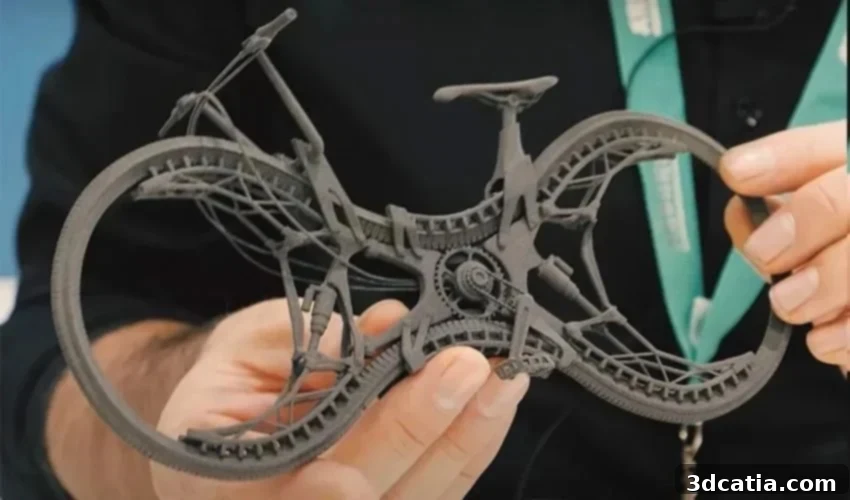
Imagine a bicycle engineered so profoundly differently from anything you’ve ever seen, it redefines the very essence of two-wheeled transport. German designer Stephan Heinrich has transformed this visionary concept into a tangible reality with the groundbreaking ‘Infinity’ bicycle, utilizing the power of additive manufacturing. This isn’t just another bike; it’s a revolutionary all-wheel drive concept poised to shatter conventional design paradigms and challenge our perceptions of what a bicycle can be. While currently a sophisticated concept brought to life through advanced prototyping, the ‘Infinity’ signals a future of cycling that could be far closer than we anticipate, proving the long-term viability of such innovative ideas through the precise capabilities of 3D printing.
The synergy between 3D printing and bicycle development is not entirely new, particularly concerning the creation of specialized components and optimized frames. This cutting-edge technology frequently enables the production of bicycle frames meticulously designed to reduce overall weight, enhance aerodynamic performance, and offer unparalleled customization for riders. However, the ‘Infinity’ project marks a distinct departure from these applications, placing 3D printing in a role of profound conceptual realization. For this audacious project, additive manufacturing was instrumental in constructing a detailed, small-scale prototype of this revolutionary all-wheel drive bicycle, acting as a crucial step in validating its radical design and mechanical principles. The journey from concept to a commercially viable product still involves many stages, and the extent to which 3D printing will be deployed in future manufacturing iterations remains an exciting prospect to be explored.
The Infinity: A Glimpse into the Future of Bicycle Mechanics
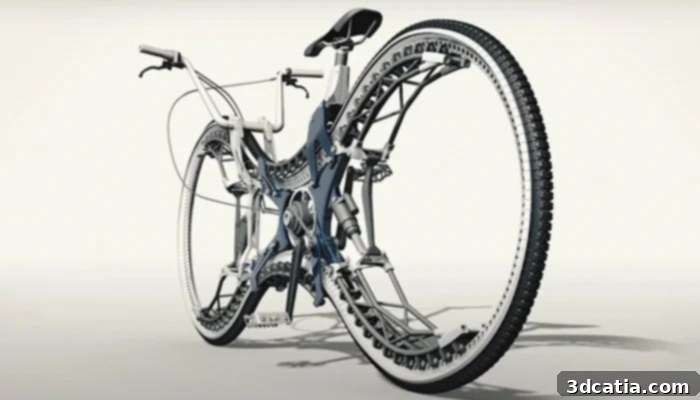
The ‘Infinity’ bicycle earns its evocative name from the intricate structure of its unique four-wheel drive system, which elegantly forms the shape of the infinity symbol itself. This design is not merely aesthetic; it is central to its groundbreaking functionality. At the heart of its propulsion lies a monotypic chain system that ingeniously forms a temporary rim on the wheel sections. This is complemented by a sophisticated toothed belt drive embedded within an inner groove, creating a seamless and highly efficient power transfer mechanism. Unlike conventional bicycles that typically drive only the rear wheel, ‘The Infinity’ propels itself from its center wheel, where the rider’s pedaling action generates the power necessary to move all four wheels simultaneously.
This innovative drive system is further enhanced by a short chain and an 8-speed gearshift, which operates on principles vastly different from those found on traditional bicycles. The integrated design minimizes exposed components, contributing to a sleek appearance and potentially reduced maintenance. Stephan Heinrich’s vision for ‘The Infinity’ extends beyond propulsion; it incorporates independent suspensions for both the front and rear of the 3D-printed bike. This crucial feature enables the bicycle to adapt fluidly to diverse terrains and absorb various impacts, promising an exceptionally smooth and controlled riding experience, regardless of the road or trail conditions. Such engineering marvels require meticulous prototyping, and for this, Heinrich turned to Selective Laser Sintering (SLS) technology from the renowned manufacturer Sintratec to develop this highly detailed, small-scale prototype.
Additive Manufacturing: The Enabler of Complex Bicycle Innovation
Additive manufacturing, more commonly known as 3D printing, has emerged as a cornerstone technology for rapid innovation across numerous industries, and cycling is no exception. Its inherent ability to produce highly complex geometries directly from digital designs makes it invaluable for creating lightweight, optimized, and structurally sound bicycle components. In the context of performance bicycles, 3D printing allows for custom frame geometries tailored to individual rider ergonomics, enabling unprecedented levels of personalization and performance enhancement. Furthermore, it facilitates the integration of intricate internal structures, such as lattices, which can significantly reduce material usage and weight without compromising strength.
For Stephan Heinrich’s ‘Infinity’ bike, 3D printing played a critical, enabling role that goes beyond simple part optimization. It was the chosen method for building a fully functional, small-scale prototype that accurately represented the complex mechanical and structural elements of his groundbreaking concept. The precision offered by technologies like Selective Laser Sintering (SLS) was paramount in bringing Heinrich’s vision to life. SLS, a powder bed fusion technique, is capable of producing robust and detailed plastic parts with excellent mechanical properties, making it ideal for testing functional prototypes that need to withstand stresses and demonstrate intricate movements. This allowed Heinrich to validate the feasibility of his all-wheel drive system, the unique chain and belt configurations, and the integrated suspension designs, all within a rapid development cycle that traditional manufacturing methods could never match.
Stephan Heinrich’s Vision: From Concept to Commercial Reality
Stephan Heinrich is not just designing a new bicycle; he is actively working to cultivate a future where radical innovation is the norm. He firmly believes that ‘The Infinity’ possesses the potential to fundamentally revolutionize the cycling market and challenge prevailing design conventions that have dictated bicycle construction for decades. His ambition is to transition this compelling concept from an advanced prototype to a commercially viable product accessible to a wider audience. This ambitious journey, however, requires significant steps beyond the initial design and prototyping phases.
The path to market will necessitate substantial funding and the establishment of strategic partnerships with manufacturing entities capable of scaling production. Heinrich articulates, “If the necessary funding is raised and strategic manufacturing partners support the project, the bike could soon go from a concept to a prototype and then to a commercially viable product for the masses.” This statement underscores the critical role of investment and collaboration in realizing such pioneering endeavors. The successful transition would not only validate Heinrich’s innovative design but also demonstrate the increasing maturity and capability of additive manufacturing to move beyond prototyping into full-scale production for specialized and high-performance products. The ‘Infinity’ could pave the way for a new class of bicycles, potentially impacting urban commuting, off-road adventures, and even competitive cycling, offering enhanced stability, traction, and adaptability that traditional designs simply cannot match.
The Broader Impact of 3D Printing in the Cycling Industry
While ‘The Infinity’ stands as a remarkable example of additive manufacturing’s potential, its impact resonates with a broader trend of 3D printing transforming the entire cycling industry. Beyond individual components, 3D printing is enabling manufacturers to create entire bicycle frames with previously impossible geometries, leading to lighter, stronger, and more aerodynamically efficient designs. This technology facilitates rapid iteration in product development, allowing designers to quickly test multiple design variations and optimize performance before committing to expensive tooling for mass production. This agility is particularly beneficial in a fast-paced market driven by continuous innovation.
Furthermore, the ability to produce bespoke parts means that cycling enthusiasts and professional athletes can benefit from highly personalized equipment. Custom-fit handlebars, saddles, or even entire frames designed precisely for an individual’s biomechanics can significantly enhance comfort, efficiency, and performance. This level of customization was once reserved for elite athletes with vast budgets but is becoming increasingly accessible thanks to advancements in 3D printing. The environmental implications are also noteworthy; additive manufacturing typically reduces material waste compared to subtractive methods, and the ability to produce parts locally can shorten supply chains, contributing to more sustainable production practices in the long run. As materials science continues to evolve, we can expect even more advanced composites and metal alloys to become printable, pushing the boundaries of what is possible in bicycle design and performance.
Challenges and the Road Ahead for Futuristic Bicycle Design
Despite the immense potential and initial success of prototypes like ‘The Infinity,’ bringing such a revolutionary product to a global market comes with its own set of challenges. The current cost associated with advanced additive manufacturing processes, especially for larger components or mass production, can be a significant hurdle. Ensuring scalability while maintaining the intricate design and performance characteristics achieved in prototypes requires substantial engineering and investment. Furthermore, the introduction of a fundamentally different bicycle architecture may encounter initial resistance from a market accustomed to traditional designs. Consumer education and demonstrating tangible benefits will be crucial for widespread acceptance.
However, these challenges are often precursors to groundbreaking innovation. Continued research and development in additive manufacturing technologies, materials, and post-processing techniques are steadily driving down costs and increasing production speeds. The long-term vision for ‘The Infinity’ and similar futuristic designs involves overcoming these initial barriers to make advanced cycling accessible to a broader demographic. As manufacturing processes mature and economies of scale are realized, the innovative designs enabled by 3D printing could become standard, offering cyclists unparalleled experiences in terms of performance, comfort, and adaptability. The journey of ‘The Infinity’ bike will undoubtedly be a fascinating one to watch, potentially inspiring a new generation of engineers and designers to reimagine everyday objects with the tools of tomorrow.
What are your thoughts on ‘The Infinity’ and the potential it holds for the future of cycling? We’d love to hear from you! Let us know your insights in a comment below or engage with us on our Linkedin, Facebook, and Twitter pages. Don’t forget to subscribe to our free weekly Newsletter here to receive the latest 3D printing news directly in your inbox! You can also explore all our compelling videos and content on our dedicated YouTube channel.
*Cover Photo Credits: Stephan Henrich